At this rate, Neal Stephenson may be the first science fiction author since L. Ron Hubbard to found a self-propagating religion — he already has the ritual music completed. As mentioned on Saturday here (disquiet.com), not only does Stephenson’s new book, Anathem — a science-fictional, nearly 1,000-page riff on the Clock of the Long Now — take music as its frequent subject, but the book has a companion CD of the mathematically informed, quasi-liturgical chanting that is inherent to Stephenson’s intricate story.
If Anathem often reads like a delirious mashup of Douglas Hofstadter’s Gödel, Escher, Bach, Umberto Eco’s The Name of the Rose, and Isaac Asimov’s Foundation, then the music (composed by David Stutz), doesn’t so much underscore Hofstadter’s Bach as it reaches further back, to the origins of polyphony, when the magic of two near but separate voices — separate just to the point of beading — was, like any sufficiently advanced science, still something close to magic.
The Stutz album is titled Iolet: Music from the World of Anathem, and there’s a sample of the singing (MP3) at his webpage, synthesist.net. The sound is quite pure, with rarified tonal color, and compositional attention to very small shifts in notes. But the point of the composition isn’t so much the notes themselves, but how they overlap when sung by multiple voices. (The singers are Linda Strandberg, Melissa Plagemann, and Rebekah Gilmore.) The piece is titled “Mascheroni’s Circles” after the (real-world, non-Anathemic) mathematician on whose geometrical studies it is based, Lorenzo Mascheroni. Below is the piece’s opening sequence, from Stutz’s score, which he has posted online (PDF):

The score includes what amount to stage directions regarding how multiple singers are intended to enact the piece:
Circles: Each line of music represents a circle. The first note in the line is the circle’s center.
Centers: The starting note on a line is the circle’s center. When beginning a new circle, always sing the center first. There are two different representations: the double whole note or the diamond tremolo note. To sing a double whole note center, simply hold the note a long time. To sing the diamond tremolo, repeat the note in a moderate staccato, using the basic tactus as your tempo.
Scales: The repeated scales represent sung circles. Scales that have brackets above them are sung faster or slower than the basic tactus. (The different rhythmic patterns represent different diameters.) You may repeat a circle as many times as you like (circles are endless, right?), but you should try to sing it the same way on every repeat, with the exception that on some repetitions, you may elect to sing some or all of the “points” that exist on your current circle (see below). You do not have to sing any points at all on a given repetition, nor do you have to sing the same points on subsequent repetitions. The singing of points should be somewhat random.
Points: The whole notes and triangle tremolo notes represent marked points on the circle. To sing a whole note point, simply hold that note longer than the normal pulse for your current circle. To sing a tremolo triangle point, repeat the note in a staccato fashion using the pulse for the current circle. “Points” should be held long enough for other singers to hear and act upon. them
To begin a circle, listen for someone else singing the point that coincides with the center of the circle that you wish to start. (Circles may only be drawn from a point that matches their center.) Obviously, a circle can only be started when another active circle contains the point that represents the center of the new circle. To sing this piece as a solo, sung points become centers – the long note or staccato pattern is elided with the center of the next circle sung. (Long notes match long notes, stacatto notes match staccato notes.)
Stutz, a former programmer with Microsoft, writes further, on synthesist.net, about the geometry and game-play at the heart of the music:
I chose to represent musical circles as symmetric scales or patterns that revolve around a central pitch, repeating themselves over and over. More importantly, one don’t need no stinking straightedges or lines or triangles in a world of circles and points! As a result, I was able to draw the points needed for the Bride’s Chair Proof by starting with a single point and a single circle. (I’ve embedded the diagram below in this post.)
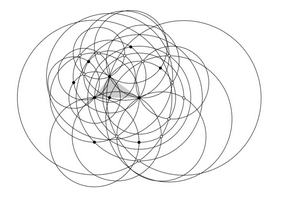
Armed with the construction, I then prepared to turn it into music by doing an analysis of the centers, radii, and incidences involved. In this particular construction, there were 22 circles and 22 important points. Some of the points were shared by many circles, some not. Some of the points were meetings between circles, some acted only as centers, and some fulfilled both functions. I created a chart based on this information, and started fitting musical patterns to the elements of the chart. And lo, after a few iterations, I had musical elements that were very pleasing to my own ear! As a final nod to the avout, I then turned these musical elements into a game that might be played by fids learning the Adrakhonic Proof. In this game, the musical circles are provided on the page, along with the points within them that are important. Finding the path through them, however, is left as a cooperative exercise to the performers. (See the score for details.)
The words “avout,” “fid,” and “Adrakhonic” are from the novel, which is thick with referential wordplay. Just as an aside, Stutz’s detailing of Mascheroni’s work includes a reference to how Mascheroni (1750 ”“ 1800) was, in fact, re-discovering what Georg Mohr (1640 ”“ 1697) had done more than a century prior — a recycling of innovation that is also part of the broader Anathem narrative. The following conversation appears on page 101 of the novel:
“It’s frustrating, talking to you. Every idea my little mind can come up with has already been come up with by some Saunt two thousand years ago, and talked to death.”
“I really don’t mean to be a smarty pants,” I said, “but that is Saunt Lora’s Proposition and it dates to the Sixteenth Century.”
Seven additional samples of Stutz’s score, some of which have a Tuvan throat-singing quality, appear on the Anathem page on Stephenson’s site, nealstephenson.com. There is also video (fora.tv) and a downloadable file (MP3) of Stephenson reading from Anathem (in it he name-checks the Tallis Scholars), followed in each by a performance of Stutz’s music, recorded last week in San Francisco. Revenue from sales of the Iolet CD will go to the Clock of the Long Now.


 A year or so ago, I found myself in a small, downstairs club in Tokyo named Soft (