
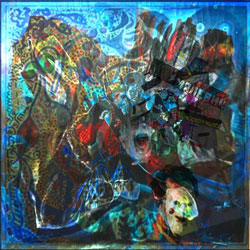
 Dread is rarely as efficient, as sacrosanct, and as suggestive as it is on Discourse of the Other, a collaborative seven-cut album by oVdk and Bunk Data. The record is a sequence of stark gray audio, tracks of manipulated voices (along with other sonic material) that strain to be comprehended. In “Feel Thier Präcoxgefuhl,” the constricted neigh of a horse is more understandable than anything uttered by the muffled minions heard throughout; the hushed voices sound like rough, chaotic crowds — bringing to mind the rushing mall-like prisons of THX-1138, or the nightmarish totalitarian society of 1984 (MP3). By contrast, “Flight of the Yameil Jyuravli” has a serenity to it, but it’s a serenity whose prevailing mode is that of resoluteness — it’s the serene in stark contrast to the prevailing world; the tones are attenuated, the feeling that of ritual atonement, but it’s shot through with tension and a feeling of foreboding (MP3).
Those are just two of the album’s seven tracks. Full release at darkwinter.com. More on oVdk at usyugana.hp.infoseek.co.jp, and on Bunk Data at bunkdata.com.
 The color of your Gristleism box has about as much to do with the way it sounds as the color of your copy of Douglas Coupland’s Generation X had to do with the way the story played out. In the end, both objects, regardless of their edition, produce the same chunk of culture, regardless of hue. Yet Ugol Ratmanova, a Russian duo, take the time, on the occasion of their recent free audio release, to make it clear that both the red and the black Gristleisms were employed (not the chrome one, in other words), along with a Waldorf Blofeld synthesizer and an electric guitar on December 27, 2009, when the track in question was recorded.
  The top 10 most-read posts of January (out of 42 posts in all) were heavy with Downstream entries — that is, with legal freely downloadable recommended listening: (1)
  The 10 most searched-for terms during the month of January were, in declining order of popularity, with some ties in there, “brian” (as in Brian Eno), “commercial,” “performances,” “eno” (yeah, the other half), “mention” (I have no idea what that’s about), “autechre” (whose new record, titled Oversteps, is pictured at left), “banks violette,” “broad,” “drone,” and the especially peculiar “info wedding.” (Right after those 10 came “basinksi,” as in William Basinski, “bush of ghosts,” as in the compilation Our Lives in the Bush of Ghosts and the Brian Eno / David Byrne album My Life in the Bush of Ghosts, and “cicada,” as in the insect that is often used as a point of comparison for electronic background noise.)