
- Again, the nagging question: (1) foghorn or (2) cell phone in next room on vibrate? #
- Trying to remember the last movie I saw in a theater that tempted me to just stay put and watch it again all the way through. #
- The producer is the recording artist. The band is the band. #
- The Headlands Center for the Arts was, not long ago, a military base. The hills were alive with the low level hum of constant preparedness. #
- Understatement of the week. RT @mlaffs: most music software default settings do not accommodate classical music #
Month: August 2011
From a Whisper to an Assault (MP3)
Erik Schoster isn’t joking. When he says a recent soundcloud.com track of his “gets kinda loud,” he’s right — it does just that, moving not so much from whisper to scream as from whine to assault. But it does so with just the sort of slow reassessment of the sonic source materials that it becomes the musical equivalent of the old adage about cooking a frog by gently raising the temperature in a pot until it’s reached a boil. What begins here as razor-sharp whining comes to resemble a bellows instrument as the tones thicken and moisten, only to become thunderous by the time the piece reaches its end, nearly 10 minutes further on. The result is a track that asks the listener to reconsider the noisiness of noise, to try to locate when exactly rich tonal material becomes earplug-necessary listening. Chances are, they’ll say it’s around the 6:22 mark.
Track originally posted at soundcloud.com/hecanjog. More on Schoster, who lives in Milwaukee, Wisconsin, at hecanjog.com.
Orbit: Where the Sky Begins
An essay to accompany the work Orbit by Paolo Salvagione

The artist Paolo Salvagione has been principal engineer on the clock of the Long Now Foundation (longnow.org) since he joined the project in 2000 (or, as they count over at the Long Now, the year 02000). In his spare time, his own artwork fuses the conceptual and the mechanical, to varying relative degrees. He asked me to write an essay to accompany an installation, named “Orbit,” that he debuted recently at the Marin Headlands Center for the Arts — just north across the Bay from where I live in San Francisco. It is the third of his projects that I have been invited to contribute to. I supervised the score to the video that documented his exhibit “An Excuse to Respond,” and I wrote an essay to accompany an earlier Headlands installation, “Competitive Swinging.”
As with the “Competitive Swinging” essay, this one was printed on A5 cardstock on a letterpress by Rocket Caleshu of the San Francisco Center for the Book (sfcb.org), from a design by Brian Scott. (That’s Scott of Boon Design, boondesign.com, which among other things created the “cover” art for the Disquiet.com compilations Our Lives in the Bush of Disquiet and Anander Mol, Anander Veig.)
There’s a solid description of the installation at baycitizen.org:
[“Orbit”] is an enormous wheel with one chair attached that people can strap themselves into. They are then slowly rotated from within a dark room out a window and back into another window until they complete the circle. Once outside, they take in the sweeping vista of the surrounding Marin hills. It takes about three minutes to complete the circle, meaning that the viewer becomes the viewed, as those inside the room watch riders spin languidly in and out of the space.
Letterpress seems especially appropriate to Salvagione’s work. The technology can lend a sense of antiquity and effeteness to its subject, but the opposite is very much the case with “Orbit” and, earlier, “Competitive Swinging.” Both those works have a sheer, monolithic physicality to them, and the letterpress reminds us of that weighty impression with the words embedded in the thick card stock.

The plot of land that is the Headlands Center for the Arts was, not so long ago, a military base. The splendor that we think of today as bucolic masked, not so long ago, an institution founded on anxiety. The hills were alive with the low level hum of constant preparedness. The grassy hills were the sort of place where weapons were tended to, where stations were manned. And it was the sort of place from which the coastline was observed vigilantly for signs of invasion.
Today it is the sort of place where painters stretch their canvases, where video artists work on their laptops. And it is the sort of place where a sculptor, such as Salvagione, might create a circular installation that carries a seated individual slowly out one window and back through another.
To look out a window from a Headlands building today is to see a view not dissimilar to what someone saw when it was under military control. And at times, bits of the past peek into the present: ordnance remnants, dilapidated bunkers, arcane signage.
How might we gain perspective on a place, on its history, especially when its past and present purposes are so distinct, almost at odds with one another?
We might look out a window and ponder that which others saw before us. Or we might venture further. We might take a seat in Salvagione’s circular sculpture and submit to its slow orbit. We might look out a window, and then pass through that same window, following the path that our eyes had laid out for us. We might take in the panorama by engaging with its circumference, enacting its circumference: viewing not only the distant structures and foliage, but the exterior of the building itself as the ride turns back, completing its cycle. We might, with some ease, find ourselves circulating between worlds.

The place where past and present meet is a liminal state.
It is not unlike the skin that protects internal organs from the elements, or the surface of the ocean, where vessels skim the division between sea and sky. The place where past and present meet is not unlike a window, which allows views in as well as out.
The liminal state is a tenuous one. We gain perspective only by cycling back and forth. We see the outdoors from inside our home, and we see our home as we return to it from our ventures in the world. Some of these states are more easily grasped by us than are others — more easily sensed, observed, accessed. It is a fairly simple exercise to determine where your body ends and where the world beyond it begins — easier, say, than resolving the atmospheric koan as to where, exactly, the sky begins.
Certainly, we cannot step into the past with the same ease with which we can open our front door. However, once we accept that the division between past and present resembles more familiar liminal states, we can map common experiences onto the more esoteric.
To take a seat on Paolo Salvagione’s Orbit is to ride that liminal state. To buckle in and pull tight its strap is to acknowledge the tenuous nature of being in between realms, as if taking precautions against psychic turbulence, as well as physical injury. To take that seat is to enter a mode of technologically mediated meditation. To submit to Orbit is to momentarily float free from gravity, free from now.
And to participate in Orbit is to discover yet another liminal state. This is the one that art posits between object and audience. For to truly appreciate Orbit is to participate in it. And to participate in it is to view the work by becoming part of it. And to become part of it is to be viewed by others who stand waiting to, themselves, take that seat. To participate in Orbit is to engage in its exquisite cyclical nature — not just the cycle inherent in its physical structure, but the cycle inherent in approaching it, observing it, becoming part of it, and then stepping off it to observe it anew.
An earlier draft of the essay took the form of a short story that told of a romance between an engineer and an artist, and that borrowed structurally from the implicit symmetry of Salvagione’s piece. I may post it at a later date.

All photos, except the one of the cardstock, by Andria Lo (andrialo.com)
The Sound of One GIF Animating (MP3)

Tom Moody provided an answer to a question I had asked awhile back, at twitter.com/disquiet:
“Wondering if there’s a sonic equivalent of (or parallel to) an animated GIF, and if so what it is.”
The question yielded some immediate responses at the time, beginning on May 17 in the form of comments, some collected here, at disquiet.com, and others at this site’s facebook.com/disquiet.fb page. Among them were these suggestions: A loop? A ringtone? Samples? Even a “crankable music box”? The latter is an especially enticing idea because it locates not only a sonic approximation of lo-fi visual reproduction, but does so in a technology that predates computers, let alone animated GIFs, significantly so. The general consensus tended to be that a MIDI loop is the equivalent of an animated GIF.
Moody, about a two months later, summed up his proposal at his excellent tommoody.us website as follows:
It would have to be (a) short, (b) a loop, (c) digitally timed, (d) compellingly misaligned in some way, (e) easily grasped by the listener but containing some subtleties that reveal themselves in repetition, and (f) pattern-based. Obviously we’re talking about the more abstract GIFs here, not a seagull strolling into a convenience store and stealing a bag of chips over and over.
In the process of pondering the question, Moody also recorded an example that fulfilled his hypothesis (MP3).
[audio:http://www.tommoody.us/audio/jul11/Tom_Moody_Three_Sequencers.mp3|titles=”Three Sequencers”|artists=Tom Moody]
He explains what we’re listening to:
Here, three sequences play simultaneously. Two are the same note pattern played on different synths a few steps out of alignment. The third is a different, mostly rhythm pattern. Some unexpected syncopations, polyrhythms, and polyphonies result.
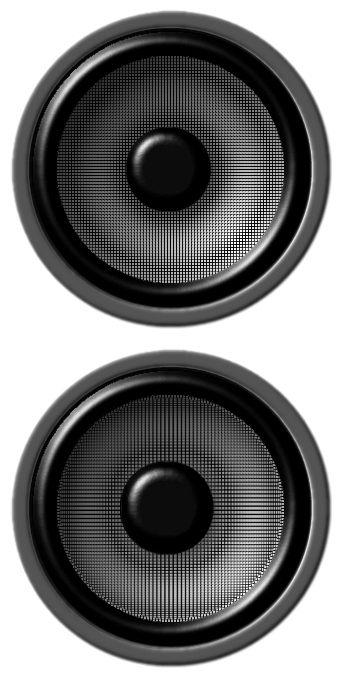
Moody’s post is at tommoody.us. (Animated GIF of speaker found at djbonebrakemusic.com via dump.fm.)
Putting Aside the Concept (MP3)
 A concept album’s concept isn’t necessarily as essential as the resulting sounds. There is an enormous amount of music made from field recordings, as well as music that focuses in on the cagey aspects of technology that turn everyone into both observer and observed. Knowing that Scanner’s early work sourced audio captured from unprotected communications did loan it a certain amount of moral-gray-area frisson, even giving it a political undercurrent, but it worked as music primarily because, well, it worked as music. The three tracks that comprise m_area, a new EP by Humeka, reportedly derive their source material from various forms of communication, but you needn’t know the facts of the music’s origins to enjoy it. The brief liner note explains, in part:
All the samples in this release were captured through some kind of communication device (i.e. mobile phone, answering machine). From the streets of Paris to the private messages …
But the fact is, on m_area those sounds are so reduced to their rhythmic essentials that it scarcely matters to the listener from whence they came. What matters is “Ecotone.” That is the set’s second and central track, which brings to mind the Mille Plateaux label’s fabled Clicks and Cuts series at its zenith: it makes delectably percussive music from brittle little samples (MP3), their cold, hard sounds belying just how nimble they prove to be in Humeka’s hands.
[audio:http://www.archive.org/download/edp040/Ecotone.mp3|titles=”Ecotone”|artists=Humeka]
The other two tracks are fun, too, notably for the aridly glitchy opening of “De Barbes a Ordener,” before a more orderly melody kicks in, and the humorous funk (or funky humorousness) of “Mum Phoned Me Tonight.”
Get the full set at archive.org. More on Humeka at twitter.com/humeka and soundcloud.com/humeka. Also visit the releasing netlabel, editoradoporto.blogspot.com.