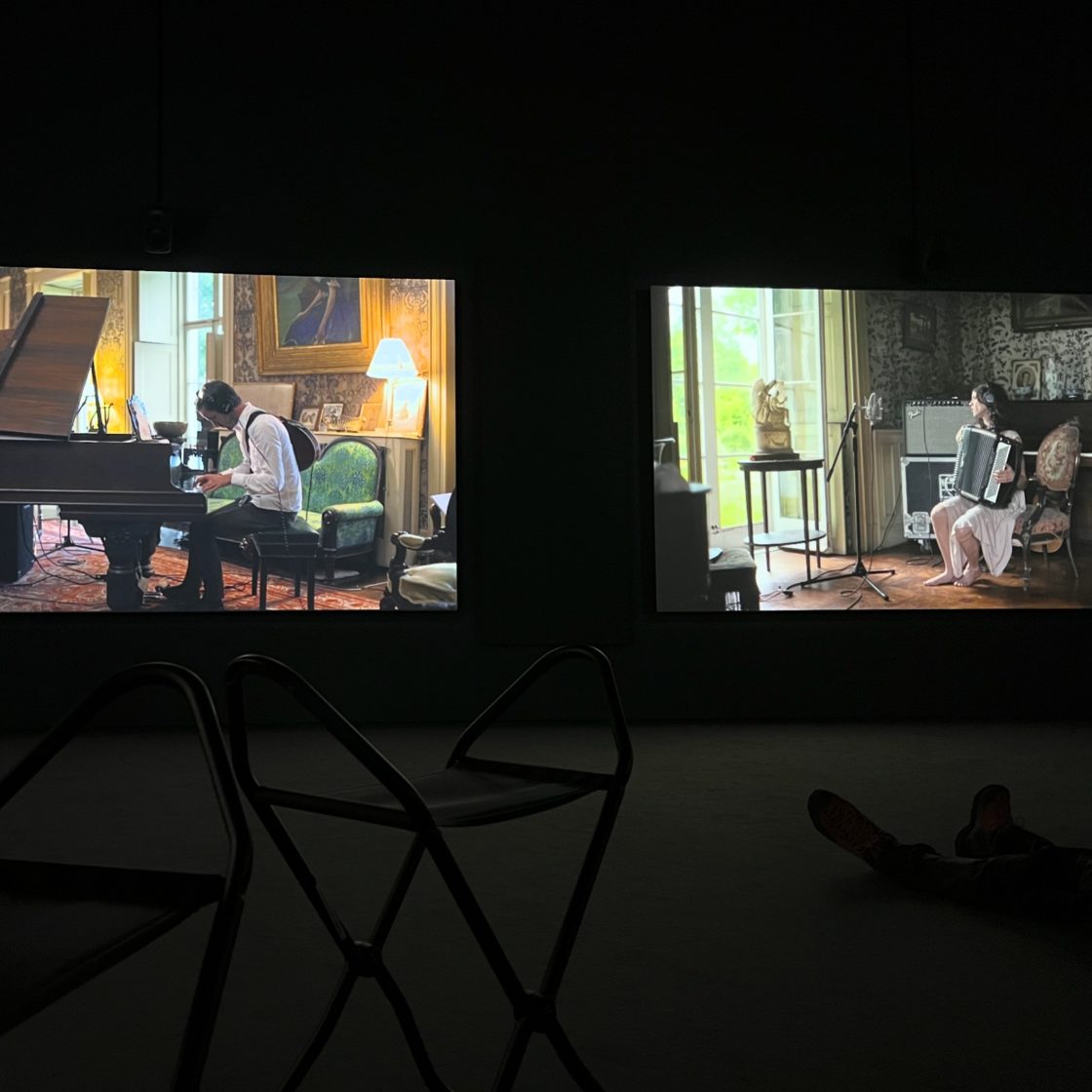
I spent the final afternoon of this three-day weekend on the floor of a dark gallery at SFMOMA, yet again (I’ve officially lost track) basking in the wonder of Ragnar Kjartansson’s The Visitors in all its simultaneous nine-screen glory (two screens shown here).
I was invited by editor Heather Quinlan to write a short essay for the ongoing “Mösh Your Enthusiasm” series — topic: “metal records from the Eighties (1984–1993, in our periodization schema)” — running at hilobrow.com. I wrote about a song by the band Celtic Frost dating from 1987. Read the full piece on the Hilobrow website.
I don’t usually do dedications of this sort, but I added a shout-out at the end of the piece to an old — and long-deceased — friend of mine, Eric Engelhardt, one of my closest friends from high school, who died in 2007, barely into his 40s. I remember wandering around an amusement park in Los Angeles with him toward the end of his life — before his ailments had been discerned — and finding myself at the top of a staircase, looking back down toward him, as he took it one step at a time, pausing now and then. I’d never had more energy than Eric in my entire life until that moment, and I knew then something was wrong. I also know the corner where I was standing in San Francisco when I got the call on my cellphone that he had died, and I find myself still avoiding it. I couldn’t attend Eric’s funeral in New York because there was a terrible rainstorm the night prior and I was stuck at the San Francisco airport, where all flights had been summarily cancelled. Eric had a ferocious affection for metal, and his love for music in general had an enormous impact on me at an age when such impact can set the course of one’s entire life. (Fun fact: Eric, an accomplished puppeteer, built the original Pepe the King Prawn for the Muppets.)
My Celtic Frost tribute is the 15th in the Mösh Your Enthusiasm series at Hilowbrow, so there are another 10 to come. (For the purposes of Disquiet.com’s emphasis on electronic music: the drum machine on “One in Their Pride,” so seemingly out of place on a metal album, was absolutely addictive to me when I first heard it. And still is.) Below are the first two paragraphs:
Much marks the Swiss doom metal band Celtic Frost’s 1987 album, Into the Pandemonium, as strange. The record is a powerful assemblage of rock mysticism, all occult caterwauling, angular solos, battle-ready drums, and arrangement wizardry. It’s the sort of thing that, at proper volume, promises to tap into the very fabric of myth — or at least lend a climactic soundtrack to a weekend Dungeons & Dragons campaign.
And no track on Into the Pandemonium embraces the band’s strangeness quite like its choice of a 12” single, a song that melds Sprechstimme narrative, Greek chorus portent, and louche metal: “I Won’t Dance.” And that’s saying something, since the album opens with a peculiar cover of “Mexican Radio” (Wall of Voodoo’s novel new wave hit from five years prior) and the single also highlighted “One in Their Pride,” which threads Apollo mission vocal samples, a screeching string section, and an admirably stark drum machine beat.
These sound-studies highlights of the week originally appeared in the February 16, 2024, issue of the Disquiet.com weekly email newsletter, This Week in Sound.
I’ve been a bit busy — shifting tools around, and plotting, and working, and moderating, and writing, and staring at PCB boards (yes, that’s redundant), and practicing guitar (poorly, but enthusiastically), and reading. The tail end of winter exerts its own sort of cleansing, the digital in advance of the physical. Among those activities, this email newsletter has a new home on the web: it’s henceforth at thisweekinsound.disquiet.com. Nothing has changed about how This Week in Sound is published, but now the domain is my own (I’ve been at Disquiet.com since late 1996) and, thus, should I choose to alter my publication infrastructure down the road, the (virtual) location itself can persist. (This shift has been on my mind in anticipation of TinyLetter.com finally shutting down many years after Mailchimp bought it.)
And so I’m ending this week with 10 key sound-related things:
▰ 1. A STAGE DIRECTION: Fascinating interview with a theater director who emphasizes accessibility for the deaf and hard of hearing. The work being discussed here is a musical, Private Jones, about a deaf soldier, a sharp shooter, who fought in World War I: “‘If the piano does something that is supposed to evoke an emotion and there’s not a visual equivalent of that, we haven’t done our job,’ Pailet says. ‘Theater is taking psychology and turning it into behavior. So everything is visual, everything is behavioral, and it’s also therefore a perfect medium for sign language, which is a visual language. It exists to be seen.’” (Thanks, Mike Rhode!)
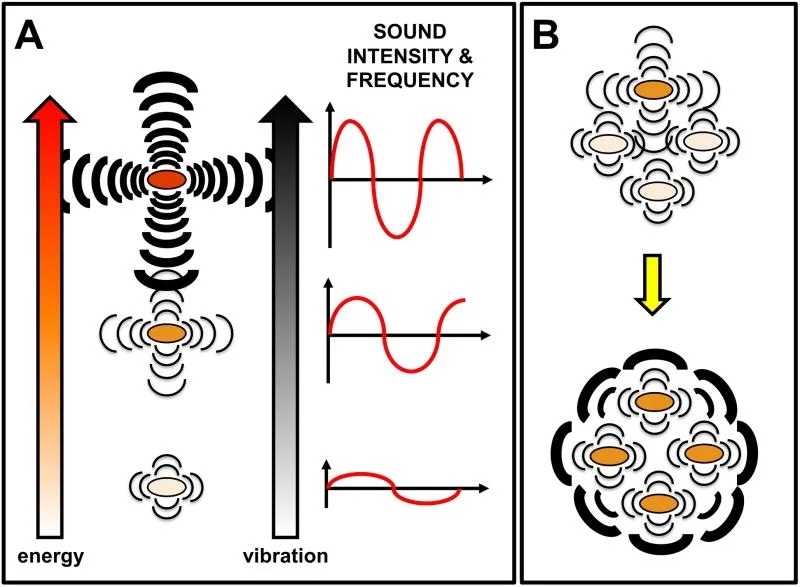
▰ 2. A MICROSOUND: Roberto Kolter, Professor of Microbiology, Emeritus, at Harvard Medical School, tracks his interest — via the Small Things Considered group blog — in the question of whether bacteria can sing, and upon learning that they can, ponders in turn what that might mean. Apparently “cells emit sound waves to carry information about their metabolic status,” he notes, quoting Gemma Reguera, another STC contributor: “Cells in communal settings, such as colonies, biofilms and microbial mats, are likely candidates to benefit from sound communication. Such close populations would allow the rapid propagation and detection of sounds, even at low intensities, and could cooperate to amplify the sound signal from individual cells.” (Thanks, Nicola Twilley!)
▰ 3. A VISUALIZATION: Follow through to a recent post by field recordist Mat Eric Hart who shares an example of how he sifts through more than half a day’s wildlife audio by first looking at the sound in a spectrogram to identify “significant audible events.”
▰ 4. A SCORE: After a long wait, the music — composed by Nicolas Snyder — from the first season of the fantastic animated series Scavengers Reign is finally available as a standalone album. In the show, the music is often indistinguishable from the on-screen activity, so it’s wonderful to hear the elegant music fully extracted from the story. Unless I’m mistaken, the release, from Milan Records, is not (yet) on Bandcamp, but it’s on all the streaming services. I previously wrote about the show’s sonic ecosystem.
▰ 5. A FLASHBACK: There is an intriguing creative tension between social media and ASMR, given that one is associated with dopamine rushes and the other with a more attenuated somatic state. Kate Lindsay of Embedded earlier this month shared a nine-year-old Q&A she did (apparently her first published freelance article, way back when) with the frequent ASMR poster CozyLotusASMR, who discusses how engagement varies by platform: “On TikTok, though, people could come across that video and you have no control if they like ASMR, if they know what that is. So sometimes you need to post something there that’s gonna grab somebody much faster, ’cause you have such a limited time to grab your audience. Whereas YouTube, they’re there for that. You don’t have to work so hard to grab their attention.”
▰ 6. A METAPHOR: Sound plays multiple roles in the research of MIT observational astrophysicist Erin Kara. For one she employs the increasingly common approach of sonification to “hear” the data that results from, in her case, research into black holes. But sound also provides a metaphor for her work with what is called reverberation mapping: “It’s akin to how bats use echolocation.They can’t see the dark cave that they’re flying through, but they know that the echo will come back at them with some delay, and they can use the fact that the echo is traveling at the speed of sound to map out the dark cave. We’re doing that, except with light traveling at the speed of light.”
▰ 7. A PROTEST: The word “deepfake” has become inherently associated with malfeasance, but parents of children killed in school shootings are employing AI to revive their deceased offsprings’ voices in order to enlist them in efforts to impact legislation. “It sounds like an episode of ‘Black Mirror,’” wrote Joanna Stern in the Wall Street Journal, “and the surreality seems to be at least partially the point.” (Tangential: “FTC Wants to Penalize Companies for Use of AI in Impersonation.”)
▰ 8. A LESSON: It’s not a musician’s duty to be eloquent about their music, but when they are, it is a unique and palpable pleasure, an example being when pianist Brad Mehldau discusses such topics as his early education, playing in groups where others stake out his harmonic territory, and distinctions he has noted between jazz standards and newer pieces (such as those by Radiohead and Neil Young he has covered), a key characteristic being that the latter generally originated on guitar.
▰ 9. A QUESTION: I’m currently reading two books about guitar pedals: Pedal Crush and Boss Book (which surveys the entire Boss line). Have you read a good book that provides insights into the transition from analog to digital guitar pedals? I’m especially interested in devices that store audio in memory (loopers, memory buffers — I think I’m wondering about delays, too). Thanks.
▰ 10. A STUDY: This will blow your mind, but cities are noisy — among other congestion-related problems — and science shows that green spaces ease the impact. A study in Nature involving 190,200 participants helped confirm the assumed: “The evidence points to the need for nature-based interventions, such as optimizing urban greenness for healthy cities with lower stress levels and related health burdens.”
I do this manually at the end of each week: collating (and sometimes lightly editing) most of the recent little comments I’ve made on social media, which I think of as my public scratch pad. Some end up on Disquiet.com earlier, sometimes in expanded form. These days I mostly hang out on Mastodon (at post.lurk.org/@disquiet), and I’m also trying out a few others. I take weekends and evenings off social media.
▰ I’m on many Discords related to sound/music, too many to track closely. I pay attention to 12k and Linear Night Market. I just signed up for Wildfire Laboratories. I peek Earth Modular, Decibels Sonification, Omri Cohen, and DivKid. Any strong recommendations (more related to sound than music)?
▰ Reeder / Feedly / iCloud question: if you use Reeder, do you (still) use Feedly, or is iCloud sync sufficient? Seems like iCloud would be. Thanks.
▰ Do itch.io sites not natively have RSS feeds?
▰ Nice. My sound studies newsletter, This Week in Sound, has passed the 4,000-subscriber milestone.
▰ Looks like threads on Threads are broken or at least malfunctioning, maybe worse than on Bluesky. I added two posts to a thread of graphic novels I’ve read in 2024, and neither of those posts shows either under Threads or Replies if you go to my /@dsqt page on Threads. They’re only visible in the original thread. On Mastodon lengthy threading works fine.
▰ I now understand that tote bags are bumper stickers for pedestrians
▰ I’m enjoying Georges Perec’s Life: A User’s Manual but the lists do get to be a little much after awhile
▰ It didn’t occur to me to check usage of the acronym (actually initialism) “TWiS” when I began using it to abbreviate This Week in Sound. Fortunately there are few (six on Acronym Finder), none NSFW. Oddly, one’s from KDVS, where I did a radio show in the early ’90s.
▰ Speaking of newsletters, the weekly Disquiet Junto project announcement has fully moved to Buttondown (from TinyLetter), at juntoletter.disquiet.com, and the automated send worked well. I can now set the project post on disquiet.com and newsletter to go live while I’m asleep, right at the start of each Thursday (Pacific time).
▰ I’m routinely receiving email newsletters where the subject line has nothing to do with the specific material in the newsletter, from authors speaking at bookstores to news items amid current headlines. I can’t tell if this is a database error, a UX hitch, or a bizarre “engagement strategy.”
▰ I was in the middle of two novels. Now I’m in the middle of three. Well, I’m well into three.
▰ I finished reading four graphic novels this week: Léa Murawiec’s The Great Beyond, a fable about social media and pursuing fame, echoing fabulists like Dash Shaw, Winsor McCay, and Bryan Lee O’Malley. A simple story told in complex way. Throughout I thought, “Please don’t end [that way].” It did. Still, breathtaking at times — comics as parkour. Volume 1 of Jeff Lemire’s horror series Gideon Falls, art by Andrea Sorrentino. The individual issue covers may be my favorite part. And volume 2 of Gideon Falls, in which past and present — near and far, trauma and fate — all connect. This is a horror comic, so not exactly a big surprise. Volume 11 of The Fable, a manga about a hitman ordered to take a year off killing: It’s clear the plan wasn’t good, as too many factors make it impossible for him to be anonymous, and he ends up turning into something akin to a superhero (the action in the film adaptations is quite something at times). Like a lot of thrillers, it has a bit of a stacked deck thing happening.