Made a little tweak to Disquiet.com regarding tags. Tags now yield simpler index views (rather than a long page of the full text of each article), so it’s easier to find (and flip backward through) interrelated material.
There’s also, at the bottom of the page, a different system for going backwards and forwards through pages. That approach will likely roll out to the rest of the website in the near future.
The Assignment: Rerecord all or part of one of your tracks using just your voice.
/ By Marc Weidenbaum
Note: This week’s project instructions are considerably more concise than has been the case in the past. What was previously around 580 words (not including the project steps and any other project-specific information) is now closer to 280. Like a contract, the project template had expanded over time — a clause here, a rule there — as I added clarifications based on participant input and on my observations about activity. The newly refined Disquiet Junto project template loses nothing and is more readable, meaning more people may actually read it, and it will — I hope — be less off-putting to newcomers.
. . .
Each Thursday in the Disquiet Junto music community, a new compositional challenge is set before the group’s members, who then have five days to record and upload a track in response to the project instructions.
Membership in the Junto is open: just join and participate. (A SoundCloud account is helpful but not required.) There’s no pressure to do every project. The Junto is weekly so that you know it’s there, every Thursday through Monday, when your time and interest align.
Disquiet Junto Project 0633: Voice Swap The Assignment: Rerecord all or part of one of your tracks using just your voice.
Step 1: You’re going to attempt to rerecord something you’ve done before, this time using your voice as the source audio. Think of a track you’ve recorded previously that might recommend itself for such an adaptation.
Step 2: Needless to say, this won’t be particularly easy. But best you can, redo the track you selected in Step 1 by replacing the source audio with your own voice. (And, of course, if you can’t do it completely, use your voice for as much of it as you can. And you can still process your voice, certainly.)
Tasks Upon Completion:
Label: Include “disquiet0633” (no spaces/quotes) in the name of your track.
Upload: Post your track to a public account (SoundCloud preferred but by no means required). It’s best to focus on one track, but if you post more than one, clarify which is the “main” rendition.
License: It’s preferred (but not required) to set your track as downloadable and allowing for attributed remixing (i.e., an attribution Creative Commons license).
Please Include When Posting Your Track:
More on the 633rd weekly Disquiet Junto project, Voice Swap — The Assignment: Rerecord all or part of one of your tracks using just your voice — at https://disquiet.com/0633/
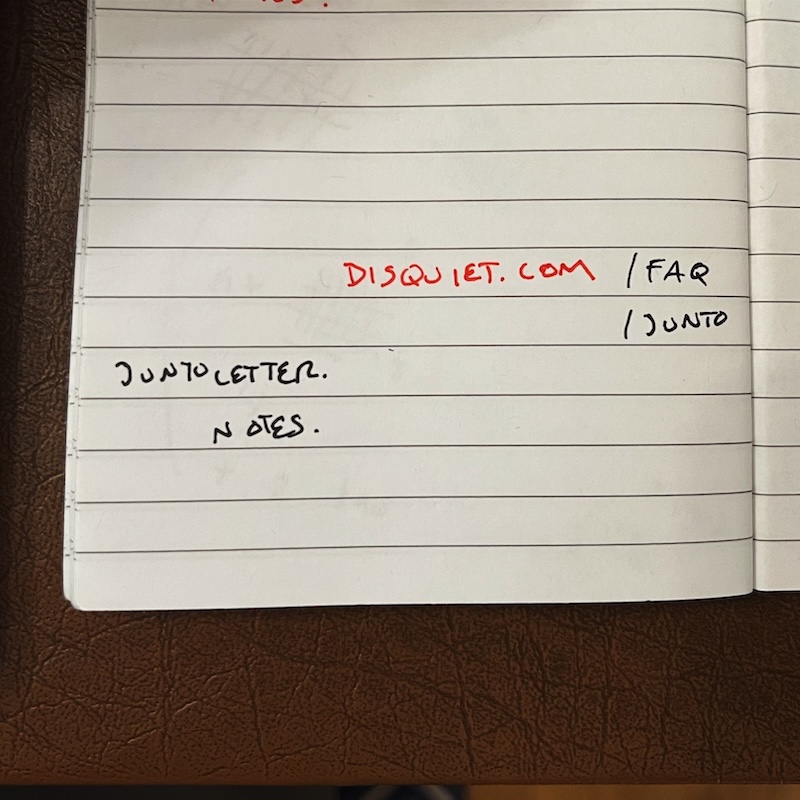
It occurs to me that this notepad page isn’t far from what the pre-Disquiet.com website I had looked like (not that these scribblings are design notes — they’re simply about subspaces and how those spaces correlate). The pre-Disquiet site was a /~mrcwdnbm folder courtesy of my ISP. That site predated the Internet Archive, so I don’t think there’s any vestige of it out there. The site’s interface was a list of items on ruled yellow paper, and I learned how to use mouseovers so it could function as an interface. Those were the days. That would have been around 1994. Anyhow, again, this new image isn’t a design document, just me sorting out current and hypothetical satellite activities.
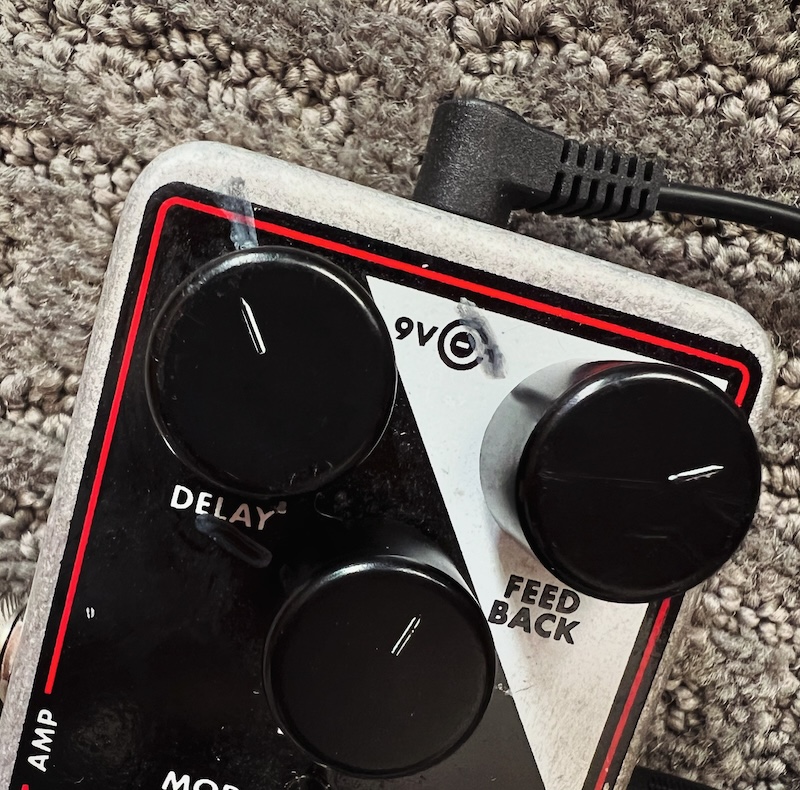
I purchase most of my music gear used, as was the case with this analog delay pedal. It’s my first ever guitar pedal for delay. Previously I only had used a synthesizer, iPad, or iPhone to achieve the effect. I love marks that evidence prior use, here in the form of three lines from a previous owner noting optimal settings. My sweet spots may edge higher, especially toward self-oscillation with feedback.
I obtained this delay pedal for a few reasons: first, to experiment with self-oscillation (note the feedback knob being further to the right); second, to experiment with a dying-battery simulator; and third, to make scale practice more interesting (note the blend knob being further to the right). So far the first and third applications have gone the best.