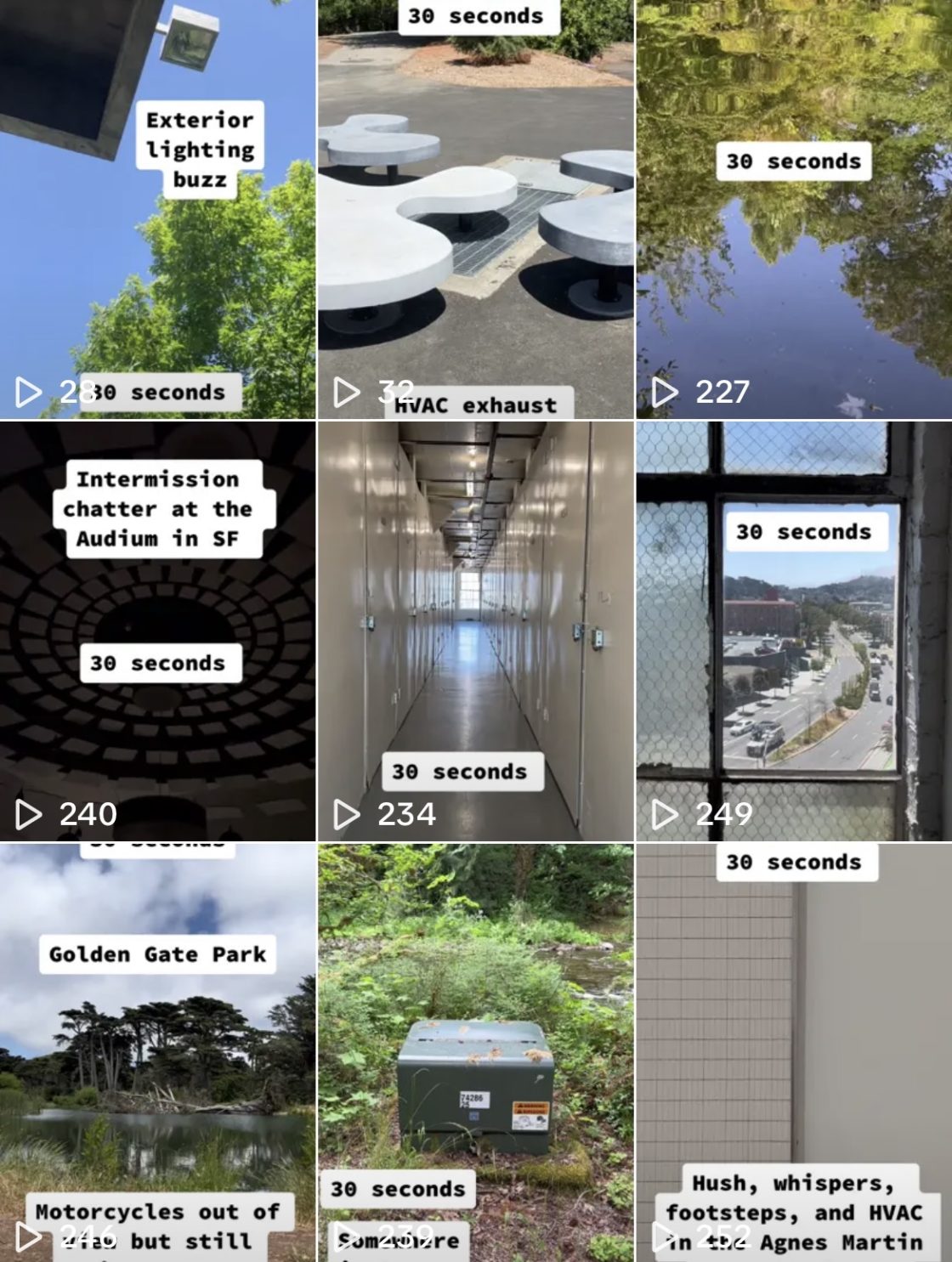
As I mentioned yesterday, I’ve been experimenting with posting brief field recordings (audio and video) on Instagram and, more recently, TikTok. Part of this is just a matter of feeding the algorithm. There’s some value to making the sort of social media you want to see in the world. Part of this is just social engineering — you’ll attract and disinterest the parties you’d want to, respectively. Part of it is functionally algorithmic: to some degree, the systems will send you material related to what you yourself do. By putting out field recordings, the boomerang that is the algorithm may send some back. Part of it is just getting a sense for how such material functions in social media: how does relative silence, the quiet noise of daily life, as expressed in field recordings, sit within the largely exaggerated modes of Instagram and TikTok? How do captions, hashtags, and location IDs — not to mention the decision-making inherent in framing and editing — shape the otherwise mundane material?
I’ve been doing these for 30 seconds each. That is long enough to encourage spending the time, and short enough — especially for people not accustomed to listening to everyday sound — to not discourage engagement. It’s long enough to allow for some variation, and short enough to allow for choosing start and end points that isolate the underlying tone of a given space and time.
The Audium is a longstanding space for experimental, immersive sound in San Francisco. The venue was originally housed in an old building in the Richmond District, opening in 1967 after over a decade of planning and one-off performances, and it has been closer to the City Hall area, on Bush Street, since 1975. The Audium’s small auditorium has no windows. When the concert begins, the lights are fully turned off. Aside from dimly glowing arrows on the floor that direct toward the exit, it is pitch black; you can’t see your own hands, let along the person seated next to you. I attended an evening concert there on Saturday, July 1: a revisitation of a 1969 work by cofounder Stan Shaff (the other founder was Doug McEachern), with Shaff’s son, David Shaff, performing. The piece was an hour long. It consisted of mostly real-world sounds — sirens, horns, bells, balloons, traffic — being moved around the room’s 176 individual speakers, and transformed in the process: filtered, slowed, garbled, dissected. In addition, one heard fantastical abstractions and bits of found media, what seemed at times like soundtracks to TV shows and commercials. There was a 10-minute intermission halfway through the concert. I shot this short video during the break as part of my ongoing series of 30-second field recordings (I’ve been posting these vertical videos at instagram.com/dsqt and tiktok.com/@disquiet.com). I’m always interested in chatter when the combined verbalization transcends communication and becomes a matter of texture, tonality, and rhythm. I was especially keen here to witness whether the specific circumstances in any way impacted the way people spoke, both individually and collectively — did they perhaps hear themselves, in this tiny room, as source audio for an intimate, spatial performance like the one we were all there to experience?
I do this manually each Saturday, usually in the morning over coffee: collating most of the little comments I’ve made on social media, which I think of as my public scratch pad, during the preceding week. These days that mostly means Mastodon (at post.lurk.org/@disquiet), and I’m also trying out a few others, including Bluesky (disquiet.bsky.social), which remains behind a beta firewall at the moment.
▰ “This person called, but left an empty message”
The digital silence of unanswered robocalls
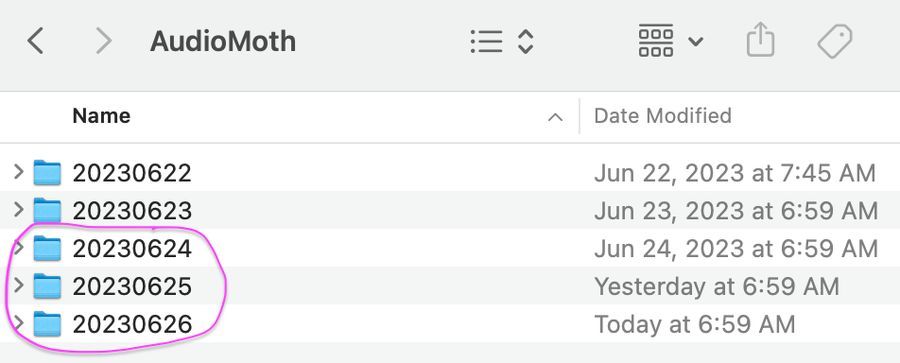
▰ The AudioMoth field recorder had its first multi-day overnight in the backyard, and the resulting 1080 files were, thankfully, automatically divided into three different folders, one for each day.
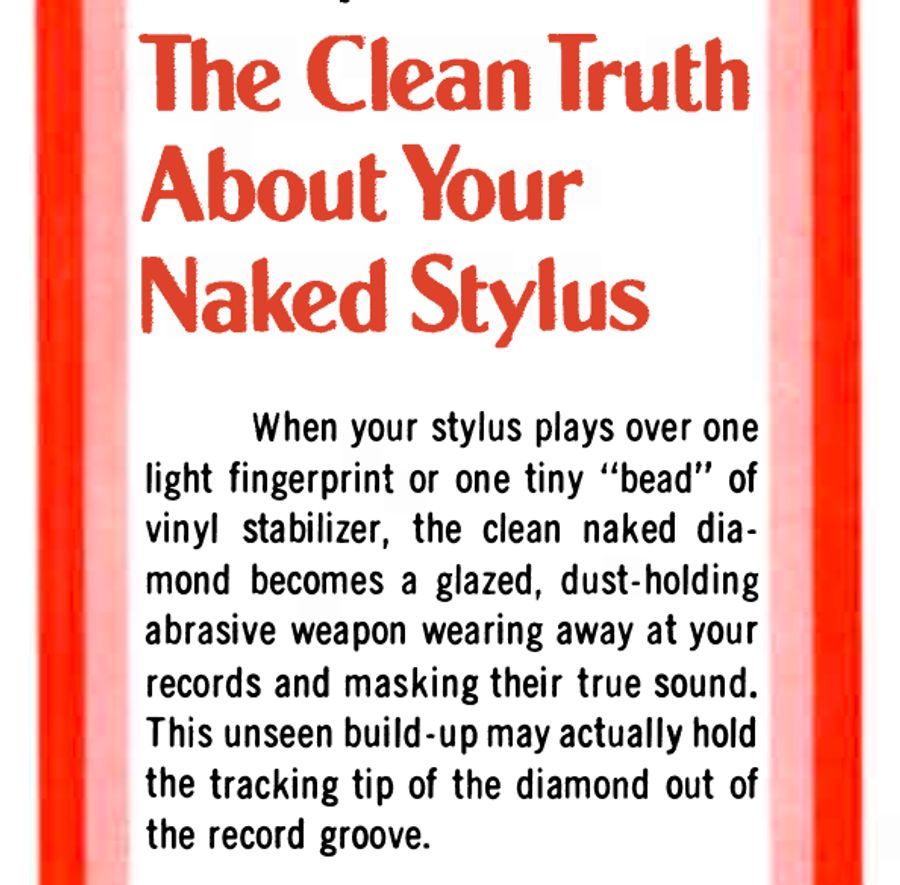
▰ I was doing some research that led me back to some ancient issues of Scientific American, and came across some excellent home-audio fear-mongering in an advertisement about turntable care.
▰ Person: “Oh, you like sound. You must love the Fourth of July, all those fireworks.”
Time for the annual conversation:
Me: ” … “
▰ Mundane crowdsourcing question: If you keep a running document on a given topic broken down by day, do you generally put the items in chronological order or reverse chronological order? I find I do some one way and some the other.
▰ The dentist had yet another iteration of x-ray tech, a 360° thing you stand in the middle of. It makes “sample and hold”-style synth beeps. Ended up talking about MRIs. The dentist said he got through the annoying noise by imagining instruments fleshing out an EDM arrangement.
▰ Several people have uploaded their Disquiet Junto tracks this week to Bandcamp, and I thought, “Hey, since I can make a playlist on the mobile app, I’ll do so.” Then I realized I can’t share that playlist with anyone else. That’s on the official app. But several people recommended some third-party solutions, so I’m trying out bndcmpr.co.