

An apartment building near the symphony hall in San Francisco. Wondering if the window with the cello case belongs to an orchestra member.
An apartment building near the symphony hall in San Francisco. Wondering if the window with the cello case belongs to an orchestra member.

This book review I wrote originally appeared in the May 2023 issue of The Wire, number 471. The article appears here (from behind the paywall, now that subsequent issues have come out) in ever so slightly edited form (just matters of punctuation). As I noted at the time of its publication: major thanks to my old friend Erik Davis for having tipped me off to this.
Here’s the review in full:
Sonorous Desert: What Deep Listening Taught Early Christian Monks – And What It Can Teach Us
Kim Haines-Eitzen
Princeton University Press Hbk 145 pp
For Kim Haines-Eitzen, the desert is both biblical and personal. An American, she spent her childhood in the Middle East, or Near East, reared by parents who, inspired by their Mennonite heritage, had moved from the US to Jordan to study Arabic and do humanitarian work. Born in the late 1960s, she associates her experience with serenity and fear alike, with the quiet expanse of the Sinai and the sirens of the 1973 Yom Kippur war. The shore of the Red Sea was her holiday playground.
Now a Cornell University professor of religion, Haines-Eitzen seeks to merge the personal and the biblical in a slim volume with a vaguely self-help-ish subtitle, Sonorous Desert: What Deep Listening Taught Early Christian Monks – And What It Can Teach Us. She achieves this goal through the humble act of sitting quietly, much like the hermits of yore.
Unlike those hermits, however, she has audio recording gear in tow. Since 2012, Haines-Eitzen has documented the sound of the places she visits and where she lives. The poetic codas to each chapter feature QR codes that, given the context, can be mistaken for the ornate initials that decorated ancient manuscripts. These link to online recordings she made around the world. Her tracks transport the listener to places like her family’s retreat in Arizona and the canyons of the Wadi Qelt in the Judean Desert.
The key word is retreat. Despite the monastic act’s association with solitude, a monastery is itself a community, and thus the notion of self-exile gets revealed here as something more akin to migration: from one life to another, from exterior to interior. In Haines-Eitzen’s telling, such paradoxes inherent in the monastic impulse run deep. While Trappists take vows of silence, most monastic life is simply remote. Less explored in the book is the contrast (even conflict?) between personal discovery and selfless divinity.
The narrative moves back and forth between the wired present and the mythic past. In meaningful ways, little has changed, least of all the human propensity to complain about noise pollution. An early avatar of this disgruntlement is Antony, a celebrated hermit from roughly 1800 years ago who “left the noise and distractions of city life for the quiet of the desert.”
We abandon civilization alongside Antony, and with other monastic aspirants. The ancient ones include the saints John Climacus, Paul, George of Choziba, and Eucherius, who said “no sound is heard in the desert save the voice of God.” Haines-Eitzen politely disagrees: the desert is rich with sound. We witness her personal revelations (sometimes repetitively) in this regard, such as the idea that to listen while recording is to listen intently, and to re-listen through the ears of the machine is to hear what one might not have otherwise. Likewise, she stops trying to capture the world “pure and pristine,” without people in it, and comes to appreciate humans’ sonic place in the environment. We also visit reverberant cave chapels, ponder the animism belied by Western monotheism, and learn lots of cool ancient Greek onomatopoeia.
Sonorous Desert is a book about seekers, among them the widely travelled author herself. Modern figures cited include Edward Abbey, Virginia Woolf, Gordon Hempton and Thomas Merton, each arriving at the same conclusion: the quest for external silence is ultimately one for internal peace. (Oddly, that list doesn’t include Pauline Oliveros, who is synonymous with the deep listening mentioned in the book’s subtitle.) Wandering into the desert provides a metaphor for the effort and time required. As Haines-Eitzen quotes Merton from 1962, foreseeing smartphone apps like Calm and Headspace half a century hence, “You can’t have interior silence just by pushing a button.”
I do this manually each Saturday, usually in the morning over coffee: collating most of the little comments I’ve made on social media, which I think of as my public scratch pad, during the preceding week. These days that mostly means post.lurk.org (Mastodon).
▰ Fun with bluetooth headphone naming

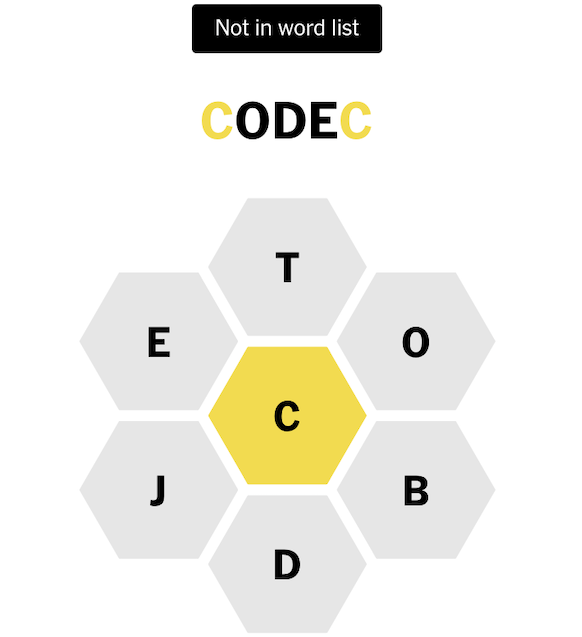
▰ How is “codec” not an option in Monday’s New York Times Spelling Bee?
▰ The Moon Baboon level of the video game It Takes Two took a lot out of me
▰ Almost a month into Duolingo and I still don’t know the German word for “labeled a bunch of music files and then realized I hadn’t converted them yet from WAV to ALAC”
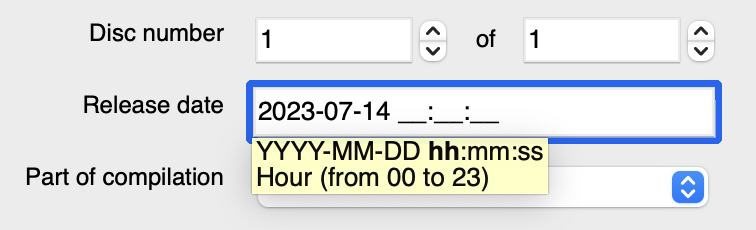
▰ Album metadata achieves new heights in trainspotting
▰ Best language I’ve seen in a security process (CAPTCHA/login) in some time: “Do not challenge me on this device again”
▰ Not sure why I find both Goodreads and StoryGraph so dissatisfying. They seem overly complicated for what they’re for (entering dates on Goodreads in particular is peculiar and often doesn’t seem to work). If you have a recommendation for an alternative (I tried the Mastodon-based one and didn’t get it) that’d be great.
▰ Nature marks where to cut
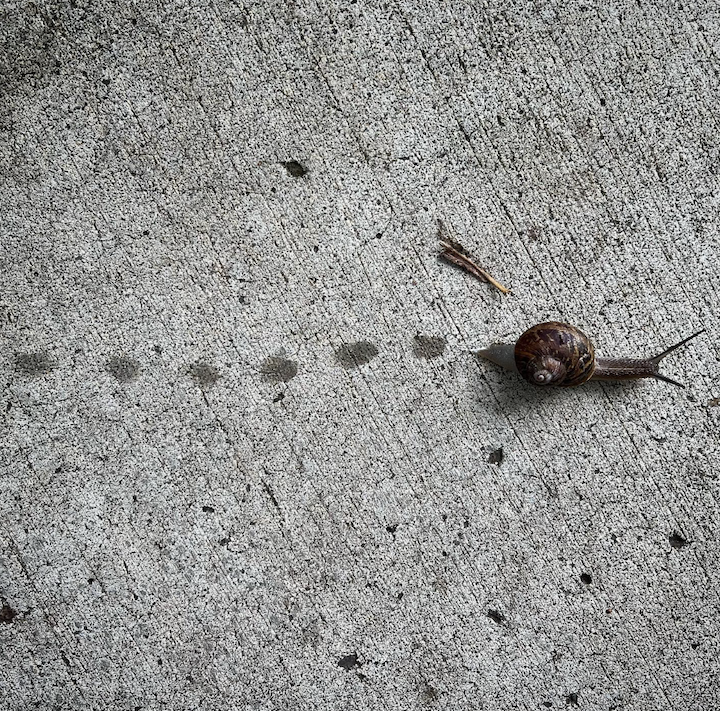
▰ Morning sounds: birdsong, chatter, air conditioning exhaust
A Wired magazine reporter, Amos Barshad, got in touch with me recently when he was writing a story, “AI Could Usher in a New Era of Music. Will It Suck?” published earlier this week, about the intersection of artificial intelligence and popular music. The article’s focus, per its title, is “Heart on My Sleeve,” a song enabled by AI that mimicked Canadian rapper Drake and got a lot of attention in the process (from audiences, from the press, and from the record label that administrates Drake’s commercial interests).
Barshad and I talked on the phone when he was researching the piece. As he quotes in the article, I think that the “hand-wringing [around AI music], it’s a strange thing to me. … We’ve been concerned with creating artificial life at least since the Golem.” The rise in anxiety about AI makes me think about issues raised when the cloning of Dolly the sheep was announced in 1997; I kept coming across people saying how “now” was the time to start debating the impact of cloning, as if cloning hadn’t been on the horizon for a long time. It was at that moment I realized how few people must read (or absorb and reflect on) science fiction, which I’ve found has routinely provided me with tools to navigate daily modern life. Sci-fi may not successfully predict the future (arguably, it is always about the present), but it can sure instigate thought experiments in advance of the future’s eventual — and in the case of Drake Prime, mundane if worrisome — arrival. I appreciate the economic and existential anxieties that come along with the current slate of AI techniques. I think the Writers Guild of America, for example, is correct is using this moment to put initial rules in place. I also think a lot of writing about “AI” treats it as a singular instance — as a known, identifiable, and nameable thing. Which it is not. In many cases, today’s writing opposed to AI reads about as sophisticated as arguments that regularly situate a nameless “they” as the source of any given problem. (As for writing that’s strongly in favor of AI, by contrast it often reads like it was written by an AI, which is a whole other problem.)
In some ways, I’m the worst person to talk with about the impact of AI on pop music because I don’t really pay a lot of attention to pop music. While on occasion a song will catch my fancy, I barely listen to anything with a singer, and haven’t for a long time. It’s not that I dislike pop music these days so much as it disinterests me. I listen to music continuously, and the patterns of adoption and mimesis in pop music strike me as slow and routine, compared with the ingenuity and invention in experimental music.
A key thing for me that Barshad touches on in his Wired article is the cybernetic history of both artificial intelligence and electronic music. The development of cybernetics is key to the development of artificial intelligence and, as I note in the article, of generative systems. The Drake AI song is, as Barshad quotes me, boring, plain and simple. It’s the end result of rote cause and effect (“please make something that sounds like X”). AI will be of interest, at least to me, as a musical instrument, as a music production tool, as a creative tool, when it engages in the creative process more thoroughly as a generative system — which is to say, one where the outcomes are considerably less certain, less like placing an order with a mechanical turk and more like, as Brian Eno says (and as, again, is mentioned in Barshad’s article), tending a garden.