In AI Landscape

Or, What would John Cage do?

I sometimes do ask myself “What would John Cage do?” — and it’s been happening with regard to ChatGPT, etc., lately as the discourse around AI grows and grows. Writing about AI has become a kind of OpEd version of the “grey goo” feared during the initial development of nanotechnology. Forgive me for adding a few hundred GMA-free* words to it.

I imagine Cage saying various things about AI circa mid-2023, and some of those things are in opposition to each other. The opposition is not representative of him being mercurial, but of me being unsure about where his opinion would potentially land. In this context, I reread some of his conversations with Morton Feldman, collected in the great book Radio Happenings, and also some of his lectures, in which he talked about computers, radio, tape splicing, and other equipment he employed.

The following two contrasting statements seem to me what might, perhaps, be the outcome of his consideration of the topic — though I say that with the emphasis on the word “perhaps.” These statements in quotes below are entirely inventions on my part. An English teacher of mine, back in 11th grade, introduced the word “perhaps” to us as a highly useful rhetorical device, and it has been a key tool for me ever since. How does one employ the word “perhaps” correctly? When uncertain, say “perhaps.” When not in doubt, definitely consider saying “perhaps.” 

These two diametrically opposed hypothetical responses are where I’ve currently found myself:

“ChatGPT is just a tool, a tool made by humans. I’ve worked with creative constraints for much of my life. I want to see what this tool can do. For what is an iteratively refined prompt other than a form of explorative constraint?”

Or perhaps:

“ChatGPT is a machine — not even a machine, but software running on a machine. Why should I care what a machine has to say if all it knows is what we’ve already told it?”

I’m not sure which direction Cage would have gone. It’s sort of like how on the one hand, Cage was exactly the wide-eyed thinker you’d want on a committee of notable humans if we were suddenly contacted by an alien world, while on the other, his response might likely be something along the lines of, “We can’t even speak with our cats yet, and we don’t know what’s at the bottom of the ocean, so why do we want to leave the planet so soon?” Of course, before deciding one way or another, he’d ask if this alien world is home to a previously undocumented species of mushrooms

Almost certainly, Cage would have come upon on a direction — an insight — about modern AI, circa 2023, that I can’t myself imagine. But with the limits of my imagination, that’s the forked path I currently find myself at the crossroads of. On the one hand, he was an inveterate tinkerer. On the other, he all but gave up on the concept of using music to “communicate,” which makes me wonder if yet another means of communication would be of interest in the first place. 

I’ll continue my dive back into Cage, and I’ll keep thinking about this.

*generatively mediated authorship
Disquiet Junto Project 0597: Goal Line

The Assignment: Get started on a plan by getting over getting started.

Each Thursday in the Disquiet Junto music community, a new compositional challenge is set before the group’s members, who then have just over four days to upload a track in response to the assignment. Membership in the Junto is open: just join and participate. (A SoundCloud account is helpful but not required.) There’s no pressure to do every project. It’s weekly so that you know it’s there, every Thursday through Monday, when you have the time and interest.

Deadline: This project’s deadline is the end of the day Monday, June 12, 2023, at 11:59pm (that is, just before midnight) wherever you are. It was posted on Thursday, June 8, 2023.

Tracks are added to the SoundCloud playlist for the duration of the project. Additional (non-SoundCloud) tracks appear in the lllllll.co discussion thread.

These following instructions went out to the group’s email list (at tinyletter.com/disquiet-junto).

Disquiet Junto Project 0597: Goal Line
The Assignment: Get started on a plan by getting over getting started.

Step 1: For a lot of people right now, it’s around the start of summer. For many of them, it can mean the start of one plan or another. You may very well have musical goals for the next few months. Think of one to focus on.

Step 2: Don’t wait. Record one piece of music that kick-starts whatever goal you’re working toward. Often the first step is the most difficult. Take that step.

This week’s project takes the start of summer as its theme. And if it’s the start of winter where you are, instead, I hope that it can still apply.

Eight Important Steps When Your Track Is Done:

Step 1: Include “disquiet0597” (no spaces or quotation marks) in the name of your tracks.

Step 2: If your audio-hosting platform allows for tags, be sure to also include the project tag “disquiet0597” (no spaces or quotation marks). If you’re posting on SoundCloud in particular, this is essential to subsequent location of tracks for the creation of a project playlist.

Step 3: Upload your tracks. It is helpful but not essential that you use SoundCloud to host your tracks.

Step 4: Post your track in the following discussion thread at llllllll.co:

https://llllllll.co/t/disquiet-junto-project-0597-goal-line/

Step 5: Annotate your track with a brief explanation of your approach and process.

Step 6: If posting on social media, please consider using the hashtag #DisquietJunto so fellow participants are more likely to locate your communication.

Step 7: Then listen to and comment on tracks uploaded by your fellow Disquiet Junto participants.

Step 8: Also join in the discussion on the Disquiet Junto Slack. Send your email address to [email protected] for Slack inclusion.

Note: Please post one track for this weekly Junto project. If you choose to post more than one, and do so on SoundCloud, please let me know which you’d like added to the playlist. Thanks.

Additional Details:

Length: The length is up to you. Sometimes shorter is less daunting.

Deadline: This project’s deadline is the end of the day Monday, June 12, 2023, at 11:59pm (that is, just before midnight) wherever you are. It was posted on Thursday, June 8, 2023.

Upload: When participating in this project, be sure to include a description of your process in planning, composing, and recording it. This description is an essential element of the communicative process inherent in the Disquiet Junto. Photos, video, and lists of equipment are always appreciated.

Download: It is always best to set your track as downloadable and allowing for attributed remixing (i.e., a Creative Commons license permitting non-commercial sharing with attribution, allowing for derivatives).

For context, when posting the track online, please be sure to include this following information:

More on this 597th weekly Disquiet Junto project, Goal Line (The Assignment: Get started on a plan by getting over getting started), at: https://disquiet.com/0597/

About the Disquiet Junto: https://disquiet.com/junto/

Subscribe to project announcements: https://tinyletter.com/disquiet-junto/

Project discussion takes place on llllllll.co: https://llllllll.co/t/disquiet-junto-project-0597-goal-line/

The Rise and Rise of Voice AI

A data dump

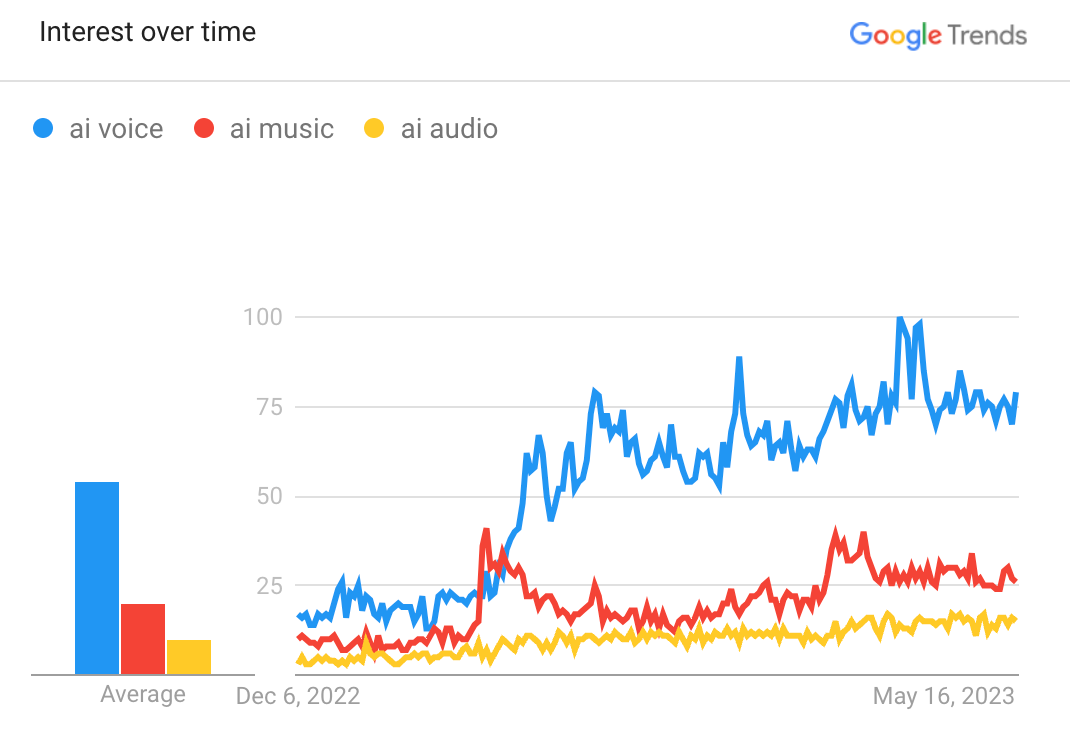
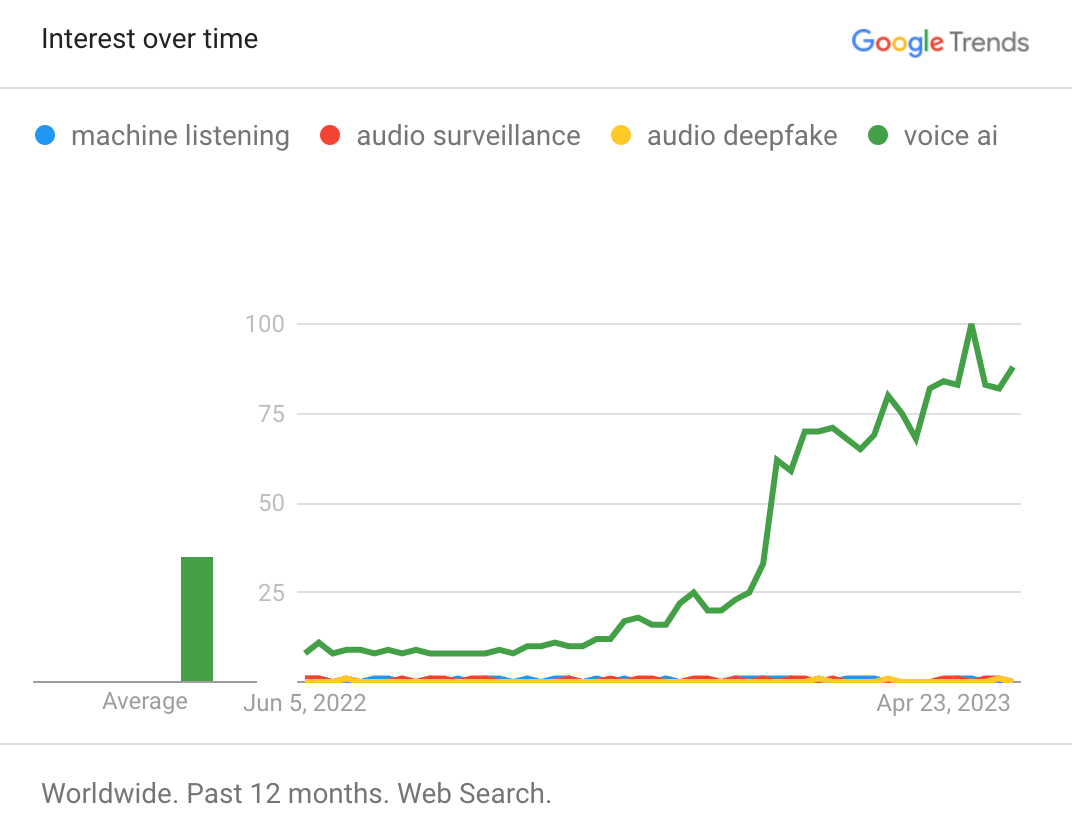
I was wondering about the relative frequency of certain topics that intrigue me in regard to contemporary, technology-oriented sound studies. For a quick glimpse, first I charted “machine listening” in Google Trends, then adding “audio surveillance” and, for a broader swath, “audio deepfake.” The three terms were almost identical in the narrow band of popularity they populated for the past few years. I sought to expand the subject matter with a fourth item, something related to artificial intelligence.

Needless to say, we’re in the midst of AI Summer. These days “AI + [anything]” — following the rise in chatter around DALL-E 2, Midjourney, Stable Diffusion, ChatGPT, DeepMind, Bard, and OpenAI, among other projects — is going to be more popular now than it was even six or seven months ago.

Still, when I selected a term, I was fascinated to see how much larger this one line item was than the others. To round out the set, I added what I imagined would be the more active “voice ai,” yielding the outlier green bar in the chart below. The results marked a significant shift:

What’s going on isn’t merely that “voice AI” is greater than the other three lines combined. It’s that “voice AI” renders any internal divergence among those three to a flattened data nothing-burger. To a degree, this divide might signal that a single term has become a catchall for all manner of subjects, fields, and anxieties in the popular imagination. Alternately, it could also mean that whatever energy might be spent more in more different ways is now focused, laser tight, on where the SEO money is. What would be great would be to see a wider variety of terms gain traction as time passes.

What other key terms interest you in this realm?

TWiS Listening Post (0004)

An arrangement, a backdrop, and an album

This went out today as a thank you to paid This Week in Sound subscribers: an annotated playlist of recommended music (a new Aphex Twin cover from Simon Farintosh, a science fiction audio backdrop from Star Trek, and a noise album from Tim Olive).

This Week in Sound: The Small Club of Species That Learns Songs

A lightly annotated clipping service

These sound-studies highlights of the week originally appeared in the June 6, 2023, issue of the Disquiet.com weekly email newsletter, This Week in Sound. This Week in Sound is the best way I’ve found to process material I come across. Your support provides resources and encouragement. Most issues are free. A weekly annotated ambient-music mixtape is for paid subscribers. Thanks.

▰ FLIGHT CLUB: “[A] growing body of research is showing that the affinity human musicians feel toward birdsong has a strong scientific basis. Scientists are understanding more about avian species’ ability to learn, interpret and produce songs much like our own.” One researcher (Hollis Taylor, a violinist and an ornithologist) “has observed what appear to be warm-up sessions, rehearsals and singing contests. Other than humans, there’s only a ‘small club’ of species with an observed capacity to learn songs and vocal patterns.” And mysteries remain: “If birdsong’s main purpose in some species is for males to attract females, then why do some females also sing? ‘Female song actually arose very early in songbird evolution,’ he said. ‘In species where females don’t sing, it’s because they’ve lost the ability to sing rather than it being gained.’ This indicates that it may have once been evolutionarily beneficial for females to sing — and scientists can’t say why.” (Read at nytimes.com with a gift link.)

▰ HELL’S BELLS: “Yes, the harvested audio will be imported onto a computer and deepened, sculpted, flayed, and spliced until it fits the unforgiving grim-dark horrors of Sanctuary, but Blizzard still takes a distinctly classical approach to the aural aesthetics of Diablo IV, one that resembles the practical Hollywood filmmaking of the 1950s and ’60s. The marauding demons are programmed with dangling bike chains, molten candle wax, and crushed fruits and vegetables, all of which is captured tangibly, without resorting to the freeware clips bobbing around the internet.” All about the sounds of the new video game.

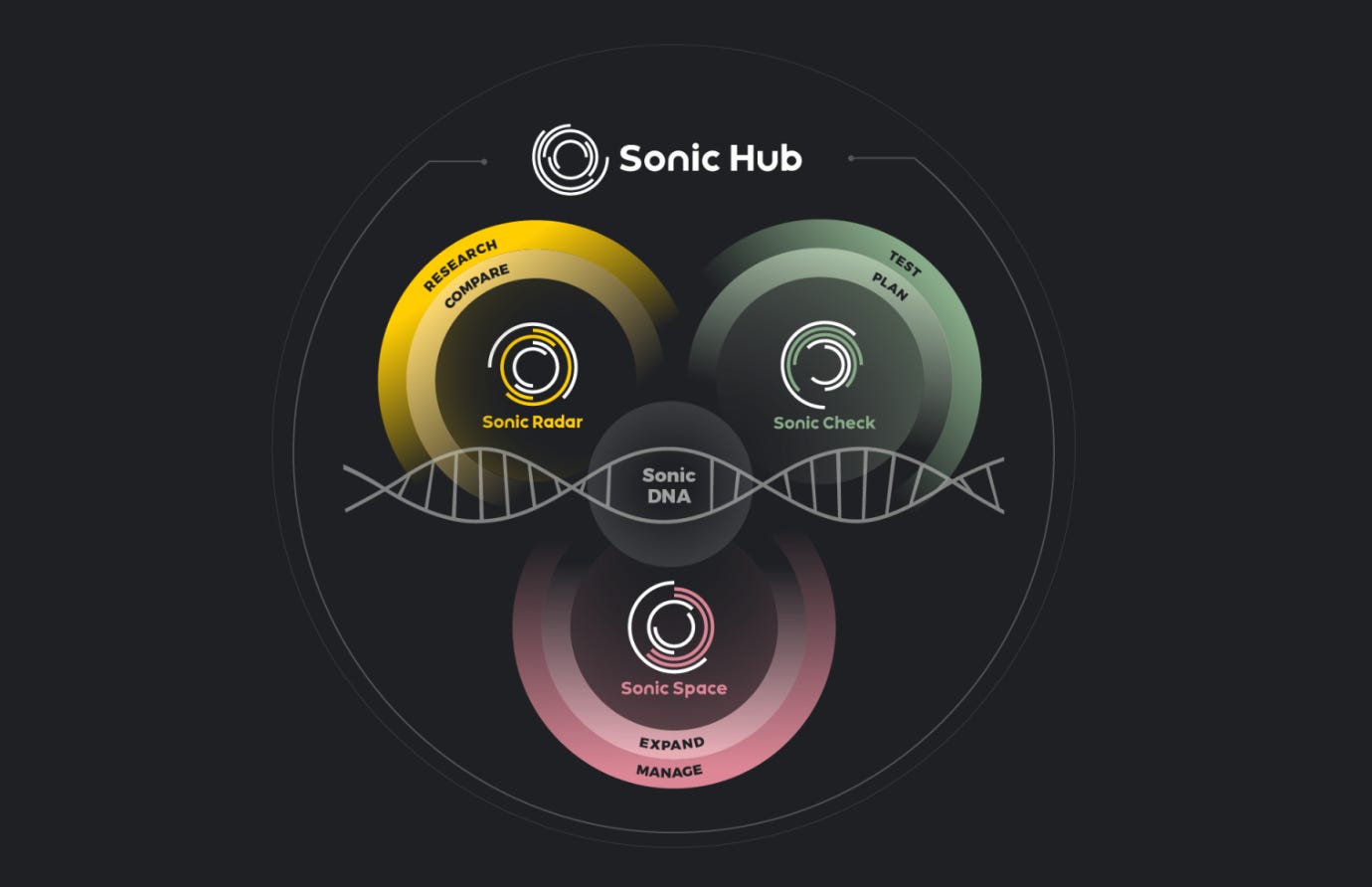
▰ AMPED UP: “He describes Sonic Check as ‘rapid-development tool’ that uses machine learning AI ‘trained with real market research’ to give the user a ‘measurement’ of a sound. It looks at how consumers responded to similar sounds in the past and provides a prediction of how a sound will be received by consumers. … Once users upload a sound, the AI analyses its performance in relation to ‘brand fit’, memorability, and ‘authenticity’.” —Abbey Bamford interviews sonic branding agency Amp CEO Michele Arnese about Sonic Hub, “which seeks to simplify the sonic branding process for designers and brands using four different AI technologies.” Sonic Check is one of its tools. The others are Sonic Radar (which provides “insights on a brand’s use of sounds across its digital channels, using music AI tagging technology ‘trained by experts to categorise music’”) and Sonic Space (which “uses generative AI to create new music out of existing music, acting as a ‘sonic repository’”). More at ampsoundbranding.com/sonic-hub.

▰ QUICK NOTES: ▰ This Is What It Sounds Like: The Shriek of the Week is the “stock dove,” which, we’re told, sounds like a normal dove’s “coo” — but “in reverse” (“Imagine the bird is scratching a record like a DJ, swiping it backwards and forwards”). ▰ Drop the Mic: Micah Loewinger of On the Media speaks to Dan Charnas, author of Dilla Time: The Life and Afterlife of J Dilla, the Hip-Hop Producer Who Reinvented Rhythm, about “how music copyright law suppresses the artistic voices of hip hop producers.” (Thanks, Rich Pettus!) ▰ Light Brigade:Behind the scenes with the Imagineers who developed the sound for the TRON Lightcycle / Run ride at Walt Disney World. ▰ Songs About Buildings: Learn all about new Finnish acoustic standards for “acoustic environments in buildings.” ▰ Grand Scale: Composer-developer Giorgio Sancristoforo’s new software is a synthesizer with 1,000 oscillators. ▰ Sized Up: How MassiveMusic Berlin updated the sonic logo of the German bank Sparkasse. ▰ Voice Over: The voices of Shaquille O’Neal, Melissa McCarthy, and Samuel L. Jackson are leaving Amazon Alexa.

▰ APPLE DROP: There was a lot of Apple news this week, and in it quite a bit of audio, such that it gets its own section this week: Coming in Apple tvOS 17 is Enhance Dialogue (“which lets users more clearly hear what is being said over effects, action, and music in a move or a TV show” — thanks, Bruce Levenstein!) ▰ The new VR goggles from Apple involve “audio ray tracing”; here’s a primer: wepc.com (“It would make it seem like … sounds are coming from your room in a particular place.) ▰ “There’s a new Adaptive Audio feature for the AirPods that combines Transparency and Active Noise Cancellation to dynamically match the conditions of the environment that you’re in.” ▰ USB-C microphones to be supported by iPads. ▰ Apple Music adds crossfading, among other features. ▰ “Users can now simply say ‘Siri’ instead of ‘Hey ‌Siri‌,’ and ‌Siri‌ will understand follow-up commands that do not include the trigger word.” ▰ “Personal Voice is designed to allow you to use artificial intelligence to create a replica of your voice.” ▰ Added to iMessage: “automatic transcriptions for voice messages.” ▰ FaceTime will have “Live Voicemail with voice-to-text transcription before answering; transcription is handled on device.” ▰ “AirPlay‌ can learn how and when you listen to certain content, for example by displaying a nearby AirPlay-supporting speaker to select depending which room you’re in.”