I spent some time last Sunday afternoon with Nathan Ho, a San Francisco Bay Area musician, coder, and educator whose name you may recognize from his gorgeous, sound-producing, complex Venn diagrams, which I wrote about at the start of 2021. (One of them served as the “cover” for this issue.) I mention him here not as a log of my social calendar, but because of something he wrote toward the end of last month on his excellent blog. It’s an essay that collates his thoughts on the underpinnings of sound design. He breaks the concepts down into nine “traits.”
The piece takes as its title “A Preliminary Theory of Sound Design,” and he notes Disney’s “12 Principles of Animation” as a model. The traits are, in alphabetical order: Contrast, Directionality, Fidelity, Regularity, Space, Transients, Verticality, and Vocals. They appear in a different sequence in Ho’s post, beginning, appropriately, with Transients (specifically the “initial” transient: “A tiny click,” he writes, “or burst of noise added to an attack, or a fade in, can make a huge difference”) and closing with Verticality (which he associates with other concepts, such as “arrangement” and “layering”). Whether you make sound or just think about it, the divisions he points out provide a useful classification system.
After reading it, you might try the following exercise: consider a sound, and then break it down into the eight traits that Ho has delineated. If you do, please report back.
I do this manually each Saturday, usually in the morning over coffee: collating most of the little comments I’ve made on social media, which I think of as my public scratch pad, during the preceding week. These days that mostly means post.lurk.org (Mastodon).
▰ How many times have I (re)learned that the best way to make sure that music files remain associated with each other as subsets of a given album in Apple Music (slash iTunes Match) is to make sure they’re MP3s or ALAC?
▰ I can hear but I don’t see the ice cream truck
▰ I’ve been trying out Duolingo for German. I assume this image means I’ll soon be reading Doepfer and Ableton synthesizer documentation in the original.
▰ Today’s near-paperless office: six screens, one tiny notebook
▰ Notifications settings:
▰ Digital-based note-taking can generate idiosyncratic cadences and processes. Today is the second day of the month. The second day of the month is the first day of the month when I need to have a document specific to the month, because my notes from my general daily note-taking, from yesterday, only became archival (historical) today. I create a new monthly doc to put those note in. Now, because I’m using IA Writer, which doesn’t sync seamlessly with Dropbox, I move the previous month’s monthly doc back into Dropbox, within a folder for the year, and then create a new monthly doc in its place within IA Writer (by “within” I just mean in an app-specific folder in iCloud). As always, some systems are simple; others reflect the accrual of habits as constrained by unique aspects of one’s perceived needs, discomforts, and priorities, which also shift and evolve over time. The latter are especially difficult to unpack after the fact. The main reality check is that this all took about two seconds to accomplish. Describing it took much longer.
Summer (i.e., the end of the school year) begins today. I’m going to try to give myself a little more time between now and mid-August for recuperation and what we now call “long form” writing. This may mean I’ll take the occasional issue off (of This Week in Sound), and maybe even an occasional blog post. The Disquiet Junto will continued unabated. To wit, there likely won’t be an issue of This Week in Sound on June 9 (next Friday). Then again, it may come naturally and quickly. We’ll see. Writing this newsletter is generally more of a release than a chore, that’s for sure.
The Assignment: Depict genres' evolution over time in music.
/ By Marc Weidenbaum
Each Thursday in the Disquiet Junto music community, a new compositional challenge is set before the group’s members, who then have just over four days to upload a track in response to the assignment. Membership in the Junto is open: just join and participate. (A SoundCloud account is helpful but not required.) There’s no pressure to do every project. It’s weekly so that you know it’s there, every Thursday through Monday, when you have the time and interest.
Deadline: This project’s deadline is the end of the day Monday, June 5, 2023, at 11:59pm (that is, just before midnight) wherever you are. It was posted on Thursday, June 1, 2023.
Tracks are added to the SoundCloud playlist for the duration of the project. Additional (non-SoundCloud) tracks appear in the lllllll.co discussion thread.
Disquiet Junto Project 0596: Phylogeny Junto The Assignment: Depict genres’ evolution over time in music.
Step 1: “Phylogeny is,” per the American Heritage Dictionary, “The evolutionary development and history of a species or trait of a species or of a higher taxonomic grouping of organisms.” Consider how such a concept can be applied to genre.
Step 2: Think about how genres change and develop over time, spawning and merging with other genres.
Step 3: Record a piece of music that depicts, charts, or otherwise expresses an example of how genres might follow the model of phylogeny.
Eight Important Steps When Your Track Is Done:
Step 1: Include “disquiet0596” (no spaces or quotation marks) in the name of your tracks.
Step 2: If your audio-hosting platform allows for tags, be sure to also include the project tag “disquiet0596” (no spaces or quotation marks). If you’re posting on SoundCloud in particular, this is essential to subsequent location of tracks for the creation of a project playlist.
Step 3: Upload your tracks. It is helpful but not essential that you use SoundCloud to host your tracks.
Step 4: Post your track in the following discussion thread at llllllll.co:
Step 5: Annotate your track with a brief explanation of your approach and process.
Step 6: If posting on social media, please consider using the hashtag #DisquietJunto so fellow participants are more likely to locate your communication.
Step 7: Then listen to and comment on tracks uploaded by your fellow Disquiet Junto participants.
Step 8: Also join in the discussion on the Disquiet Junto Slack. Send your email address to [email protected] for Slack inclusion.
Note: Please post one track for this weekly Junto project. If you choose to post more than one, and do so on SoundCloud, please let me know which you’d like added to the playlist. Thanks.
Additional Details:
Length: The length is up to you.
Deadline: This project’s deadline is the end of the day Monday, June 5, 2023, at 11:59pm (that is, just before midnight) wherever you are. It was posted on Thursday, June 1, 2023.
Upload: When participating in this project, be sure to include a description of your process in planning, composing, and recording it. This description is an essential element of the communicative process inherent in the Disquiet Junto. Photos, video, and lists of equipment are always appreciated.
Download: It is always best to set your track as downloadable and allowing for attributed remixing (i.e., a Creative Commons license permitting non-commercial sharing with attribution, allowing for derivatives).
For context, when posting the track online, please be sure to include this following information:
More on this 596th weekly Disquiet Junto project, Phylogeny Junto (The Assignment: Depict genres’ evolution over time in music), at: https://disquiet.com/0596/
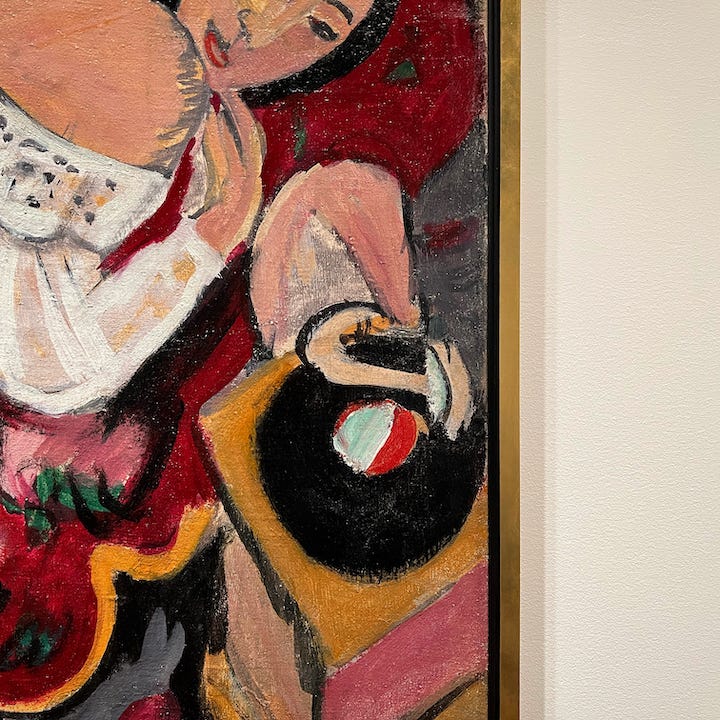
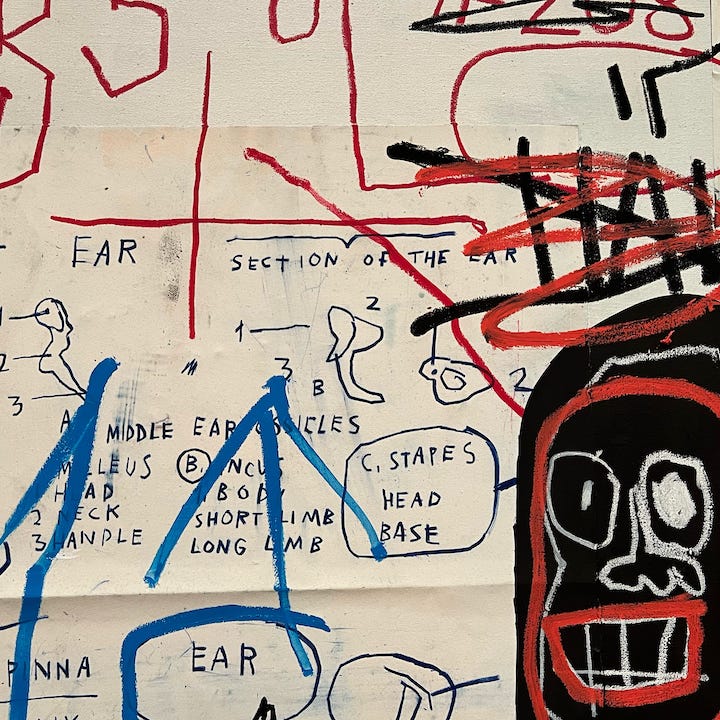
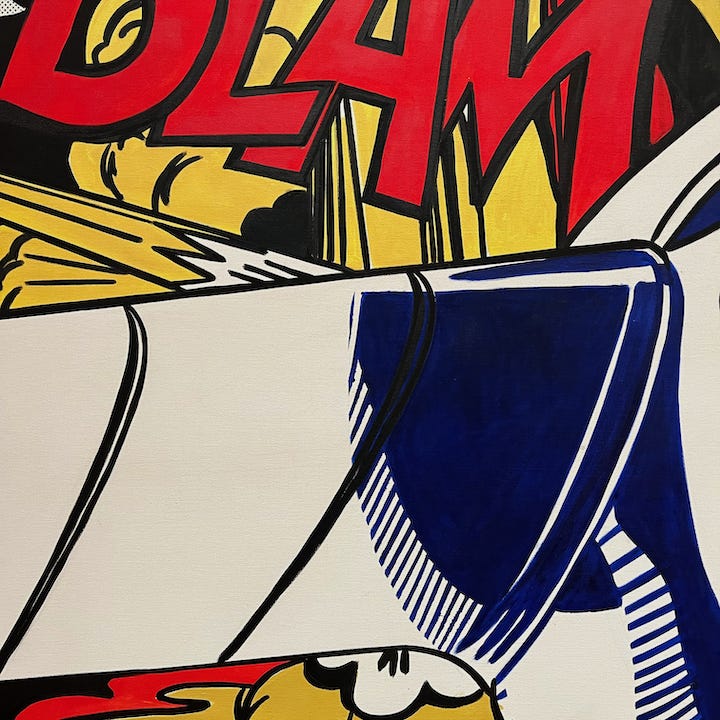
I got back late Sunday night from my college reunion, which provided both conversation late into the three nights I was there, and an afternoon visit to the Yale University Art Gallery. I took a lot of it in, and the following three details from three very different paintings made a particular impact. They’re also good examples of how I find I’m often more interested in “sound in art” than in “sound art.”
Not long after staring at the textural details of a 4,000-year-old Sumerian votive statue hewn from limestone, I found myself on a different floor, drawn from across the room to a familiar shape in the corner of a painting from merely 110(ish) years ago: this turntable, in the bottom right quadrant of a much larger oil painting, Girl in White Chemise, by German artist Ernst Ludwig Kirchner (1880-1938). (That gold vertical line is the edge of the frame. To the right is simply the gallery wall.) I want to understand how “modern” this object read to a viewer at the time, and whether the record label’s red and white coloring was easily identifiable. I was struck by the flesh color of the tone arm, and the way its seductive shape emulated that of the reclining woman.
This element was a reminder of just how much sound there is in the work of New York native Jean-Michel Basquiat (1960-1988). The larger piece is titled Diagram of the Ankle, from 1982. There is something jittery about the desire to scribble the receptive mechanisms of human hearing, a will to comprehend. This material shown here is a subset of half of a diptych, its background a cream color, adjacent to the other portion’s black, the latter of which features a visually loud, all-caps “WOOFS” next to the faces of some wild-looking dogs — perhaps the very sounds that this anatomical equipment is processing.
I was confronted by the intense graphic sensibility of another New York native, Roy Lichtenstein (1923-1997). The instant I took this photo, I was faced with the shortcomings of its resulting depiction of the piece’s surface, even when I zoomed in. Then I recalled that I spend too much time thinking about a central irony of Lichtenstein’s work: reproduction doesn’t begin to do it justice. This is from the onomatopoeically named Blam, from 1962. It’s funny to think that one common trope in the description of Lichtenstein’s work is that he “elevates” his source material, in this case a panel from a comic of the same year by artist Russ Heath (1926-2018). It’s arguable that Lichtenstein’s take is, in fact, more cartoony, not less, than the Heath original, which has more doom-laden colors and a far less abstract explosion. And as for “BLAM” itself, it is softer and more rounded in Lichtenstein’s rendering.