

This went out today as a thank you to paid This Week in Sound subscribers: an annotated playlist of recommended music (from Jeannine Schulz, Snorri Hallgrímsson, and Davide Bernardi).
This went out today as a thank you to paid This Week in Sound subscribers: an annotated playlist of recommended music (from Jeannine Schulz, Snorri Hallgrímsson, and Davide Bernardi).

These sound-studies highlights of the week originally appeared in the May 30, 2023, issue of the Disquiet.com weekly email newsletter, This Week in Sound. This Week in Sound is the best way I’ve found to process material I come across. Your support provides resources and encouragement. Most issues are free. A weekly annotated ambient-music mixtape is for paid subscribers. Thanks.
▰ HAZARD LIGHTS: The PionEar is the name of a little device that alerts drivers visually on the chance they can’t hear an emergency siren. The device, intended in part for deaf and hard-of-hearing drivers, is part of the 2023 Hackaday Prize. It was created by Jan Říha of Brno in the Czech Republic. It uses machine learning to identify sirens amid any other noise that penetrates a moving vehicle.

▰ CUSTOMS CLEARANCE: Toward the end of an interview with Danielle Venne of Made Music Studio about the sounds of the Nissan Leaf electric car is this tidbit: “And in case you’re wondering why we can’t make our own sounds for our electric vehicles: After the U.S. Department of Transportation finalized its ‘quiet car’ rule in 2018, there was some hope among EV owners that the new regulation would bring with it the option to fully customize the sound of an individual car. For a few years, it seemed like drivers would someday be able to select from a catalog of sound effects to signal when their car is backing up or slowly pulling forward. … But last summer, safety regulators scrapped that plan, saying there was a lack of data illustrating exactly why that level of customization would be necessary.” (Thanks, Rich Pettus!)
▰ NIGHTY NIGHT: The latest from the great Cities and Memory series of crowdsourced projects is “seeking field recordings from all over the world that reflect your interpretation of sleep, rest and tranquillity – these restful soundscapes could be drawn from the natural world or man-made sounds, rural or urban.” Tracks are due by June 30. “Artists will reimagine recordings from a treasure trove of birdsong, wave sounds, nature, song, bell chimes and other calming sound sources to develop a suite of brand new pieces that will help listeners all over the world to find sleep.”
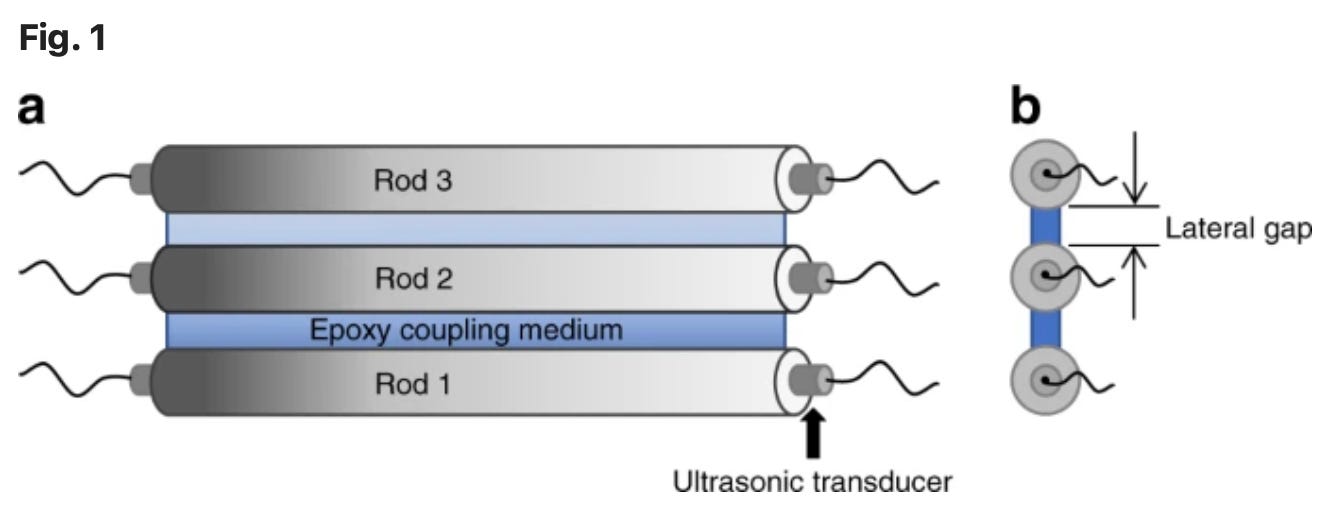
▰ ACOUSTIC COMPUTING: If you think quantum computing is confusing, how about using non-quantum resources to simulate quantum computing … using sound? Welcome to the “phi-bit,” per work presented at the Acoustical Society of America in Chicago earlier this month: “Some properties of quantum computers can be imitated with sound trapped in a simple mechanical device. This has the advantage of being less fragile than quantum computers, while still replicating some of their properties. … Pierre Deymier at the University of Arizona and his colleagues glued together three aluminium rods, each a little over half a metre long, to create something that could act like a quantum bit, or a qubit, but with a much larger device. Qubits differ from conventional bits because, in addition to encoding information as 1s and 0s, they also have many so-called superpositions that are both and neither at once. … The researchers used speakers to create vibrations at one end of the stack, and detected them at the other. When the sound frequencies were tuned just right, localised ‘chunks’ of sound formed in the rods – the researchers named them ‘phi-bits’. Deymier says that information could be input into the phi-bits by tuning the sound.” Members of the team back in 2019 reported progress on using such rods in the development of ultrasonic transducers.
▰ COMB FILTER: How do you find a bird no one has recently seen and for which “no definitive recording of the bird’s call exists?” When it comes to the South Island kōkako, of New Zealand, you turn to math: “[I]t’s thought to sound something like its North Island cousin, and to be a haunting call with organ and flute-like notes and some other sounds mixed in. … Using this as a starting point, mathematician Stephen Marsland at Victoria University of Wellington algorithmically generated every conceivable variation of this kind of call, and has used these to comb billions of hours of audio recordings from different locations for possible South Island kōkako calls. In this way, his team was able to identify 250 possible calls, and then narrowed these down further to only five, which are now under review by experts.”
▰ THUNDER FROM DOWN UNDER: A letter to the editor at NewScientist proposes an explanation for animal awareness of earthquakes: “As to animals being scared before a quake, infrasound (sound below the audible range) creates fright, even in us. It can be used in soundtracks to arouse fear. But we tend to live in places where it is drowned out. The early rumblings of an earthquake would produce such sounds and perhaps these scare horses and other animals.”
▰ QUICK NOTES: Another Dimension: Andy Price reports on the promise of a “post-stereo world,” (musicradar.com) — and yes, variations on the word “immersive” appear over 30 times on the webpage. ▰ Tatooine You: On the 40th anniversary of The Empire Strikes Back, here’s Ben Burtt and Randy Thom (at starwars.com) discussing some of the sounds from the film, including the voice of Jabba the Hutt (“a made-up language … based on the Peruvian-Incan dialect, Quechua”). ▰ Pole Position: From the latest update to the video game Minecraft: “Environmental Audio Changes – Audio positioning for ambient sounds is now emitted relative to the camera’s location” (sportskeeda.com). ▰ Just Browsing:Learn about a Chromium extension called Chrome Hotword Shared Module that reportedly appeared in version 43 of Google’s open source browser platform, and that is said to have disappeared as of version 46 (makeuseof.com). ▰ High Pitch:Read up on the sonic branding of the women’s Rugby World Cup 2021 in Aotearoa (New Zealand), an “audible memento by embedding the live sounds of the match — such as young female superfans’ voices, play-by-play commentary and the stadium atmosphere” (thedrum.com). ▰ Egged On: Ordinary everyday chickens served as the source material for the sound of ferocious dinosaurs mating in Apple TV’s Prehistoric Planet (variety.com). ▰ Let’s Submerge: “Bubble curtains” can reduce the impact of sound in the ocean (hackaday.com). ▰ Color Code: The “Shriek of the Week” is that of the greenfinch, which produces “a sudden drawn-out wheeze. Often this makes an abrupt change of tone in the middle of the trilling conversation, as in the recording above” (shriekoftheweek.substack.com). ▰ Air Fare: Which airlines have the best boarding music (travolution.com)? ▰ Voiceover Kill: If you think there are already too many podcasts, just wait for impact of AI-produced ones (wired.com). ▰ Medallion Cartel: The debate about the magical qualities of the taxi whistle in the final episode of The Marvelous Mrs. Maisel was pretty wonderful. (And the way she stared at that microphone was something else.)
86: Percent of radio listening that takes place on radio receivers
8: Percent on phones
2: Percent on smart speakers
Source: insideradio.com.
This review I wrote originally appeared in the May 2023 issue of The Wire, number 471, the one with Slayer drummer Dave Lombardo on the cover. The article appears here (for the first time from behind the paywall, now that the subsequent issue — the bright red one with the Fall on the cover — has come out) in ever so slightly edited form. As I noted at the time of its publication:
The primary observation I didn’t have room for in the review is that sound is so prevalent in horror that several of the other books in the British Library’s Tales of the Weird series, of which Spectral Sounds is part, employ it in the examples shown at the back of the book in the catalogue, and also on the publisher’s website. What distinguishes the stories in Spectral Sounds is that sound is central to each tale’s narrative, rather than just a colorful element of the mood-setting.
Here’s the review in full:
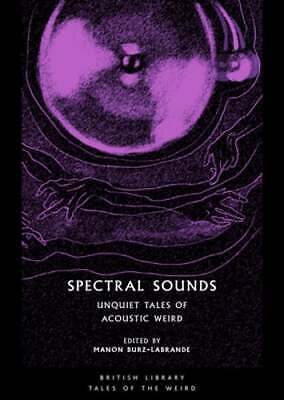
Spectral Sounds: Unquiet Tales of Acoustic Weird
Manon Burz-Labrande (Editor)
British Library Pbk 315 pp
In 1866, Irish writer Ruth Mulholland, then aged 25, published a spooky story in All the Year Round, a periodical edited by Charles Dickens. She was two years old when Dickens exhibited ghostly expertise with A Christmas Carol (1843), in which we’re told “Scrooge was not a man to be frightened by echoes.” Mulholland developed an interest in sound’s potential for horror, and vice-versa. Titled “The Haunted Organist of Hurly Burly,” her tale involves a strange musician claiming to be betrothed to the deceased son of the organ’s caretakers.
“Hurly Burly” and 13 other stories comprise Spectral Sounds: Unquiet Tales of Acoustic Weird. Edited by Manon Burz-Labrande, a researcher and lecturer at Austria’s University of Vienna, the book is part of the British Library’s Tales of the Weird paperback series. Thematically linked sections highlight strange utterances (Thomas Street Millington’s “No Living Voice” from 1872), audible presences (Elizabeth Stuart Phelps’s “The Day of My Death” from 1868), and the post-apocalyptic soundscape (MP Shiel’s “The House Of Sounds” from 1911), among other eerie tropes.
Time does peculiar things to language. Expressions become — in LP Hartley’s formulation — foreign. Hartley’s horror isn’t collected here but we do get Edith Wharton, as well as Edgar Allan Poe’s “Siope — A Fable” (1837), thankfully more obscure than “The Tell-Tale Heart.” The book contains aged sentences that cause the reader to wonder how something once declarative becomes mystifying. Are these Lovecraftian prose poems casting the unfathomable oddness of our world? Oftentimes no, just plain English rendered weird by the years.
A few paragraphs into the opening story, Florence Marryat’s “The Invisible Tenants of Rushmere” (1883), we’re told by the narrator, a physician about to inadvertently rent a haunted house: “The hostages which I had given to fortune had made that strenuous action which attention to my numerous patients supplied incumbent on me.” This seems to mean the doctor works too hard; the reader may sympathize. Placing such a phrase early in the book was wise: it signals the reader to keep alert. Here be linguistic dragons.
Anxiety proves more impervious to time than does language. Archaic as some of the wording in Spectral Sounds may be, the many sources of its dread are familiar, occasionally to the point of feeling samey. Note the “whine of a door” and how “the wind whistled in at the keyhole,” not to mention the “curse of silence” and countless unidentifiable voices from beyond. These same evocations serve contemporary thrill writers and seekers alike to this day. Part of what makes sound so powerful a narrative tool is that the stories’ authors and characters are equally aware of the symbolic portent inherent in the ear’s duty as the human nervous system’s alarm. Algernon Blackwood, in his “A Case of Eavesdropping” (1906), sets a scene this way: “All was still but the howl of the wind, which to his ears had in it a note of triumphant horror.”
The scariest stories leave their mark. You close a book, exit a cinema, or power down the TV only to find that the images, the sounds, the psychic imprint, linger. One additional impact from Spectral Sounds — more obsession than haunting — is the wealth of further readings, both academic and fictional, recommended in the volume’s introduction and each story’s helpful preface. Consider yourself forewarned.
This Junto Profile is part of an ongoing series of short Q&As that provide some background on various individuals who participate regularly in the online Disquiet Junto music community.
What’s your name? Magnus Lindencrona is my real name. Although I don’t consider myself an artist, I have often used my login (gis_sweden) as an “artist name” on different sites, such as Soundcloud, YouTube, and Bandcamp. But I’m not consistent …
Where are you located? I live in a town south of Gothenburg on the Swedish west coast and work in Gothenburg. Commuting to and from work is inspiring as it gives me time to reflect, listen and observe.

What is your musical activity? When I started making my own music, it began with what is called “synth pop” in Sweden. As a student, I had all the time in the world. But now, my head is always filled with ideas that I will never have the time to follow up on. Family, work and horse set the frames for musical excursions. Maybe that’s why I like the Disquiet Junto projects — to get a “compositional assignment.” I have also participated in SP-Forums beat battles. Now I’m a typical bedroom producer and can do what I want. One evening some years ago, I made this:
or
It belongs to an account which I have lost the password for, but I like it that way — make and forget. I know that BBC radio has used sounds made by me from Freesound.
What is one good musical habit? I believe in working with what you have — new gear will probably not help.
What are your online locations? I like to read threads on Lines (llllllll.co) and log in on ModWiggler sometimes. That’s enough for me.
What was a particularly meaningful Junto project? I don’t remember how I found the Junto Project — was it via ModWiggler? I don’t know. But I was fascinated by the experimental spirit. Just throw away conventions and record. Don’t care about likes — that’s my spirit. For me, it’s not important to make a nice track perfectly mastered; I don’t have time for that. Instead, I focus on the idea and creative part.
You mentioned using the gear you have. What do you work with? I consider my little modular synth as my main instrument. The synth is an all analog modular. But if I feel like it I can use DAW, SP-404SX, field recordings or any instrument in the house.
When you do the Beat Battles entries, do you add your own sounds, or just work from the provided samples? When I participate in beat battles I try to use only the provided samples, even if the rules says that you can add drums, bass etc. Working with limitations is fun.