
Very nicely done, slow-build, ambient-infused glitch track from keinseier, all the better because it’s a live video, a precise work-out on the Tonverk, a polyphonic multi-sampler, with each step in plain view. Listen as the held tones give way to a rising momentum, dotted with these little short-circuit snaps of firecracker disruption. More from keinseier, based in Hamburg, Germany, at keinseier.bandcamp.com.
Rudy Rucker’s Software Embodiment
OMAC Your Enthusiasm
The sheer messiness of flesh and blood (and data and robotics) is essential to Software’s role in the birth of cyberpunk as a genre. The first of the Ware books, Software arrived in 1982, two years before William Gibson’s Neuromancer, four years before Bruce Sterling’s Mirrorshades anthology of cyberpunk short stories, and a full decade before Neal Stephenson’s Snow Crash. Now, there is plenty of software in Software, but ultimately the operative term is the first half of the title, not the second. What’s really at work in this first book isn’t a tale of mere technological singularity — in which data rules supreme, outpacing human cognition, blah blah blah — but quite the contrary, one in which embodiment is explored as the essence of life. How punk is that?
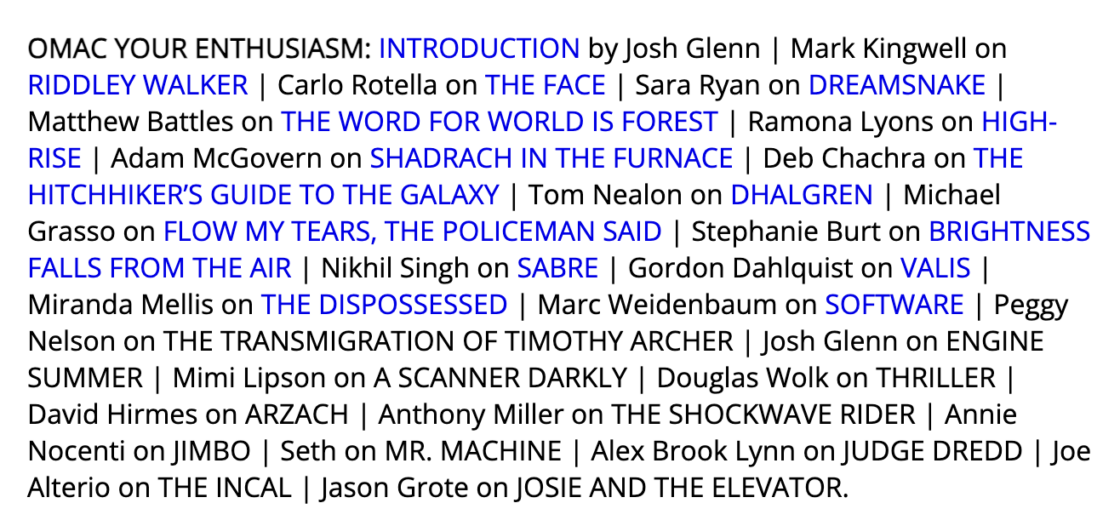
That’s from my new essay about Rudy Rucker’s classic early cyberpunk novel Software, which turned out to be the first of four books in a tetralogy (or quartet) that ran for nearly 20 years, from 1982 to 2000. The essay is part of a series on hilowbrow.com, “OMAC Your Enthusiasm,” in which the contributors write about “a favorite sf novel or comic from the Seventies (1974–1983).” Below is the full list. The ones in blue have already been published. Check them out at hilobrow.com, starting with editor Josh Glenn’s introduction. The “OMAC” set of essays is a kind of sequel to 2024’s “Vurt Your Enthusiasm,” in which contributors wrote about “science fiction novels and comics from the Eighties (1984–1993, in our periodization schema).” For Vurt I wrote about writer-illustrator Howard Chaykin’s comics classic American Flagg! (the exclamation point being part of the title). Eagle-eyed readers of disquiet.com (or my Instagram account around the same time) might have noticed I was (re)reading a paperback of Software back in November.
Scratch Pad: Scores, HTML, Reading
From the past week
At the end of each week, I usually collate a lightly edited collection of recent comments I’ve made on social media, which I think of as my public scratch pad. I tag on what books I may have finished reading. Knowing I’ll revisit my social media posts, I’ve found, serves as a positive and mellowing influence on my online activity. I mostly hang out on Mastodon (at post.lurk.org/@disquiet), and I’m also trying out a few others. And I generally take weekends off social media.
▰ I posted: We live in the golden age of movie scores (that is, movie — and TV — scores being released as albums). But that means we also live in the golden age of recognizing just how much most movie scores sound alike, or more to the point alike within a type.
And Ethan Hein replied: “In grad school I learned that the homogeneity is partially due to regular risk aversion but also due to the rise of very detailed temp scores. The music editor makes an entire placeholder score by remixing and editing existing scores and then the composer has to just SBD it (Same But Different).” And then he added something particularly interesting about a later John Williams piece for Star Wars: “A guy in my PhD cohort wrote his dissertation about the Duel of the Fates sequence in the Phantom Menace. John Williams wrote the score, they recorded the London Symphony Orchestra at Abbey Road, but then they made over a thousand edits to the sequence.”
▰ I asked: Anyone have trouble getting Bandcamp embeds to work in self-hosted WordPress and then figure out how to fix the problem? Thanks.
And then: Michael Donaldson, aka Q-Burns Abstract Message, aka editor of the excellent Tonearm, sorted it out for me: “it’s been a while but I seem to remember the WordPress code never worked for me — I always had to just use the regular HTML embed code in an HTML block.”
▰ Finished reading two books this week: Dashiell Hammett’s The Maltese Falcon and Camden Joy’s 35 Days of Fe, about the Souled American album Fe (I bought the book at the Souled American concert last week).
On the Line
Some favorite recent(ish) writing
▰ For You and Me
In being silent, voiceless, the land itself is often left out of politics and economics.
That is from Soren Callo’s “A Quiet That Cannot Defend Itself” at the website of the Sierra Club.
. . .
▰ Top Score
I thought about the stockings that Willy buys for the other woman, and I thought, If those stockings had a sound, what would it be? Or when Willy talks about his admiration for an older salesman who settles down in the evening with his green velvet slippers: If those green velvet slippers had a theme of their own, what would that be?
That is composer Caroline Shaw speaking in New York magazine with Justin Davidson about her score for the revival of Arthur Miller’s Death of a Salesman.
. . .
▰ Chasing Waterfalls
Trump’s phone could be heard ringing during a recent press conference in which he discussed a proposed 50 percent tariff on Apple. The familiar sound of the default “Reflection” ringtone—you know the one, the synthesized waterfall of xylophone tones—was a reminder that the tariffs targeted the company that makes his beloved device.
That is Ashley Parker and Michael Scherer (with additional reporting from Jonathan Lemire) in The Atlantic on the sitting president’s phone, security concerns, and the history of White House inhabitants’ affection for making and taking calls.
This Week in Sound: Musical Trainspotting
A lightly annotated clipping service
These following sound-studies highlights originally appeared in the May 20, 2026, issue of my Disquiet.com weekly email newsletter, This Week in Sound. This Week in Sound is the best way I’ve found to process material I come across. Reader support provides resources and encouragement. Most issues are free. An occasional annotated mixtape is for paid subscribers. Thanks.
▰ Keeping Tine: “In order to document bird songs, Mathews hiked through the thickets of the heavily forested White Mountains with a tuning fork and a notebook. Some contemporaries toted a stopwatch, too. He would have had to listen for birds calling repeatedly and long enough to decipher them. He might have tapped the tuning fork with a mallet to determine the key of the bird’s song. Then it was penciling each note onto the staff. Ironically, he called his notations ‘recordings’—not recordings in the analog or digital form, but a handwritten record of each song.” (From the always excellent newsletter This Week in Birding, by Bob Dolgan.)
▰ Round the Bend: The sound of a Siemens automotive called the Taurus makes when getting going is something to behold: “The power converters have to adapt the current from the overhead line to convert it to the three-phase motors of the locomotive, and that generates a rising tone. The engineers decided to change the logic to increment the tone in precise few steps resembling a musical scale, rather than allowing it to rise continuously.” (From Marchin Wichary’s Unsung.)
▰ Volume Control: “Now we can add a new gripe [about data centers] to the list: in addition to just being noisy, a sustainability nonprofit called the Environmental and Energy Study Institute (EESI) is claiming that data centers are emitting ultra-low frequencies [or “infrasound”] — think the powerful sub-bass at an EDM festival — that, while not picked up by a conventional decibel meter, cause an unsettling rumble for nearby residents.” (From Krystle Vermes at futurism.com.)
▰ Button Mash: The new video game controller from Steam has some tricks up its plastic and metal sleeve: “[A user] recently discovered that one of those easter eggs is how the controller literally screams when you drop it. More specifically, it will recreate the Wilhelm scream, which originated in a 1950s Western and is now considered the ‘most famous scream of all time.’”
▰ GRACE NOTES: (1) Lip Service: Tips on controlling your phone with your voice (Wired). ▰ (2) Wave Form: Why not build yourself a radio wave detector with aluminum foil? (Wired). ▰ (3) Sound Art: Jeff Koons’ iconic “balloon dog” sculpture is now a speaker. ▰ (4) Smoking Jacket: “Experimental clothing brand Vollebak has created the prototype Sonic Jacket, which is fitted with 180 inward-facing speakers.” ▰ (5) Dynamic Duo: A pair of pristine WWII-era radio transmitters “survived the war in brand new condition in their original shipping crates.” ▰ (6) Public Venture: Industrial-music legend JG Thirwell (Foetus) has a Tumblr and apparently he sees music performances all the time and posts clips of them, among other things.
▰ Citation Credits: Thanks, Lowell Goss (WWII)!