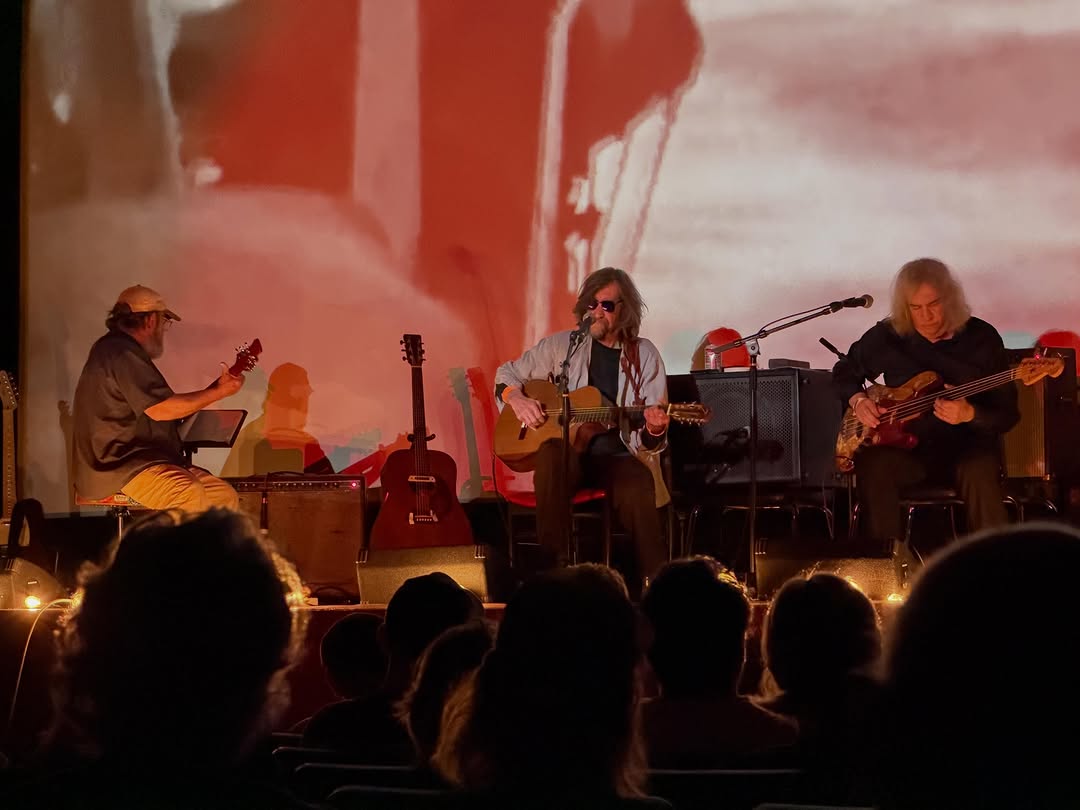
Souled American was one of the first three acts I interviewed professionally, way back in 1989 (maybe late 1988?) — that was in Manhattan, for Tower Records’ Pulse! magazine, before I moved to Sacramento to work for Pulse! full time — and tonight, May 18, 2026, I got to see them live at the 4 Star, mere blocks from where I live in San Francisco. I was stoked beyond belief, and the audience was treated to two sets, followed by two encores. They didn’t do “Soldier’s Joy,” and I wasn’t in the mood to call out for it, even the one time they (half-jokingly?) asked for requests; I just wanted to sit back and enjoy musical trip they took us on. The band, once a quartet, at this point is guitarist/singer Chris Grigoroff (center) and bassist/singer Joe Adducci (right), with guest guitarist Brian Smith, whose sonic beds reminded me of original member Scott Tuma. For a night, I was 22 again.
On Sundays I try to at least quickly note some of my favorite listening from the week prior — things I would later regret having not written about in more depth, so better to share here briefly than not at all.
▰ Solo ambient cello, heavy on the texture, from Ukrainian musician Fedir Tkachov:
▰ On July 17, Kate Carr will release Vertical London (New Year’s Day), a collection of field recordings that aim to collate the sounds of London from minus 20 metres below sea level to 240 metres above, hence the album’s title. As of this writing, four of the set’s 22 tracks are online:
“Early birds and planes in Loughborough Junction”
“I am not sure which tube station is the furthest below sea level, but I am visiting quite a few”
“Under the Thames with cyclists, joggers and echoes in the Greenwich Foot Tunnel”
“Popping up at Island Gardens.”
▰ The two-track EP Graceless is driving industrial noise, made with no-input feedback loops, from Chia-Chun Xu, based in Taipei City, Taiwan.
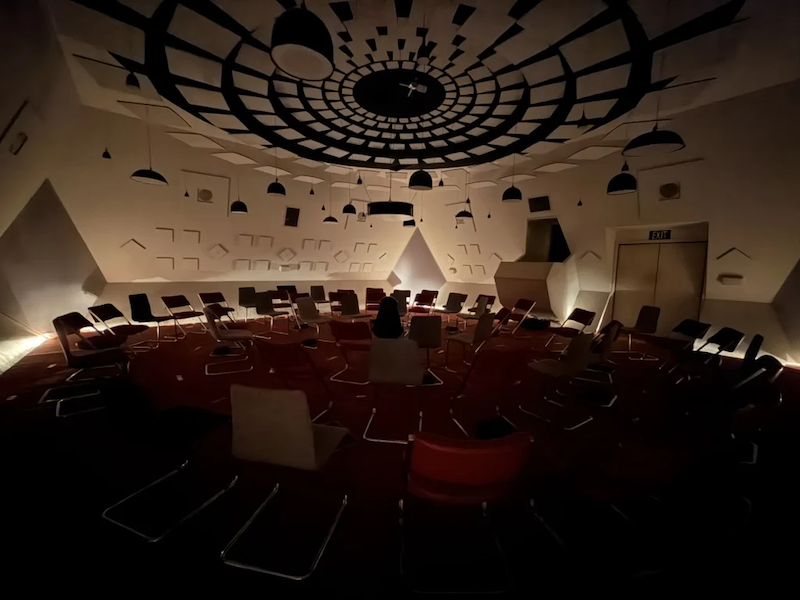
This past week I again visited the Audium, a special sonic space in San Francisco, and one that I have spent much time in over the course of many decades. The Audium has 176 carefully arranged speakers in a small room kept dark during performances, which often are explorations of spatial musique concrète — that is, of sound works made from recordings of sound, rather than using live instrumentation.
My friend Łukasz Langa, who went with me, took this shot of the interior after the performance we attended:
Founded by Stan Shaff and Doug McEachern, the Audium’s first dedicated physical space, with a quarter as many speakers, was in my longtime neighborhood, the Richmond District, in what is now a small office between a day spa and a hair salon. That was back in 1967.
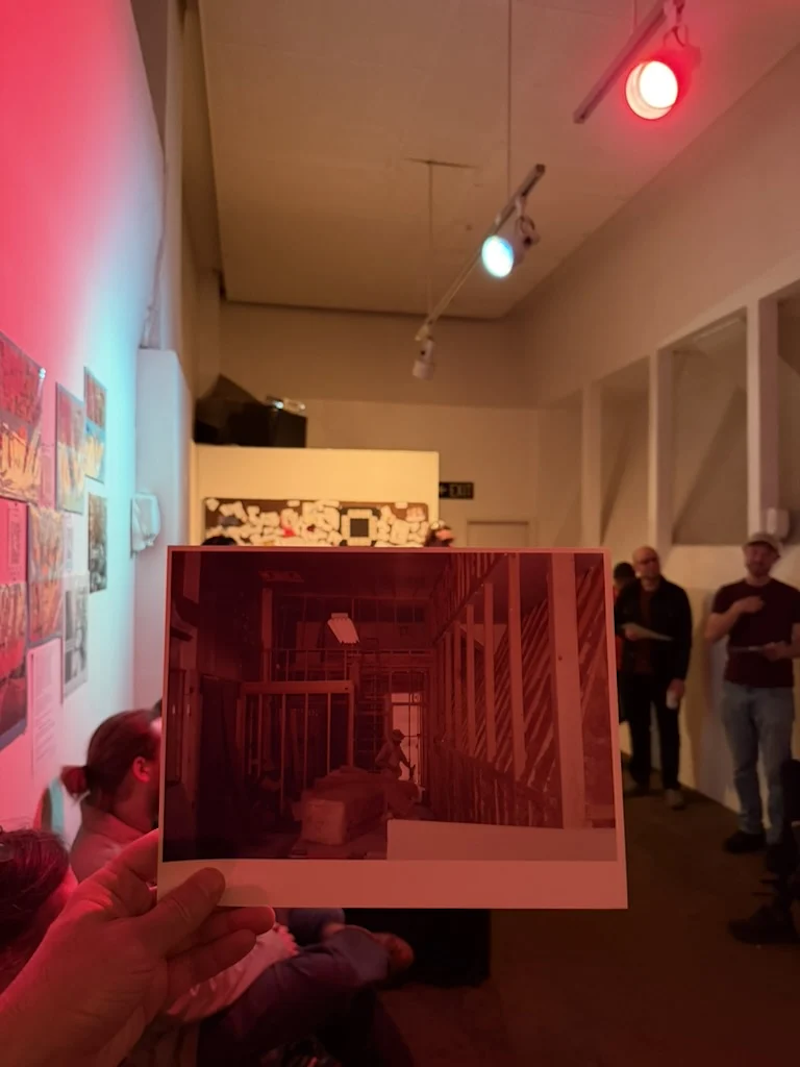
By 1969, the Richmond District space had expanded to 61 speakers. Then in 1975, following an NEA grant and substantial construction work, the Audium moved to its current location, a former donut shop on Bush Street, not far from the major thoroughfare of Van Ness Avenue. Here’s a shot of my hand holding a photograph of the current space when it was still under construction, in the context of the space as it appears today. That’s Shaff’s son, David Shaff, in the baseball hat on the right.
There’s a lot to be said about any Audium show, and in addition to hearing everyday sounds and synthesized fragments move in three dimensions, I’ve had the pleasure of listening to a live jazz band perform, also in the dark. Something new-to-me always is happening at the Audium, and this time what struck me in particular was a thoughtful little design touch.
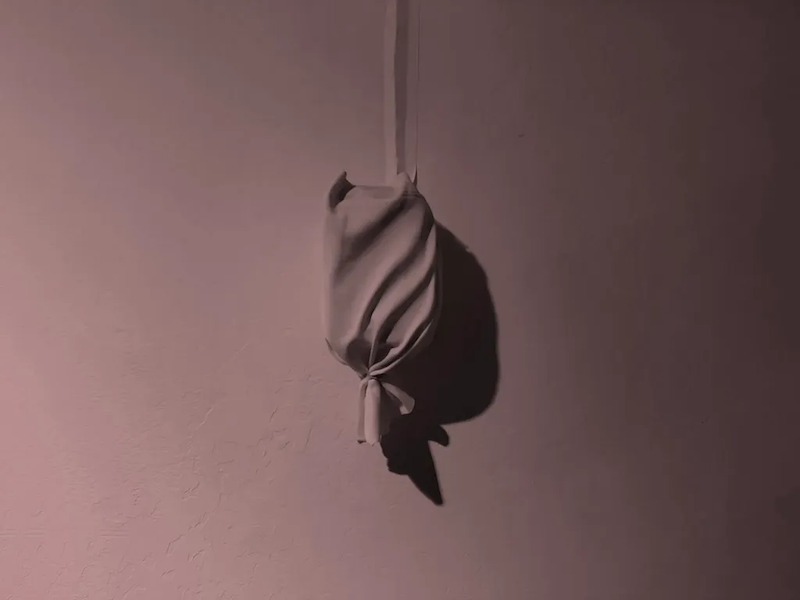
The lobby of the Audium serves as a gallery for an ever-changing series of sound art installations, and the current one plays through wall-mounted speakers. The exhibit is an audio-visual collaboration between Alex Abalos and Roco Cordova. What I noticed as I walked around wasn’t just the sounds or the projected images. It was how the sounds were being emitted: Each of the speakers is inside a cloth bag, which is pulled tight.
The carefulness of the speaker presence at the Audium reminded me of the snaking cables that caught my eye at a Marina Rosenfeld sound art exhibit back in 2021. In that case, rather than the bulky black cables being casually arranged out of necessity, they were artfully, even playfully, placed, and thus they became, in essence, part of the work, rather than a necessary byproduct.
In the Audium’s lobby, it was, frankly, nice not to be surrounded by a bunch of hard plastic and metal commercial objects, which is the standard mode for sound art. I also couldn’t help but connect the hand-tied cloth bags with the handcrafted nature of the space itself. It’s a simple touch, and one I’m surprised, in retrospect, that I don’t see more often in sound art exhibitions.
This article originally appeared in the May 13, 2026, issue of my Disquiet.com email newsletter, This Week in Sound.
At the end of each week, I usually collate a lightly edited collection of recent comments I’ve made on social media, which I think of as my public scratch pad. I tag on what books I may have finished reading. Knowing I’ll revisit my social media posts, I’ve found, serves as a positive and mellowing influence on my online activity. I mostly hang out on Mastodon (at post.lurk.org/@disquiet), and I’m also trying out a few others. And I generally take weekends off social media.
▰ Erica Grayscale Bastl Doepfer Frap
▰ Eno Guðnadóttir Bryars Dempster Fennesz
▰ Elfman Goldenthal Badalamenti Desplat Fiedel
▰ I made a friend down by the ocean. (After I posted this image, a friend of mine commented, calling it a “viral photo.”)
▰ Erksine Garbarek Bley Darling Frisell
▰ I marvel how you can have lower than average “skill” on a Wordle, and lower than average “luck,” and still somehow best the average score (in terms of “steps”) by over a point.
▰ Eckstine Garrett Blakey DeJohnette Foster
▰ Draft revisions underway, following an editorial check-in, for a very cool project I hope to be able to share news about soon. It’s someone else’s book. I’ve just contributed 1,000 words or so. It’s gonna be beautiful.
▰ EHX Glou-Glou Boss Donner Fairfield
▰ I highly recommend eating an apple cut with a blade that just previously cut an orange. And on that note, have a good weekend, or best you can.
These following sound-studies highlights originally appeared in the May 13, 2026, issue of my Disquiet.com weekly email newsletter, This Week in Sound. This Week in Sound is the best way I’ve found to process material I come across. Reader support provides resources and encouragement. Most issues are free. An occasional annotated mixtape is for paid subscribers. Thanks.
▰ Head Trip: “A new study by Britton Elliott Brooks argues that medieval religious images were never truly ‘silent.’ Instead, they could evoke imagined soundscapes in the minds of viewers, creating immersive experiences that blended sight, memory, and sound. The research focuses on the Harley Roll, a medieval English scroll depicting the life of Saint Guthlac, and suggests that pilgrims and worshippers may have mentally ‘heard’ winds, hammering, animal cries, and demonic noises while viewing its images.” Brooks received a PhD at Oxford in English and is an associate professor at Kyushu University in Japan.
▰ Bio Drone: “Scientists from TU Delft, SoundCell and RHMDC (the laboratory at the Reinier de Graaf hospital) have discovered that different bacterial species produce their own characteristic sounds. Building on an earlier development from the same team, they have now shown that bacteria can be identified and their antibiotic susceptibility determined simultaneously, based solely on their sound. This combined approach delivers results within hours instead of days, offering a major step forward in the diagnosis and treatment of bacterial infections.”
▰ Radio On: The great ongoing Cities and Memories project — developed and maintained by Stuart Fowkes — of field recordings and sound works based on field recordings now has its own dedicated online radio station: “an uninterrupted flow of more than 8,000 sounds and reimagined pieces from across more than 140 countries.”
▰Buzz Killers: The New York Times ran a wonderful online feature by Gina Ryder, with photographs by George Etheredge, about the city’s intercoms and doorbells, and as anyone who follows my Instagram account might imagine, I enjoyed it immensely. It opens: “When a visitor presses a button on an analog New York City apartment intercom, they enter a time portal to somewhere in the last century when the wiring was likely installed. If they’re lucky, someone upstairs will hear it: a metallic, almost offensive clang that sets the dog barking and sends cortisol spiking. Then comes the electric sigh of the lock releasing, and they’re let inside.”
▰GRACE NOTES: (1) Disintegration Tapes: A study in Nature measures how mildew degrades analog tape. ▰(2)We All Scream:Whales have learned to “yell” to compensate for the noise of ship traffic. ▰(3) Volume Matters: A New Yorker cartoon (by Sophie Lucido Johnson and Sammi Skolmoski) joked about loud bird song as a form of, er, compensation. ▰ (4)Ether Madness: A recent XKCD cartoon joked about the absurdist concept of “soniferous aether.” ▰ (5) Coma Dose:Brains under anesthesia may still hear and process the sound of podcasts.
▰Citation Credits: Thanks, Nicola Twilley (bacteria), Michael Rhode (cartoons), and Rich Pettus (anesthesia)!