
This Junto Profile is part of an ongoing series of short Q&As that provide some background on various individuals who participate regularly in the online Disquiet Junto music community.
What’s your name? My full name is Wing Sze Tsang. In my artist practitioner-researcher life, I use W. Sze Tsang. In the majority of face-to-face interactions, I use Sze (pronounced like ‘sea’, I usually tell people to think of the ocean). When I’m ordering food or coffee from a shop, I use Wing because people will mishear ‘Sze’ and turn it into a variety of different names.
samarobryn is my moniker for my solo music projects. ‘samarobryn’ comes from a Nostradamus quatrain:
Samarobryn, a hundred leagues from the hemisphere,
Shall live without law, exempt from policy.
I chose ‘samarobryn’ because I was really drawn to this image of a strange, watchful, distant cryptid — as a fellow strange, watchful cryptid, I can totally relate to the experience of observing the world from afar.
I’m currently in two bands: Veils is an experimental, instrumental band combining vocals, guitar, modular synths, laptop and live visuals. Phantom Island is a thumping, new-wave tinged rock band featuring a bunch of local legends.
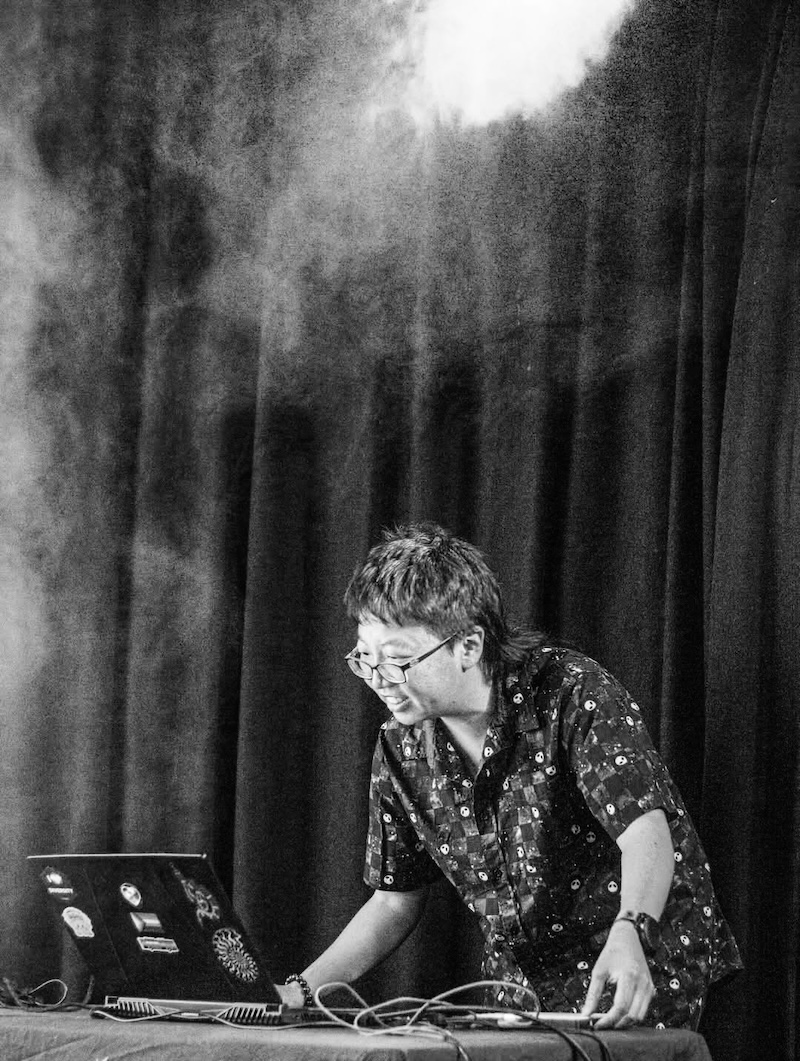
Where are you located? I was raised in, and currently live, work and play in Boorloo [Perth], on Whadjuk Noongar Boodja, part of the Noongar Nation [South-Western Australia]. My ancestral roots are in Hong Kong, where I spent the first two years of my life. I’ve travelled a lot over the years, but Boorloo is my home.
I currently live in the outer northern suburbs, with the beach in the west and a national park behind. I generally enjoy living here, although it can feel isolating because I’m far away from the city’s cultural hotspots. Living in Boorloo itself can also be quite isolating, as we are so far from the rest of Australia and the world, but we have an active, close-knit arts scene where everyone is so supportive of each other. I also think the isolation has given me the space to approach my music in novel ways.
What is your musical activity? At its core, my work is about exploring how I feel about something — and this something can be a theme, a place, or an idea. I list a few keywords that summarise my feelings, then I ask myself — how might I express these feelings through sound? I’m really interested in the intersections between history, place and self, and this interest ultimately led me to completing a PhD in Music Composition in 2023, via the Western Australian Academy of Performing Arts at Edith Cowan University.
The main foundation for my works are field recordings, for two reasons. Firstly, it’s a way of incorporating place into my works as a way of self-reflexive narrative. It’s interesting to explore what drove me a) to go to a place and record and b) why did I choose to record a certain sound? Secondly, using field recordings is a way of exploring how I could use existing sounds in a new way. I use a lot of audio manipulation in my works — delays, time-stretching, distortion, phasers, reverbs — because it’s fascinating how these tools can dramatically alter the character of a sound.
Time-stretching is one of my favourite techniques, particularly extreme time-stretching. I first came across the idea via English composer Joanna Baillie, who would do extensive elongations on small moments in time. She termed this process as, ‘freezing’, and it’s about exploring all the hidden rhythms and melodies of an instant, and allowing these events to become accessible to memory. In a similar vein, Canadian composer Barry Truax also uses elongation as a way to dive into the inner, hidden harmonics of a sound.
A lot of my work tends to be quite aurally dense — full of drones and sounds asynchronously layered, alongside unaltered field recordings. Much of my work is based around deep dives into a single field recording — taking moments of varying lengths, elongating and manipulating them, having them pan and weave around each other. It’s also quite exciting because I can never predict the final result.
I’d say my current practice started to coalesce around 2017. For about three years prior, I had been exploring how to translate my landscape photography to sound. The work I created had a bit of field recording, but it was largely sonification (aka the process of translating non-musical data into musical data) and beat and notes-based.
In terms of music in general — the very first instrument I learnt was the piano. I did classical piano until I was 16, until I discovered the cathartic power of smashing out distorted power chords on guitar. While I don’t directly employ my classical training in my current music, I find that it’s been a great foundation for structuring compositions and working out melody lines when I’m playing guitar. Speaking of which — the guitar has taken me to some interesting and unexpected places. I’ve been part of lots of local bands over the years, and also played guitar in a dance show (Cry Baby) and a theatre show (The Dirty Mother). It would’ve blown my angsty teen self away.
What is one good musical habit? I think it’s always good to ask yourself, “What am I trying to convey with this song/piece/sound?” Then always circle back to your original rationale with anything you do while in the midst of your work. Think about whether this technique/piece of equipment/instrument etc. will help you achieve your goal. Sometimes people get caught up in wanting to, or feeling like they need to, use something that’s new to them, simply because it’s there — and not because it’ll actually enhance the final work.
That’s not to say you shouldn’t experiment — on the contrary, experimentation is where you get some of the best ideas! — but it’s a) okay to try something and abandon the idea because it’s not the right moment and b) always think back to whether something is going to help you create your work’s narrative.
What are your online locations? If you want to find out more about my work and research, my website is a great place to start. Contains links to everything!: samarobryn.work/
I post about my latest updates and works-in-progress on my Instagram: instagram.com/samarobryn/
For my bands, you can check them out here:
Veils: instagram.com/veils.collective/
Phantom Island: instagram.com/phantomislandband/
What was a particularly meaningful Junto project? I first started joining the Junto in 2018, as a way to overcome my then writer’s block — so there’s quite the back catalogue! After some thought, I finally settled onto this one from December 2020 — [distant screaming], from Disquiet 0469.
2020 was a difficult and tumultuous year for me — it marked the advent of the pandemic where I was an essential worker as frontline hospital staff. I also dealt with lots of personal losses, and the cherry on top of this hellscape was dealing with a toxic workplace that sent my mental health into the shitter. It was very healing to record myself screaming and getting the frustrations of the year out of my system.
What characteristics does your music have today that it didn’t before you studied for and received your PhD? Good question! Sound-wise, I’d say the main characteristic is the emphasis of field recordings as the basis for creating work. Before my PhD, it was there in the background as a supporting element, while I was more interested in thinking how to convey data from photographs I’d taken in the field (in the form of HEX and histogram values) into sound. I had that interest because I was into landscape photography at the time, and wanted to find a way to combine my love of photography with my music practice. During the course of my research, I began to find this approach limiting, in two ways — firstly, I really wanted to find ways of incorporating place into my work, so that place becomes intertwined within, and secondly, my supervisors at the time really encouraged me to dive into the reasons why I was doing all of this in the first place.
So I began to use field recordings as my foundational source, because the association between HEX and histogram data from photographs of a place and the place itself is pretty loose, whereas field recordings are far more immediate and visceral. Also, I began to really appreciate field recordings as a way of documenting the perspective of the recordist, as well as documenting place itself at a particular moment. I found this quote by Hildegard Westerkamp quite powerful:
I use environmental sound and language as my instruments. I want to find the “voices” of a place or situation, voices that can speak most powerfully about a place/situation and about our experience in and with it. (Westerkamp, 1985)
My current work is more about the texture of the sound, and the conveying emotions rather than anything melodic. Any harmonies or rhythms are purely incidental. I also embrace aspects which might otherwise be seen as “audio flaws” — the sound of the wind hitting the microphone, handling noise, the sound of my footsteps as I traverse a terrain — because to me, that’s all about capturing the entirety of the soundscape at the time. I am part of the soundscape being recorded, in the same way that I am part of the work that arises from these recordings.
In terms of conceptual differences — I’ve gained a deeper appreciation of the complexities of the nature of place, and the relationship between place and artist. I’ve realised that my personal experiences very much matter in the creation of work, and that having that level of self-reflection can make a work quite powerful. I’m also more thoughtful about history and culture — both within myself and of the places I record. A lot of places have contested histories and arguably my personal history is similar. There’s things that have happened that people don’t want to acknowledge because it’s too difficult. All this probably reflects on why my music is always a bit unsettling with these undercurrents of darkness.
Do you use the sound of your voice frequently in your music, and if not, why? Actually, no — I use my voice very rarely. Although there’s been a few times where I’ve used my voice in a piece. I recorded a piece once where I sang with a recording of an Australian raven, slowed 8x. That was interesting because all these rich microtones really came out. Then, of course, there was the Dischoir prompt from Disquiet 0419.
I was really interested in using more of my voice though, at one point, mainly because I liked how personal voice can be. It’s emanating directly from you — how much more personal and intimate could you get? I imagined my work to be something akin to Scottish artist Susan Philipsz, who explores the psychological and sculptural aspects of place through sound, by primarily using recordings of herself singing reworked compositions acapella, which are then played through a PA. It’s interesting to hear how her voice interacts with place — i.e., how it bounces off buildings and the terrain, and how it interacts with the soundscape of the moment. Then I found myself moving in a decidedly non-musicality direction, so I let go of the idea of using my voice.
This is fun. It’s good you’re writing more of these profiles.