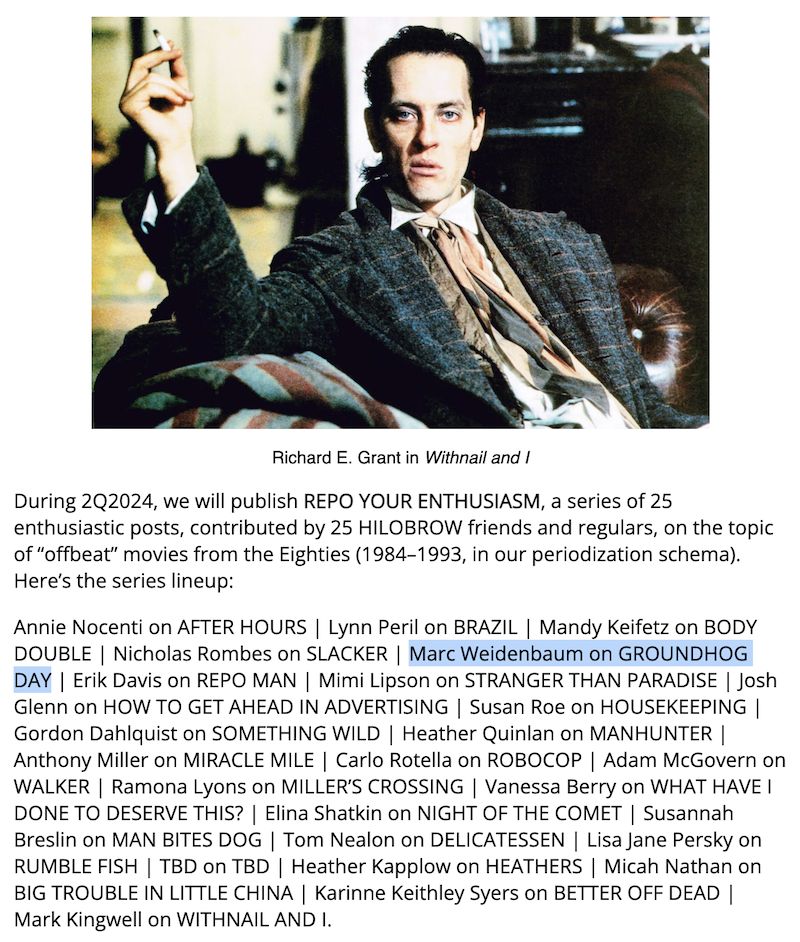
I’m excited to have a short piece on Groundhog Day, one of my favorite movies (and, perhaps just as key, one of my favorite stories), in this series alongside some friends and writers I admire. It’ll be rolling out on hilobrow.com over the next few months.
I do this manually at the end of each week: collating (and sometimes lightly editing) most of the recent little comments I’ve made on social media, which I think of as my public scratch pad. Some end up on Disquiet.com earlier, sometimes in expanded form. These days I mostly hang out on Mastodon (at post.lurk.org/@disquiet), and I’m also trying out a few others. I take weekends and evenings off social media.
▰ Having a newsletter about a specific topic is a virtuous circle. I process material that interests me in a way I wouldn’t otherwise. In turn the audience drawn to that material sends me additional items I might not have otherwise known about. Then I share some of those as well. Round and round.
Several times this week people sent me:
sentences from novels I’ve never read
references to scientific journals I didn’t know existed
summaries of podcasts I’ve not listened to
anecdotes from their own lives
Now I have another issue of the newsletter to prepare.
▰ When you share an album for review consideration, here is a mind-blowing and underutilized concept: put your bio and liner notes inside the ZIP archive along with the music and the album cover.
▰ Acting on my urge to say: social media is fine but if you’ve got a focus for your interests, do yourself a favor and start a blog, even if all you do is collect your social media posts there and sometimes expand on one or another of ’em. Blogs are like ecological sentinels, the bees of the internet.
▰ “If you would like to hold without music, please press star.”
*
▰ This is pretty great. Nonesuch has nicked the Criterion Closet idea, and on top of showing the musicians pull their favorites, it also has playlists with examples of the audio. Nicely done. Four so far: pianist Tigran Hamasyan, multi-instrumentalist/singer Vagabon, pianist Timo Andres, and guitarist Mary Halvorson.
▰ Folks popping up in the Google Drive spreadsheet for the current, three-part sequence of Disquiet Junto projects, looking for tracks to turn from solos into duets, which may later become trios
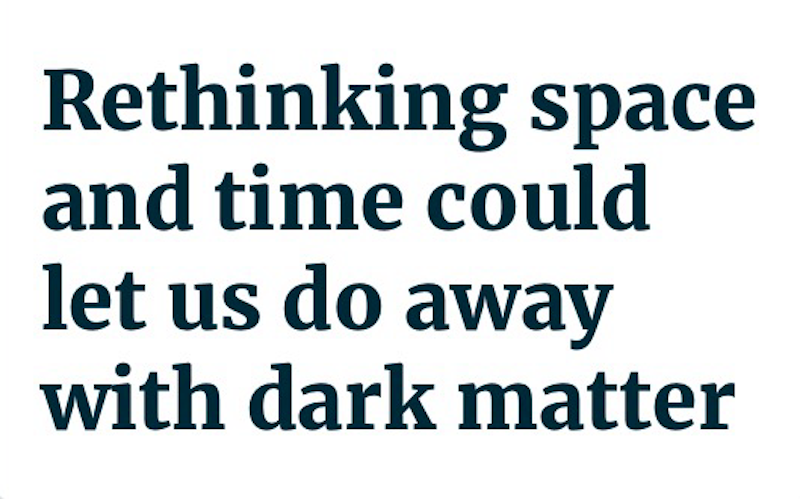
▰ I love New Scientist’s take on the advice column
▰ For the moment I’m going to assume that the seeming increase in quantity of music releases (gauged by my overstuffed email inbox) and the rise of generative AI tools is a coincidence (or even me seeing patterns that aren’t there), but the parallel is striking
▰ Happy to report I was considerably less brain-dead when it came to 7th chords in guitar class this week. Bonus for the moment when my teacher played a sequence of notes and I, instinctively, played it back — Close Encounters of the Third Kind style — as a form of communicating my semi-sentience.
▰ Finding myself following the twisting paths of cables in modular synth videos to confirm they’re real and not, like the gloopy fingers common to AI-generated imagery, a tell of hallucinogenic forgery
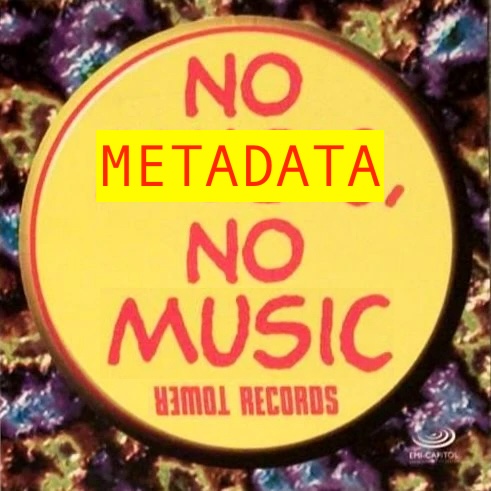
▰ No Metadata, No Music — take it from this former Tower Records employee
These sound-studies highlights of the week originally appeared in the March 19, 2024, issue of the Disquiet.com weekly email newsletter, This Week in Sound. This Week in Sound is the best way I’ve found to process material I come across. Your support provides resources and encouragement. Most issues are free. A weekly annotated ambient-music mixtape is for paid subscribers. Thanks.
▰ AID UPGRADE: October 17, 2022, marked an important turning point for hearing aids, when the FDA identified a new category of over-the-counter devices in an industry long held captive to prescriptions, the cost for which can be in the thousands of dollars (U.S.). The FDA’s landmark decision has led to new, cheaper, more widely available tools for consumers, as well as to upgrades of existing devices. A new major turning point may be arriving, with the rumored addition of hearing aid features in the upcoming iOS 18 release for Apple’s iPhones, as initially noted by Bloomberg’s Mark Gurman. As Chance Miller wrote for 9 to 5 Mac, the foundations of such a move have been in place for some time: “AirPods already offer a feature called Live Listen, which launched as part of iOS 12 in 2018. This feature essentially turns an iPhone into a directional microphone, transmitting the audio captured by that iPhone to AirPods in real time. … Apple also introduced a Conversation Boost capability to AirPods Pro in 2021, which boosts mic pickup from directly in front of you, to better hear someone talking to you. A study in 2022 showed that some of these existing AirPods Pro features already compare well to much more expensive dedicated devices.”
▰ SOUND ADVICE: “Researchers at Vanderbilt University Medical Center and McMaster University in Hamilton, Ontario, have found that making medical device alarms more musical can significantly reduce perceived annoyancewithout negatively impacting the ability of research participants to learn and remember the alarms. … Hospitals have a great many auditory alerts, with prior research indicating upward of 85% of alarms require no urgent clinical action. This overabundance of noise poses patient risks, with clinicians sometimes tuning out important alerts. Modifying timbre could mitigate excessive annoyance while keeping alarms informative, the study suggests.” (Thanks, Glenn Sogge!)
▰ MINE GAMES: “If you have an audiobook coming out,” writes Brent Underwood, author of the book Ghost Town Living: Mining for Purpose and Chasing Dreams at the Edge of Death Valley, “I encourage you to think of places to record it other than a nameless studio in a major city. Your publisher might not like this idea, but your listeners will.” Underwood recorded himself reading his audiobook in one of the mines he wrote about — 900 feet underground. “It took three full days to record the book. During breaks, I walked miles of mineshafts, reading parts of the book about the mines to myself as I walked. Which, back at the microphone, brought the stories to life in a way that would have been impossible anywhere else.” There’s also a video he shot of the experience. (Thanks, Mike Rhode!)
▰ PHONON HOME RUN: “A tiny, levitated bead is at the core of an unprecedentedly bright laser that shoots particles of sound instead of light. … Just as a ray of light is made up of many particles called photons, sound consists of particle-like chunks called phonons. For several decades, researchers have been creating ‘phonon lasers’ that output these particles in a narrow beam, similar to the way optical lasers emit photons.” Per New Scientist, researchers at Hunan Normal University in China have “enhanced the laser’s ‘brightness’ – the amount of power it delivered at each phonon frequency – tenfold, as well as making its beam tighter and helping it last longer.” Due to phonons moving with less disruption through liquids than do photons, “they could be more effective than conventional lasers for imaging watery tissues in biomedicine or in some deep-sea monitoring devices,” according to Hui Jing, a co-author of the research.
▰ GLOBE TROTTER: The Sphere in Las Vegas apparently isn’t just about the surround visuals: “It was an event that introduced Holoplot’s proprietary 3D audio-beam-forming and wave-field synthesis technology—which provides headphone-quality, personalized audio to every seat—to a literally and metaphorically massive stage,” per Fast Company. “That was just one of the several projects in the past year that have showcased the Berlin-based company’s impressive ability to manipulate sound to improve the experience of listening to music.”
▰ VOICES CARRY: MIT postdoc Nauman Dawalatabad talks about potential positive uses of the technology also credited with troubling deepfakes: “Beyond the realm of creativity, where voice conversion technologies enable unprecedented flexibility in entertainment and media, audio deepfakes hold transformative promise in health care and education sectors. My current ongoing work in the anonymization of patient and doctor voices in cognitive health-care interviews, for instance, facilitates the sharing of crucial medical data for research globally while ensuring privacy. Sharing this data among researchers fosters development in the areas of cognitive health care. The application of this technology in voice restoration represents a hope for individuals with speech impairments, for example, for ALS or dysarthric speech, enhancing communication abilities and quality of life.”
▰ QUICK NOTES: Havana ‘Nother Look: Research into the brains of those who reported suffering from so-called Havana Syndrome show “no clinical evidence for the mystery condition.” ▰ Hum a Few Bars: YouTube continues to roll out a feature that identifies songs when users hum them. ▰ Making Sense: Marjorie Van Halteren unpacks poetic work of artist Andy Slater originally published in McSweeney’s: “It satisfies the quest for an approach to audio disconnected from image-‘splaining slavishness to format,” she writes. “It’s completely untethered from a listener’s second guessing, yet utterly compelling.” I love this idea of “image-‘plaining.” ▰ Shriek of the Week: The latest is that of the nuthatch: “They whistle, and chitter, and whisper. But their loud ‘dweep dweep’ call is one of the easiest to latch on to.” ▰ SeaTrek: A scientific deep dive into how noise pollution impacts whale migration — also, there’s a Scientific American podcast episode about the “anatomical workings” behind whale song. ▰ Audi-phile: Aside from a steering wheel, there are no physical hand controls on the Audi Q6 e-tron car: “it’s touchscreen or talking only.”
“And if more than eight lines of awkward dialogue threaten irrevocable awkwardness, silences like the one now elapsing between M and me are an even greater peril. And I am a guy who knows how to measure silences. But whereas in music, a prolonged pause adds power and vividness to the refrain that follows it, pauses in conversation have the opposite effect, of debasing whatever comes next to the point that a perfectly witty riposte will be reduced to the verbal equivalent of a shrunken head, if too long a pause precedes it.”
That is from The Candy House, Jennifer Egan’s excellent sequel to her novel A Visit from the Goon Squad. The bit about how the speaker is “a guy who knows how to measure silences” is a call back to a bit in Goon Squad when the younger version of this character kept track of songs with pauses in them. Here, older and maybe a little wiser, that character finds additional (and painful) meaning in silence.
. . .
"I stood out in the road, by Brewster’s Yard,
and waited for a ghost, since ghosts were true,
a pair of Clydesdales pressing to the fence
to listen: rain; the music of the spheres;
or else, those calls I knew, from other worlds,
the wind across the sands, a whimbrel’s cry."
That is from one of two poems by John Burnside published in the March 21, 2024, edition of the London Review of Books. I didn’t know what a “whimbrel” was before I read this. I enjoyed the comprehension void before I filled it with a simple Google search, during which the word could have referred to anything at all. It’s nothing special, but I won’t say what a “whimbrel” is so you, too, can — if you also don’t know — take a pause before doing the search yourself.
. . .
“Out of the Zenith hi-fi shook crazy saxophone stuff from the Village. Freddie could have identified who was playing, and on what basement bebop nights he'd seen them, but whenever Carney heard those sounds he felt trapped in a room of lunatics.”
That is from the novel Harlem Shuffle by Colson Whitehead, whom I had not gotten around to reading until now. It’s a great book, and there’s a lot packed into those two sentences, key among the data: (1) the identification of the make of hi-fi relates the main character’s job as a furniture salesman, a form of employment that begins as background information but comes to serve as a filter for how he processes the world around him, and (2) the notion of jazz as being like something from “lunatics” is a marker of a cultural divide between that character, who is Black, and certain aspects of the culture in which he was raised. (I’ve been on a novel-reading tear. Harlem Shuffle was my eighth in 2024. Reading is a form of writing procrastination that sort of doubles as research.)