
These sound-studies highlights of the week originally appeared in the November 14, 2023, issue of the Disquiet.com weekly email newsletter, This Week in Sound. This Week in Sound is the best way I’ve found to process material I come across. Your support provides resources and encouragement. Most issues are free. A weekly annotated ambient-music mixtape is for paid subscribers. Thanks.
▰ WHOLE LAVA LOVE: The magazine Quanta profiled Jackie Caplan-Auerbach, a volcanologist in the geology department at Western Washington University: “I study the earthquakes that take place in volcanic systems, which I describe as the songs of the volcano. I’ve always loved sound. And I’ve always loved resonance and standing waves. A classic example of standing waves is when you take a beer and blow over the top of the bottle, and it hums — or it’s when you run your finger on the top of your wineglass, which is more to my boozy tastes, and the glass sings. Everything has a hum that is associated with its shape and its material properties, and volcanoes are no different. Their conduits have hums.”
▰ DANCE ON: Fascinating article on the potential for voice description in dance performances: “Since emerging as a formal access tool about 45 years ago, audio description in the United States has become increasingly available across the arts, bolstered by broader movements for accessibility and disability rights. But while you’re now likely to find it in movie theaters, on streaming services and at Broadway shows, it’s less common in dance. Developed for dialogue-driven media like theater and film, the conventions of traditional audio description don’t necessarily translate to a largely nonverbal form of expression. Which is perhaps one reason that dance artists, and especially disabled dance artists, are devising their own alternatives.” The article also profiles dancer Krishna Washburn and choreographer Heather Shaw, who co-directed a new film, Telephone, “exploring the creative possibilities of audio description for dance.”
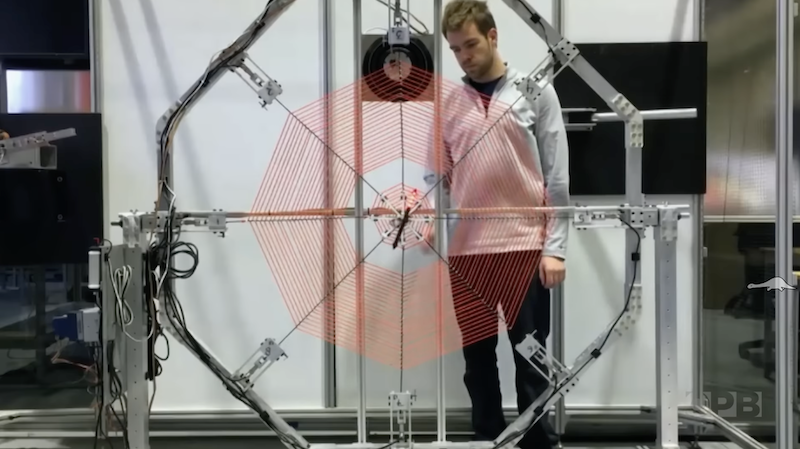
▰ SPIDERS, MAN: Attempts to understand how spiders benefit from a web’s vibrations yielded a musical instrument, thanks to the research of scientists Ross Hatton (“Spiders that weave webs often have very poor eyesight, and so they understand the world through the vibrations in their webs”), Damian Elias, and Andrew Otto. The device shown here resulted from Hatton wanting “something tangible he could use to translate the abstract language of engineering to a wider audience.” Check out the video and article for more detail. (Thanks, Rod Stasick!)
▰ FAKE OUT: There are tools being developed to help ward off AI, such as AntiFake, which focuses on audio content: “AntiFake scrambles the audio signalso that it confuses the AI model. The modified track still sounds normal to the human ear, but it sounds messed up to the system, making it hard for it to create a clean-sounding voice clone.” The tool was developed by Ning Zhang, an assistant professor of computer science and engineering at Washington University in St. Louis.
▰ BROACH THE TOPIC: A new phone-less phone, a wearable gadget called the Ai Pin, has gotten a lot of coverage lately. Because it does away with the idea of holding a phone, it depends a lot on the sounds that the user experiences (what’s known as “UX”). This bit is from an overview by Erin Griffith and Tripp Mickle in the New York Times (gift link):
A haunting whoosh filled the room, and two dozen Humane employees, seated around a long white table, carefully concentrated on the sound. It was just before the Ai Pin’s release, and they were evaluating its rings and beeps. The pin’s “personic” speaker (a company portmanteau of “personal” and “sonic”) is critical, since many of its features rely on verbal and audio cues.
Mr. Chaudhri praised the “assuredness” of one chirp noise and Ms. Bongiorno complimented the “more physical” sounds for the pin’s laser. “It feels like you’re actually holding the light,” she marveled.
Less assuring: That whoosh, which plays when sending a text message. “It feels ominous,” Ms. Bongiorno said. Others around the table said it sounded like a ghost, or as if you made a mistake, almost. Someone thought it was a Halloween joke.
Ms. Bongiorno wanted the sound for sending a text to feel as satisfying as the trash-can sound on one of Apple’s older operating systems. “Like ‘thunk,’” she said.
WORD PLAY: Tongue twisters could become ways to check sobriety: “Whether it is the story of Peter Piper and his pickled peppers or a woman selling sea shells on the seashore, tongue-twisters tackled when sober can sound rather different after a drink. Now researchers believe such changes, in particular those relating to pitch and frequency, could be used to alert people to their level of intoxication. Dr Brian Suffoletto, the first author of a study from Stanford University, said the approach has a number of potential future applications. ‘The most obvious one is as a form of ignition lock on cars which would not allow someone to start their car unless they could pass the “voice challenge” which could be used in certain high-risk workplaces like school bus driver or heavy machine operator to ensure public safety.’”
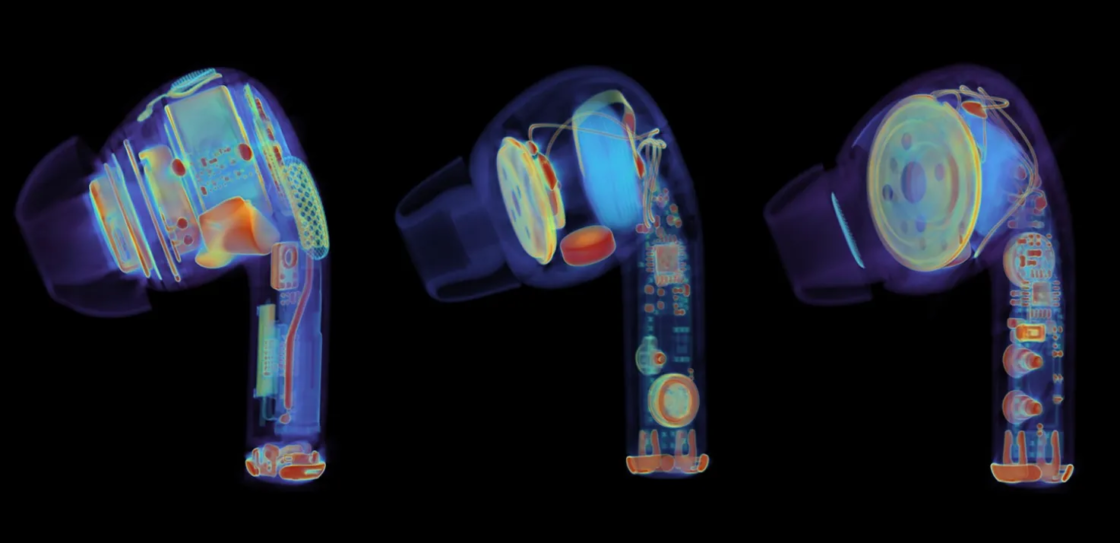
▰ QUICK NOTES: Bud Light: X-rays (see above) show the relative density between actual Apple AirPods and knockoffs. ▰ Oz Noises: A popular “Slip Slop Slap” ad campaign about skin cancer has been added to the National Film and Sound Archive’s Sounds of Australia registry for 2023. ▰ Hot Lips: A faked recording of London Mayor Sadiq Khan “dismissing the importance of Armistice Day events this weekend is circulating among extreme right groups, prompting a police investigation.” ▰ Hot and Heavy: Low-flying helicopters in Queensland, Australia, are arousing the local reptile fauna — “they’re like Viagra for crocodiles.” (Thanks, Matthew Nix!) ▰ Noise Police: “This year is supposed to be quieter. Neighbors are still on edge” — neighbors of a Providence, RI, police shooting range complain about noise. ▰ Good Grief: The term “grief tech” is being applied to tools that can, by employing “voice cloning technology” and other resources, simulate the dead in service of the mournful living. ▰ Hydro Phone: “Divers could soon communicate underwater over large distances by sending radio messages along the water’s surface, getting around the fact that radio frequencies can’t travel far through water.”