The Rise of “Soundscape”

An additional annotation to a piece I published earlier this year

When I was working, earlier this year, on my article for JSTOR Daily about the origins of the modern usage of the word “soundscape,” statistics briefly reared its characteristically ambiguous head. In the piece I wrote, “The word soundscape was essentially a linguistic nonentity until the late 1960s. Then it took off, steadily at first, soon after astronomically.” The data I cited came by way of the Google Books Ngram, which helpfully charts relative usage of words over time. However, even after an evident and sharp increase of frequency in recent decades, the word “soundscape” still ranked at .0000367606 percent — which is to say, exceedingly small. 
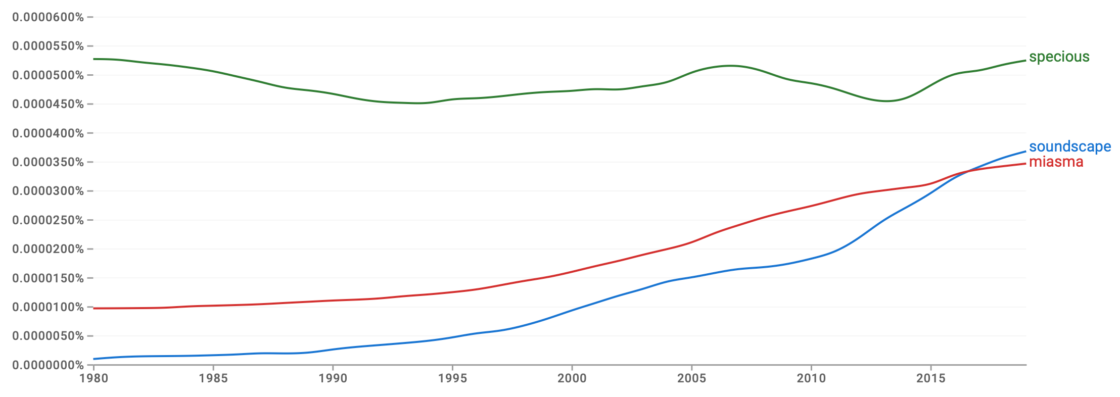
Or seemingly so. Of course, it’s all relative. There are so many words in the English language (Webster’s Third New International Dictionary, as of 1993, included almost half a million) that ultimately most of them have a tiny occurrence rate. It’s the rate of usage in the context of the consistency of adoption — that is, of increasing use — that matters here. For example, think of words like “specious” or “miasma.” Those two words and “soundscape” all have relatively equivalent usage today (per the above graph), but when you look over time, “specious” has had an absolutely massive drop since the early 1800s, whereas “miasma” has had a fairly consistent rate across the past two centuries. In contrast, over the last 50 years, “soundscape” went from essentially zero usage to equivalent to those two other words. This rise of “soundscape” from near-zero is a measure of a word that would have been almost meaningless in conversation before, say, John F. Kennedy was assassinated, and is now easily understood in everyday use.
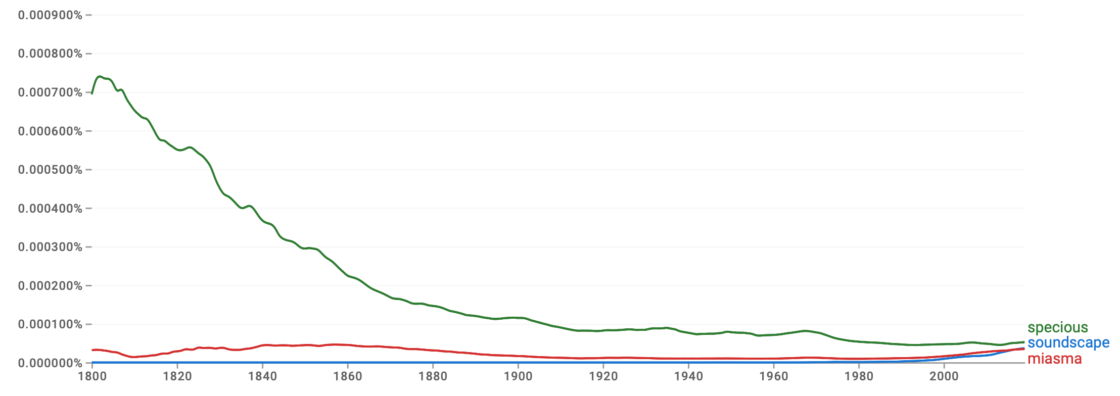
By the way, the data shown in the above graphs is now outdated. As it happens, right after my soundscape story was published by JSTOR, the Google Ngram database was updated (to 2022, from 2019), resulting in a notable and questionable drop-off for all three words of the words I cite above as examples:
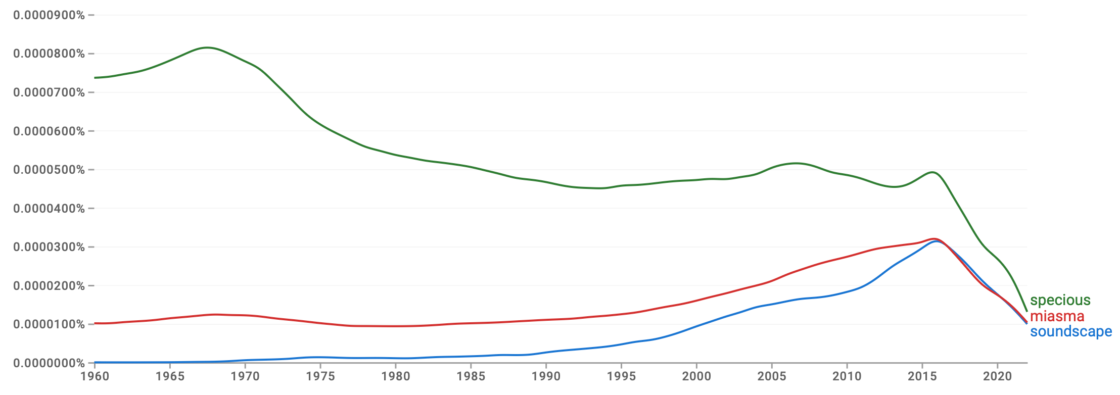
The visible steep decline strikes me as odd, and makes me wonder what words were on the rise, or more broadly what circumstances changed such as to cause such a change across the board.

Before finishing this summary, I did a quick search of my email account, to take stock of how the word “soundscape” is being used today. There was an example that described a real-time descriptive aid for the blind as contributing to their personal soundscape. There were multiple references to the soundscapes produced by electronic musicians, sometimes in the sense of an immersive, and thus quasi-environmental, context, and in other cases in the sense of scene-setting for specifically alien and otherwise unusual spaces. Sometimes the word was associated with a separate genre term, such a “neoclassical” or “Afro House,” that seems contrary to the concept of a soundscape, but that takes on a new meaning in combination. A museum exhibit with multiple genres of music accompanying visual art was described as having an “interdependent soundscape.” And a piece of music-making software described itself as useful in the crafting of soundscapes. 

And those examples were just from emails I received during the past 36 hours. The word “soundscape” has evolved and its meaning has expanded as it has emerged into popular use and gained currency over the past half century or so, and it will continue to.

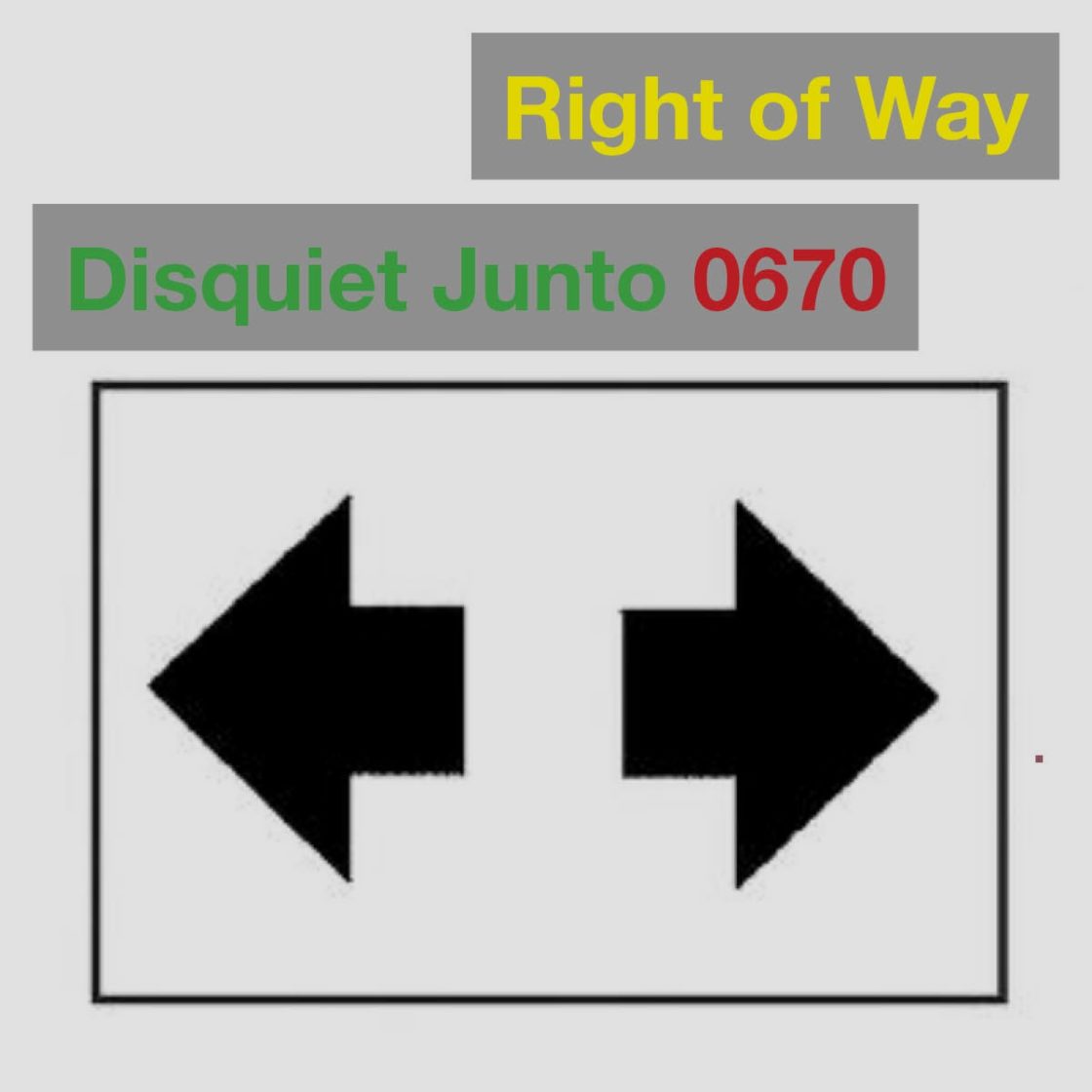
Disquiet Junto Project 0670: Right of Way

The Assignment: Music for turn signals.

Each Thursday in the Disquiet Junto music community, a new compositional challenge is set before the group’s members, who then have five days to record and upload a track in response to the project instructions.

Membership in the Junto is open: just join and participate. (A SoundCloud account is helpful but not required.) There’s no pressure to do every project. The Junto is weekly so that you know it’s there, every Thursday through Monday, when your time and interest align.

Tracks are added to the SoundCloud playlist for the duration of the project. Additional (non-SoundCloud) tracks also generally appear in the lllllll.co discussion thread.

Disquiet Junto Project 0670: Right of Way
The Assignment: Music for turn signals.

Step 1: Record the sound of a car’s turn signal (or, alternately, use a prerecorded one, for example at freesound.org).

Step 2: Improvise on top of the recording of the turn signal with as many or few layers of additional sound as you like, emphasizing rhythm (versus melody or harmony), and retain the original turn signal sound, so it is still audible for most if not all of your finished track

Background: This project is something of a callback to the 11th Disquiet Junto project, way back at the end of March 2012.

Tasks Upon Completion:

Label: Include “disquiet0670” (no spaces/quotes) in the name of your track.

Upload: Post your track to a public account (SoundCloud preferred but by no means required). It’s best to focus on one track, but if you post more than one, clarify which is the “main” rendition.

Share: Post your track and a description/explanation at https://llllllll.co/t/disquiet-junto-project-0670-right-of-way/

Discuss: Listen to and comment on the other tracks.

Additional Details:

Length: The length is up to you. How long a wait at the light is it?

Deadline: Monday, November 4, 2024, 11:59pm (that is: just before midnight) wherever you are.

About: https://disquiet.com/junto/

Newsletter: https://juntoletter.disquiet.com/

License: It’s preferred (but not required) to set your track as downloadable and allowing for attributed remixing (i.e., an attribution Creative Commons license).

Please Include When Posting Your Track:

More on the 670th weekly Disquiet Junto project, Right of Way — The Assignment: Music for turn signals — at https://disquiet.com/0670/

This Week in Sound: Shame Has a New Ringtone

A lightly annotated clipping service

These sound-studies highlights of the week originally appeared in the October 29, 2024, issue of the Disquiet.com weekly email newsletter, This Week in Sound. This Week in Sound is the best way I’ve found to process material I come across. Your support provides resources and encouragement. Most issues are free. A weekly annotated ambient-music mixtape is for paid subscribers. Thanks.

▰ NO BACKSIES: Shame has a new ringtone. At the American Airlines terminal at San Francisco International Airport, “a warning sound [is] triggered when passengers attempt to board outside their assigned group. When a boarding pass is scanned, an ‘audible alert’ will notify the gate agent, displaying the passenger’s correct group number.”

▰ DUTY CALLS: “The audio team at lead dev studio Treyarch is enhancing the 3D soundscape to new levels, allowing players to better sense the location, speed, and direction of nearby activity, helping them to respond more effectively and become even more immersed in the world,” writes Dean Takahashi. I’m intrigued by this level of sound design detail in Call of Duty: Black Ops 6, especially as it correlates with being a meaningful component of gameplay, and not just of story, design, and setting. Says audio engineer audio engineer William Cornell: “We’ve been working closely with the Project Acoustics team to simulate the way that sound waves bounce and propagate through the world down to the smallest details like what materials are made of, the size and shape of the room, and what path the sound has to take to get from where it happened to where you’re hearing it.”

▰ CREW CUT: The year-old company Crewless Marine, based in Rhode Island, expands sea research: “It’s important to understand our oceans, and understanding undersea acoustics is really a key part of that. The scope of that problem is something that crewed or manned platforms can’t handle alone — the ocean is too big. With the emergence of uncrewed platforms — in surface vehicles, undersea vehicles, and stationary platforms — we have an opportunity to put acoustic sensors on these vehicles to get a sense of the ocean and get a better understanding of what manmade and biological sounds are doing to the marine environment.”

▰ FLY BY: A potential model for how airports manage community concerns about noise will debut at the website of Tweed New Haven Regional Airport, reportedly to “give airport officials and airport neighbors the opportunity to measure where a plane is, or was, and how loud it was at any given time, from any spot on the map.” The website will be powered by tools developed by the Australian company Envirosuite. Per an article in the New Haven Register, this offering is beyond the capabilities of familiar plane-tracking services such as flightaware.com and flightradar24.com.

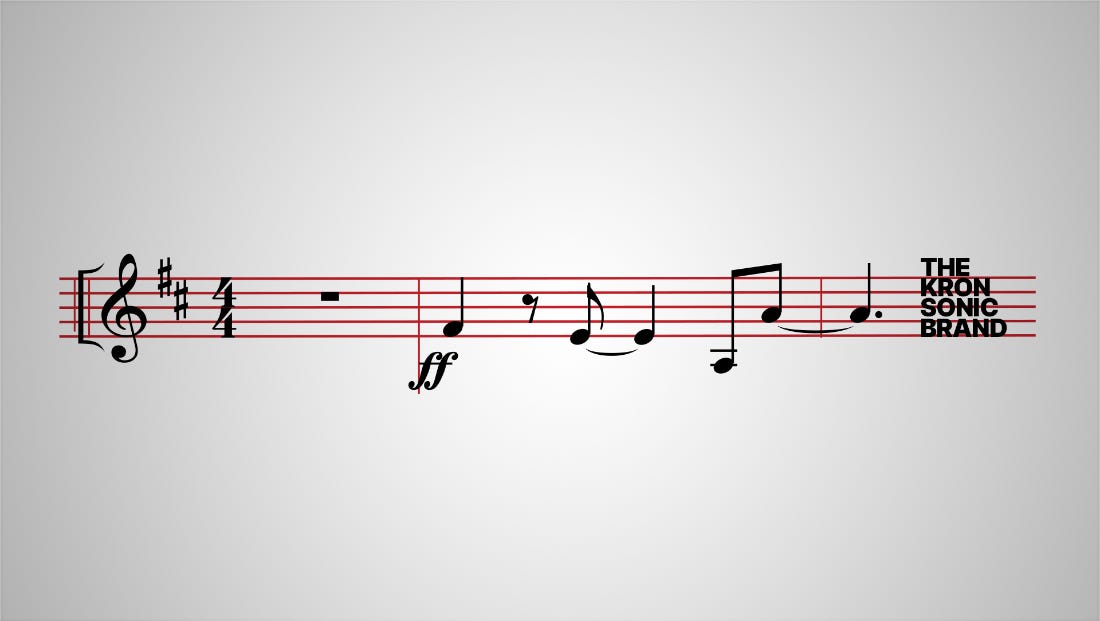
▰ PALETTE CLEANSER: A brief summary on the four-note theme of the San Francisco television station KRON on the occasion of the station’s 75th anniversary: “The four-note sonic brand originated during KRON’s 50th anniversary when composer Michael Boyd created the station’s signature sound, debuting in 1995 and in use until 2001 and again from 2006 until 2020. The new orchestration builds upon this foundation while expanding the musical palette.” Says an engineer at the firm that refreshed the sound logo: “If you’re at home and preparing dinner, and you hear that logo, you know it’s time for the news.” (Bonus points for the idea that one “hears” a logo.) 

▰ GRACE NOTES: Hear, Say: The word “earwitness” was wordsmith.org’s word of the day this week, and apparently, if I’m reading correctly, it dates back to 1539? (Thanks, Mike Rhode!) ▰ Unbound: “Audiobooks have surpassed e-book sales for August and the first eight months of the year for the first time.” ▰ Sales Call:SoundHound CEO and cofounder Keyvan Mohajer talks about helping power the “voice-commerce ecosystem,” which to a good degree means shopping by talking. ▰ A Good Caws: Movies get birds wrong a lot, and “rarely sound, look, or behave like they should.” One bird in one movie in particular apparently has disturbed birders for a quarter century: Charlie’s Angels (2000) may contain “the wrongest bird in the history of cinema.” ▰ Lab Report: Good Morning America got to visit Apple’s audio lab. ▰ Pod Saves: The podcast of The Wirecutter piggybacked on the hearing tools in Apple’s AirPods for a full episode of gadget commentary and personal anecdotes. (Thanks, Rich Pettus!) ▰ Road Rave: Local coverage, from Great Yarmouth, Norfolk, England, on the installation of so-called sound cameras, which capture images of loud vehicles. ▰ Orchestral Manoeuvres: The Los Angeles Philharmonic has announced a half-day marathon on November 16: “This year’s programming focuses on field recordings, combining a series of performances with panels engaging composers, acoustic ecologists, field recordists and climate scientists on the intersections of art, nature and technology.” ▰ Ads Up: This isn’t going to be a big surprise, but research suggests that, when it comes to advertising on smart services like Alexa and Siri, “giving users more sense of control through a combination of methods reduced negative reactions to advertising messages.”

On the Line

Some favorite recent phrases

▰ Like a Glove:

The chanters give the puppets voice with intense and compressed screeches, gasps, and tears of terror, shame, and remorse — but they themselves slip from our awareness. Their disembodied voices operate like a soundtrack, synchronized with puppet gesture and emotion: a sinking chest, the kink of an elbow, a feverish shake.

That is Jennifer Homans in The New Yorker describing the art of Japanese puppetry, focusing here on the individuals who give voice to the dolls.

. . .

▰ Spaced Out:

... there are mysteries below our sky:
the whale song, the songbird singing
its call in the bough of a wind-shaken tree.

That is Ada Limón, U.S. Poet Laureate, in her brief poem, “In Praise of Mystery: A Poem for Europa,” which could almost be read to suggest there’s enough on Earth worth wondering at, that the skies are a distraction. Almost.

. . .

▰ Room Tone:

In this case, the great volume of air seemed charged and activated, but often I felt that the elegant airiness operated like a buffer and that the work could use some coaxing, that some itinerary or timeline or thematic might have been laid out.

That is critic Alex Kitnick, writing at 4columns.org, about a retrospective of the art of Christine Kozlov currently exhibited at the American Academy of Arts and Letters in Manhattan. The further context of this description is Kozlov’s Information: No Theory (1970), in Kitnick’s words: “a recording system that commits a room’s sound to magnetic tape only to immediately erase it.”