
About Last Night
An ongoing series cross-posted from instagram.com/dsqt
I do this manually at the end of each week: collating most of the recent little comments I’ve made on social media, which I think of as my public scratch pad. I also find knowing I will revisit my posts to be a positive and mellowing influence on my social media activity. I mostly hang out on Mastodon (at post.lurk.org/@disquiet), and I’m also trying out a few others. And I generally take weekends off social media.
▰ I was revisiting some of the past year’s albums on labels I follow, and I was struck how several 2024 Warp releases, such as Bibio’s “Llyn Peris” and Seefeel’s “Hooked Paw,” could easily be mistaken for lost Selected Ambient Works Volume II tracks.
▰ Remember: the proper way to listen to audio files is to download the WAVs, check the metadata, add them to your player, get frustrated that the player has subdivided them into multiple albums, delete the WAV files, and then download the MP3s and then listen to those.
▰ Getting an email alert about an upcoming aerial drone safety inspection of your neighborhood’s power lines and roofs is like being in an early-years Heinlein novel
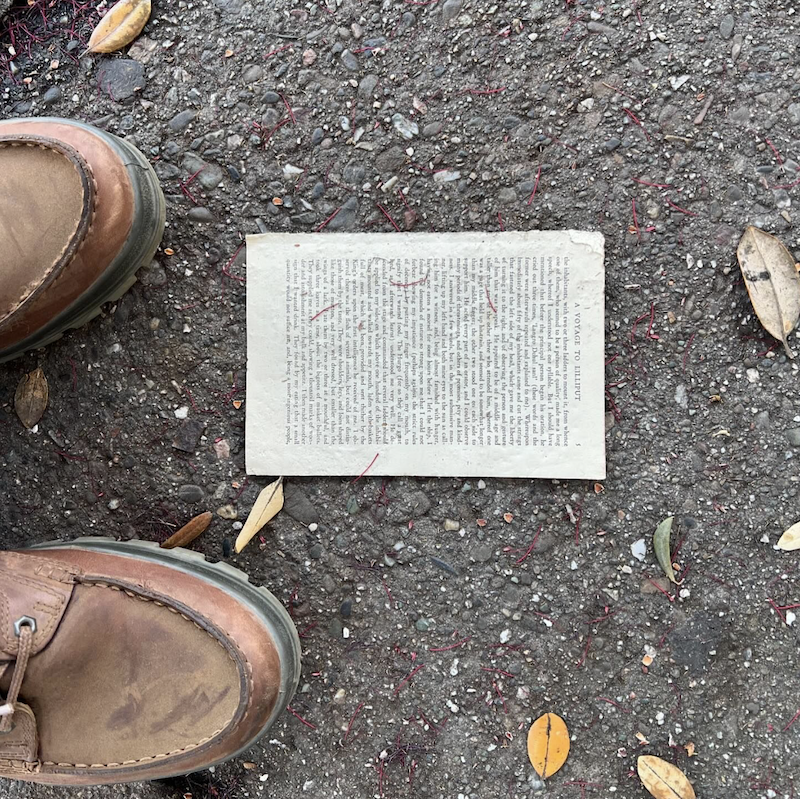
▰ I sort of literally wandered into Lilliput:
▰ I appreciate that the home security camera alert says “person seen” every time someone is noticed, like it isn’t doing surveillance and instead it’s taking the time and doing the work necessary to recognize people as individuals for their thoughts, feelings, and needs.
▰ I don’t think I understood in 1999, newly arrived in New Orleans and beginning to telecommute for the first time, that the Niels Diffrient Freedom chair I bought was a totally new thing. Mine lasted until about 6 months ago, and I’m seated on its replacement now. Happy anniversary to the original.
When I was working, earlier this year, on my article for JSTOR Daily about the origins of the modern usage of the word “soundscape,” statistics briefly reared its characteristically ambiguous head. In the piece I wrote, “The word soundscape was essentially a linguistic nonentity until the late 1960s. Then it took off, steadily at first, soon after astronomically.” The data I cited came by way of the Google Books Ngram, which helpfully charts relative usage of words over time. However, even after an evident and sharp increase of frequency in recent decades, the word “soundscape” still ranked at .0000367606 percent — which is to say, exceedingly small.
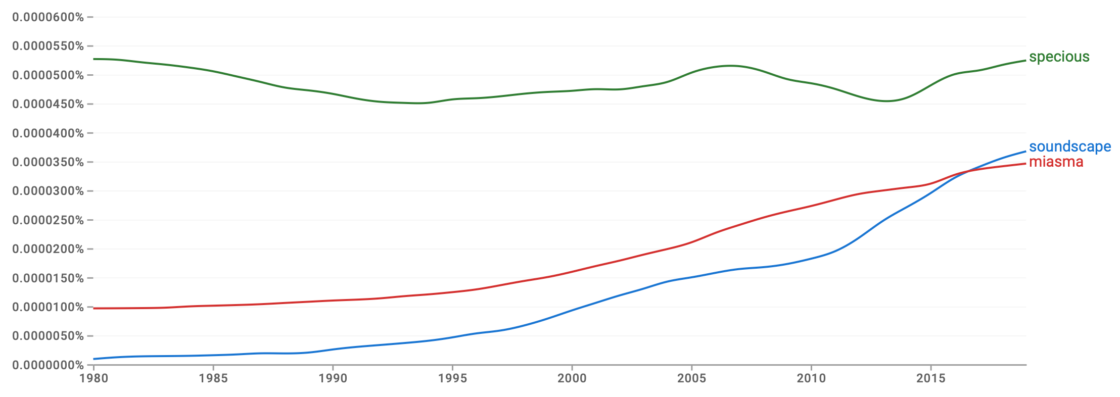
Or seemingly so. Of course, it’s all relative. There are so many words in the English language (Webster’s Third New International Dictionary, as of 1993, included almost half a million) that ultimately most of them have a tiny occurrence rate. It’s the rate of usage in the context of the consistency of adoption — that is, of increasing use — that matters here. For example, think of words like “specious” or “miasma.” Those two words and “soundscape” all have relatively equivalent usage today (per the above graph), but when you look over time, “specious” has had an absolutely massive drop since the early 1800s, whereas “miasma” has had a fairly consistent rate across the past two centuries. In contrast, over the last 50 years, “soundscape” went from essentially zero usage to equivalent to those two other words. This rise of “soundscape” from near-zero is a measure of a word that would have been almost meaningless in conversation before, say, John F. Kennedy was assassinated, and is now easily understood in everyday use.
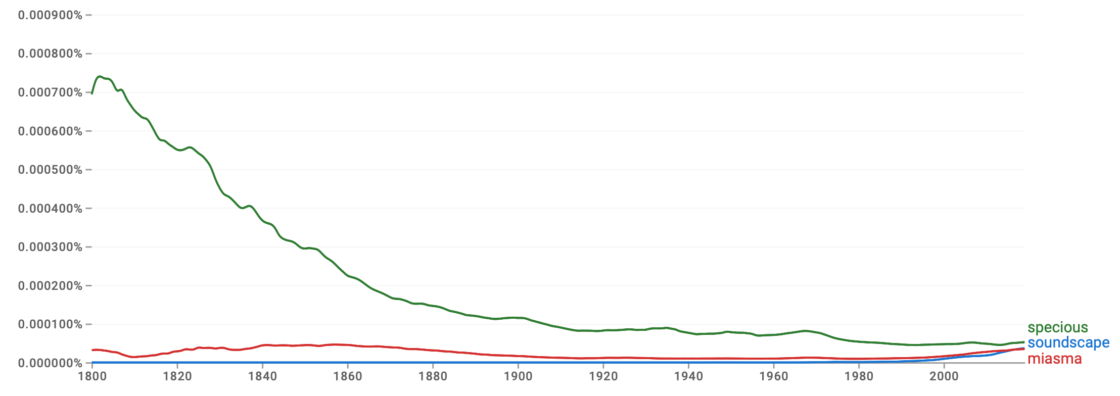
By the way, the data shown in the above graphs is now outdated. As it happens, right after my soundscape story was published by JSTOR, the Google Ngram database was updated (to 2022, from 2019), resulting in a notable and questionable drop-off for all three words of the words I cite above as examples:
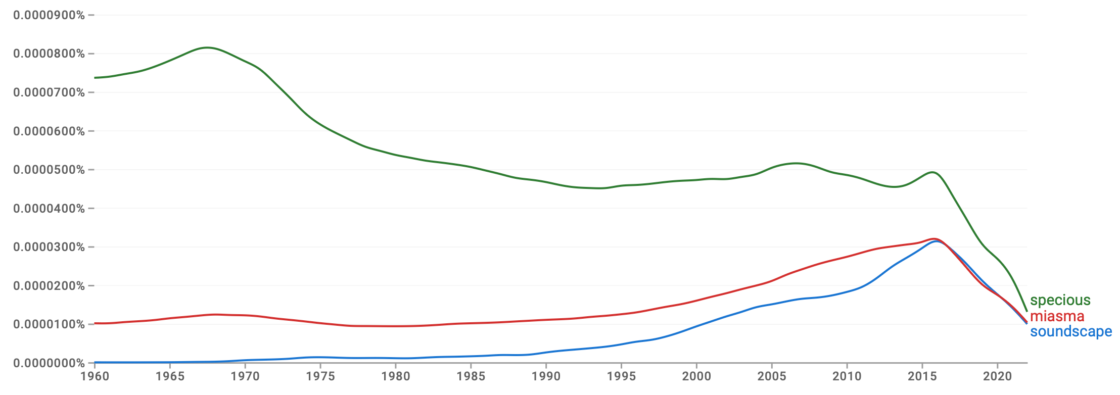
The visible steep decline strikes me as odd, and makes me wonder what words were on the rise, or more broadly what circumstances changed such as to cause such a change across the board.
Before finishing this summary, I did a quick search of my email account, to take stock of how the word “soundscape” is being used today. There was an example that described a real-time descriptive aid for the blind as contributing to their personal soundscape. There were multiple references to the soundscapes produced by electronic musicians, sometimes in the sense of an immersive, and thus quasi-environmental, context, and in other cases in the sense of scene-setting for specifically alien and otherwise unusual spaces. Sometimes the word was associated with a separate genre term, such a “neoclassical” or “Afro House,” that seems contrary to the concept of a soundscape, but that takes on a new meaning in combination. A museum exhibit with multiple genres of music accompanying visual art was described as having an “interdependent soundscape.” And a piece of music-making software described itself as useful in the crafting of soundscapes.
And those examples were just from emails I received during the past 36 hours. The word “soundscape” has evolved and its meaning has expanded as it has emerged into popular use and gained currency over the past half century or so, and it will continue to.
Halloween sound studies content
Each Thursday in the Disquiet Junto music community, a new compositional challenge is set before the group’s members, who then have five days to record and upload a track in response to the project instructions.
Membership in the Junto is open: just join and participate. (A SoundCloud account is helpful but not required.) There’s no pressure to do every project. The Junto is weekly so that you know it’s there, every Thursday through Monday, when your time and interest align.
Tracks are added to the SoundCloud playlist for the duration of the project. Additional (non-SoundCloud) tracks also generally appear in the lllllll.co discussion thread.
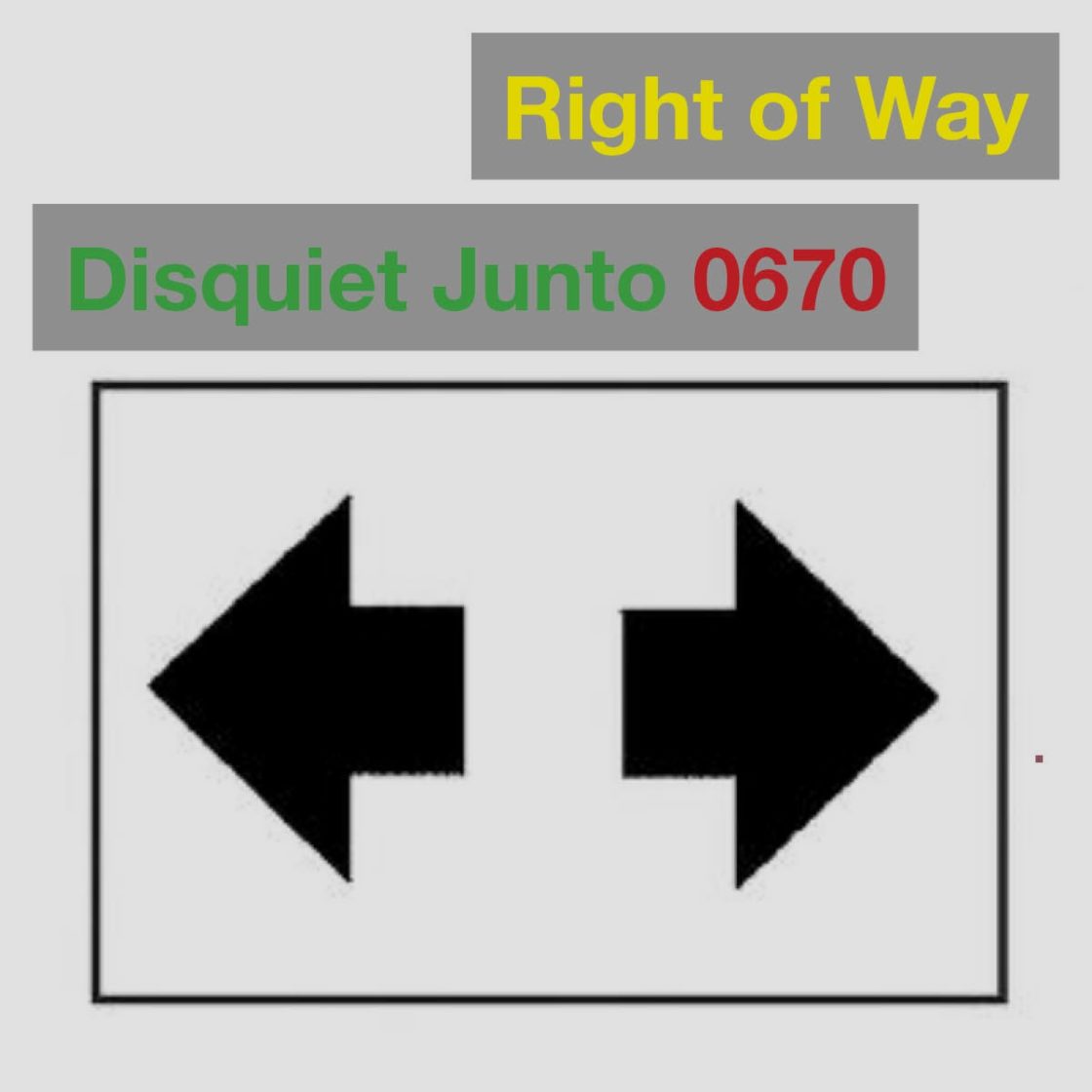
Disquiet Junto Project 0670: Right of Way
The Assignment: Music for turn signals.
Step 1: Record the sound of a car’s turn signal (or, alternately, use a prerecorded one, for example at freesound.org).
Step 2: Improvise on top of the recording of the turn signal with as many or few layers of additional sound as you like, emphasizing rhythm (versus melody or harmony), and retain the original turn signal sound, so it is still audible for most if not all of your finished track
Background: This project is something of a callback to the 11th Disquiet Junto project, way back at the end of March 2012.
Tasks Upon Completion:
Label: Include “disquiet0670” (no spaces/quotes) in the name of your track.
Upload: Post your track to a public account (SoundCloud preferred but by no means required). It’s best to focus on one track, but if you post more than one, clarify which is the “main” rendition.
Share: Post your track and a description/explanation at https://llllllll.co/t/disquiet-junto-project-0670-right-of-way/
Discuss: Listen to and comment on the other tracks.
Additional Details:
Length: The length is up to you. How long a wait at the light is it?
Deadline: Monday, November 4, 2024, 11:59pm (that is: just before midnight) wherever you are.
About: https://disquiet.com/junto/
Newsletter: https://juntoletter.disquiet.com/
License: It’s preferred (but not required) to set your track as downloadable and allowing for attributed remixing (i.e., an attribution Creative Commons license).
Please Include When Posting Your Track:
More on the 670th weekly Disquiet Junto project, Right of Way — The Assignment: Music for turn signals — at https://disquiet.com/0670/