
These sound-studies highlights of the week originally appeared in the June 7, 2024, issue of the Disquiet.com weekly email newsletter, This Week in Sound. This Week in Sound is the best way I’ve found to process material I come across. Your support provides resources and encouragement. Most issues are free. A weekly annotated ambient-music mixtape is for paid subscribers. Thanks.
▰ 1. LOUD FOOD
The impact and mitigation of restaurant noise
The Washington Post (gift link) has an excellent, lengthy interactive/multimedia article on the role of sound in restaurants, with an emphasis on the impact and mitigation of noise. Some key takeaways:
- “Noise was the most cited complaint in Zagat’s last Dining Trends Survey in 2018.”
- “the average noise level in restaurants may not be shooting up”
- “Some acousticians believe we simply became used to quieter surroundingsduring the pandemic, which could make us more aware of loud environments”
- “Experts are advocating for standards that would not only alleviate customer complaints, but also protect the health of patrons and staff members.”
- “a vibe that’s either kind of industrial or cool” may explain how modern restaurant design has contributed to the noise issue
- “Alcohol blunts our hearing,” which may explain “why intoxicated individuals talk louder”
- “People with autism spectrum disorder have both a higher sensitivity to noise and difficulty in filtering background noise”
- Hearing difficulty differs from hearing loss: “Age also plays a role in cognitive processing, with older people finding it more difficult to switch attention from one speaker to another”
- “sound treatment is about 2 to 3 percent of a new venue’s total building costs”
The article also covers SoundPrint, an app (iOS, Android) I’ve mentioned previously: “The app’s developer, Greg Scott, has been looking at data collected from about 14,000 active monthly users from more than 6,000 restaurants during the past four years, and he’s optimistic venues are not getting louder. According to Scott’s data, the average decibel readings in restaurants have been below 77 … for the past two years.” (Thanks, Mike Rhode!)
▰ 2. TALK (SORT OF) LIKE THE ANIMLAS
A classroom exercise on human/chimpanzee distinctions
The Journal of the Acoustical Society of America has a piece (its title is, in part, “What’s special about human speech?”) introducing differences between humans and chimpanzees, in the process exploring why it may be that humans have speech and chimpanzees do not: “For example, modern humans are unique among primates in having lost the vocal membranes of the larynx during human evolution.” The numerous graphics in the article show differentiations between how people speak alongside data on a “home-raised” and “speech-trained” chimpanzee, named Viki. This example shows the relative clarity of a human speaking the word “cup”:
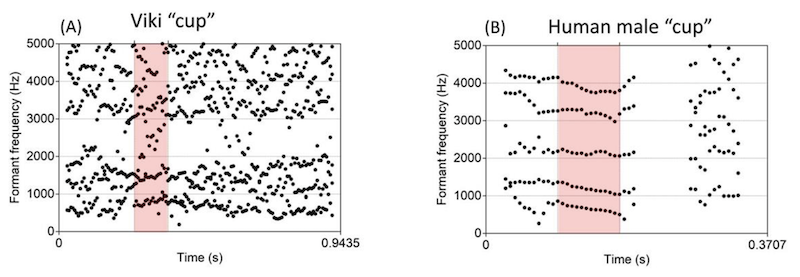
The article is by William P. Shofner, Associate Professor of Speech, Language and Hearing Sciences at Indiana University Bloomington. Shofner details an exercise from a course he has taught since 2021 that “provides students with important insights into the anatomical differences between humans and chimpanzees related to vocal production.” It covers aspects of chimpanzee vocalization focused on the mouth and larynx, and also notes genetic matters and neural circuitry. While scientific, certainly, it’s not difficult to follow.
▰ 3. CAGE FOR KIDS
A splendid new children’s book
Nothing: John Cage and 4’33” is the title of a new book for kids about the composer John Cage and his most famous work. It was written by Nicholas Day and illustrated by Chris Raschka and came out in April from Neal Porter Books. Said Day in an interview with Publishers Weekly: “I think Cage is kind of the most open — especially late Cage — and, to use the word joyful, open-spirited of a composer. And that’s part of why 4’33” works so well as a question for children to start with, right? Because it’s this thing that can feel alienating to people who have had more contact with the world, but if your experience with the world is still fresh, the questions that 4’33” asks seem intuitive and perfectly natural.”
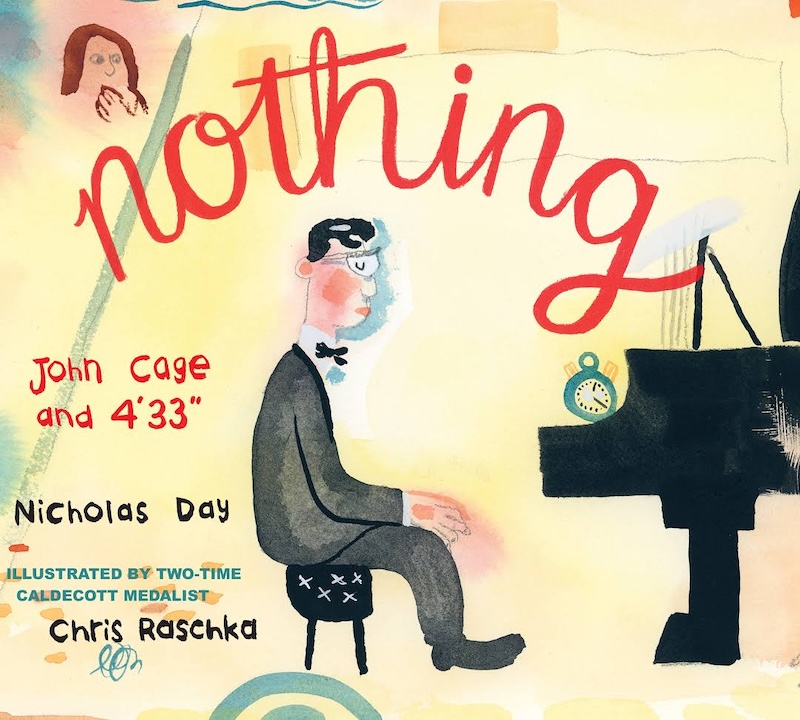
Reactions to the book have been overall positive. “Twice, the word nothing is scrawled in cursive on a double-page spread featuring just that word, giving readers space to pause and absorb the concept,” notes Julie Hakim Azzam in a review (Azzam is assistant director of the MFA program in the School of Art at Carnegie Mellon University). And in the School Library Journal, Kirsten Caldwell wrote: “Children will be encouraged to discover what music means to different people and to explore the silence. The watercolor illustrations bring this story to life in their whimsicality, but they do not trivialize the event or aftermath.”
And of course, that isn’t John Cage on the book’s cover. That would be David Tudor, who premiered 4’33” on August 29, 1952. (Thanks, Mike Rhode!)
▰ 4. AN AI ROUNDUP
It might as well stand for “audio intelligence”
Once upon a time, concern about nanotechnology focused on the concept of gray goo, a “a hypothetical global catastrophic scenario” in which the Earth would be covered by rapidly reproducing machines. With artificial intelligence, a parallel concern might be the sheer onslaught of news. These are just a few of the many recent sound/voice/audio-related items:
- Nature reports on the proposed use of large AI datasets to diagnose depression. One can only imagine the privacy impact, were this used during, say, job interviews or on dating services.
- Stable Audio Open is an open source text-to-audio model for generating up to 47 seconds of samples and sound effects.
- The US Justice Department declined to make public recordings of the president’s recent testimony, stating that “releasing the audio could ignite an artificial-intelligence-powered deepfake frenzy.”
- Actors Paul Skye Lehrman and Linnea Sage are suing an AI company (New York Times gift link) they say reportedly cloned their voices without their permission. (Thanks, Rich Pettus!)
- A political consultant in the US who used deepfakes in robocalls faces a $6 million fine and political charges
- AI is now able to be used to separate distinct Indian classical instruments, for use in film and music production
- Fliki is a “Text to Video editor featuring lifelike voiceovers”
- Underlord is “a toolbox full of AI gadgets that make obvious edits and fix lousy audio.”
- ElevenLabs (which was in the news earlier this year as the tool used for making political deepfakes) has a service that lets you “Generate any sound imaginable from a text prompt”