
This is a review I wrote for the July 2024 (Issue 485) of The Wire. It appears here with some very light edits:
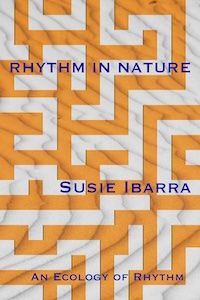
Rhythm in Nature: An Ecology of Rhythm
Susie Ibarra
Habitat Sounds Pbk 158 pp
The great drummer and composer Susie Ibarra — born in Anaheim, California, home to Disneyland, among the most artificial environments on Earth — has long embraced the natural world as intrinsic to her music. In 2002, her Songbird Suite, released by John Zorn’s Tzadik label, teamed her with a supergroup (the label’s term) of Jennifer Choi, Ikue Mori, and Craig Taborn. Uncredited were additional participants: the birds whose music could be heard on the title track, not merely sampled, but having provided evident inspiration for her antic percussion and for Taborn’s impressionistic piano playing. Two decades on, Ibarra’s Walking on Water (Innova, 2021) melded a larger ensemble with more birds and, trenchantly, the sounds of glaciers in decline. At times during Walking on Water, a listener might think Ibarra’s music had lost a battle with the field recordings, before coming to recognize the water is, in fact, the music.
There are ecological and musicological facets to Ibarra’s efforts in deploying, as a composer, the sounds of everyday reality. On the one hand, she focuses on the matter of our rapidly changing planet, and to that end has collaborated with Dr. Michele Koppes of the University of British Columbia, most recently for an ongoing project called Listening to Climate Change. On the other hand, as a musician, Ibarra is deeply engaged with how the cycles of the natural world as well as the sounds inform art and the human experience.
In her new book Rhythm in Nature: An Ecology of Rhythm, Ibarra channels her hard-won insights into a sequence of examples that might appeal to numerous readers — listeners, environmentalists and fellow musicians.
The book is as much a supplement to as it is an overview of Ibarra’s work as an educator and composer. It is broken into six main sections, one each on glaciers, oceans, trees, birdsong, deserts, and natural echoes (combining canyons and — stretching the definition of nature — human-made metal cisterns). Throughout, Ibarra exudes a holistic, imperturbable sense of humankind’s place in the larger natural order. An investigation of glaciers leads to the realisation that the rhythms of water are equivalent to that of popular music around the globe: “We are continually playing, listening, and seeing water rhythms while out in the field.”
The book isn’t merely a study of the sound of the world. It’s a study of the structure of sound. An exploration of glass informs her understanding how liminal states — “moving from one moment to another” — are essential to her art. Work with trees yields an appreciation for fractal mathematics. “The anatomy in the tree,” she writes, “reveals the sonic rhythms.” In addition to her descriptions, there are numerous photos (so many, in fact, that you might think they’re included to expand the page count to book length) and fascinating bits of scores (for those who read music).
The book’s main downside is it bears the imperfections of self-publishing, with more than its share of typos, as well as descriptive text that could benefit from an editor. Nonetheless, the reader reaches the conclusion to which Ibarra has served as a naturalist guide: pondering our place in the world. As she puts it at the end, she doesn’t know “if I am the rhythm or maybe I am the landscape.” It’s a small world, after all.