
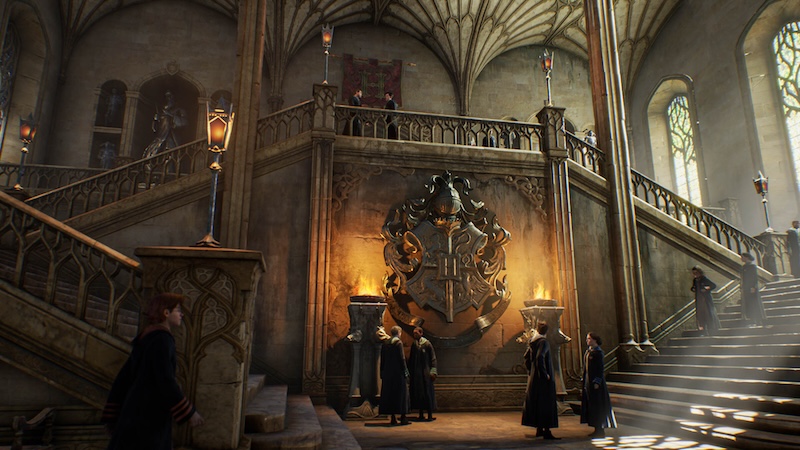
I’ve got this week off, mostly from work, entirely from social media, though only slightly from writing, and late in the afternoon I got in some time on the PS5 with a video game, Hogwarts Legacy (2023). The decision as to what to play was based in large part on its industry recognition: Game Developers Choice Awards Best Audio (honorable mention), British Academy Games Awards Music and Audio Achievement (longlisted), and Grammy for Best Video Game Soundtrack (nominee). As is my habit, I dialed down the score to a little under a quarter of the relative volume, and the dialog to about 90%, and I let the “world sounds” of the game take the primary spot.
Two key things stood out, as of our arrival at Hogwarts — which is to say, right up until the title card — following extended cut scenes and some necessary wand — that is, controller — training:
First is how drastic shifts in the tonal quality of the imaginary spaces signal the transitions, and how stark those transitions are, given the magical transport that is involved in getting from most places to the next. For example, at one point we’re in a massive interior space, with an echoing room tone, and then suddenly we just barely escape a pillar leaning toward us, felled by something a bit like the Destroyer from the first Thor movie. Then we move instantly through a portal into the outside world, a forest after dark. Not only are the nocturnal sounds of the bugs prevalent, but they highlight the otherwise seemingly blank audio slate, the relative silence of the forest. Throughout, the significant tonal shifts are markers of stages.
Second is the small speaker built into the PS5 controller. This is a subject I want to explore more thoroughly. I’m used to vibrations from controllers. For example, in the game, we don’t just hear the footsteps of our character; we also feel them. But the controller sounds are something else entirely. During a fight sequence, we hear aspects of the spell-casting as if the wand is right in our hands. There is something beyond the mere distinction between diegetic and non-diegetic sound here, between the real-time sounds of a given scene and those, such as score or voiceover, outside the world of the story. The sound from the controller has a power different from the one coming from the living room television. This controller speaker sound is hyperdiegetic.