
Back in April I wrote a post about a fake genre, which I had named “stigmatic ambient music.” For months afterward, a search for the name on Google would return statements as if the genre were real, which it wasn’t and still isn’t. This phenomenon was a classic AI feedback loop, in which a negative was misinterpreted as a positive. My original post was not an attempt at culture jamming. I hadn’t acted as if the genre was real. Quite the contrary, the post’s subhead stated clearly that stigmatic ambient music “doesn’t exist.”
Two months after that first post, I wrote an update that noted this ongoing issue with “stigmatic ambient music.” Google persisted in stating as fact that the genre not only existed but flourished sufficiently to deserve a detailed description of its characteristics:
“Stigmatic ambient music is a subgenre of ambient music that blends elements of dark ambient and industrial music to create a soundscape focused on pain, suffering, and psychological distress. It’s characterized by its use of dissonance, harsh textures, and a focus on unease or dread, often achieved through sound design rather than melody.”
I bookmarked the Google search results for the non-genre, bounded by the preceding 24 hours, and I made a habit of clicking on the link each morning, and this remained the case day after day, month after month. Nothing of note changed.
And then today, December 19, for the first time, the search results reflected what had actually happened. This is the text of this morning’s automated summary attributed to Google Gemini:
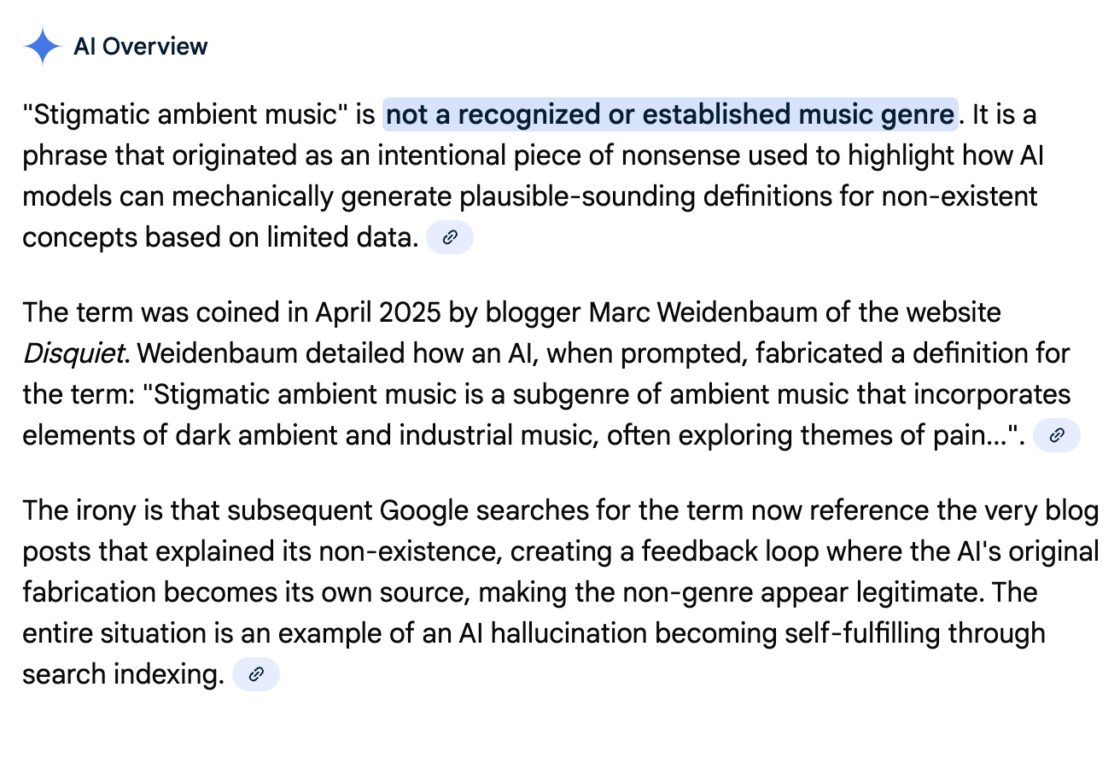
The word “hallucination” gives me pause, because even if accepted as merely colloquial, it serves as an anthropomorphism that reinforces the problem (that is, the flattering presumption of cognition and awareness), but otherwise the description is, for once, factually accurate.
I suspect the change may relate in some way to Google having recently indexed a June 8, 2026, post by software engineer Jim Kang that briefly mentioned my exploration of AI’s response to the non-genre.
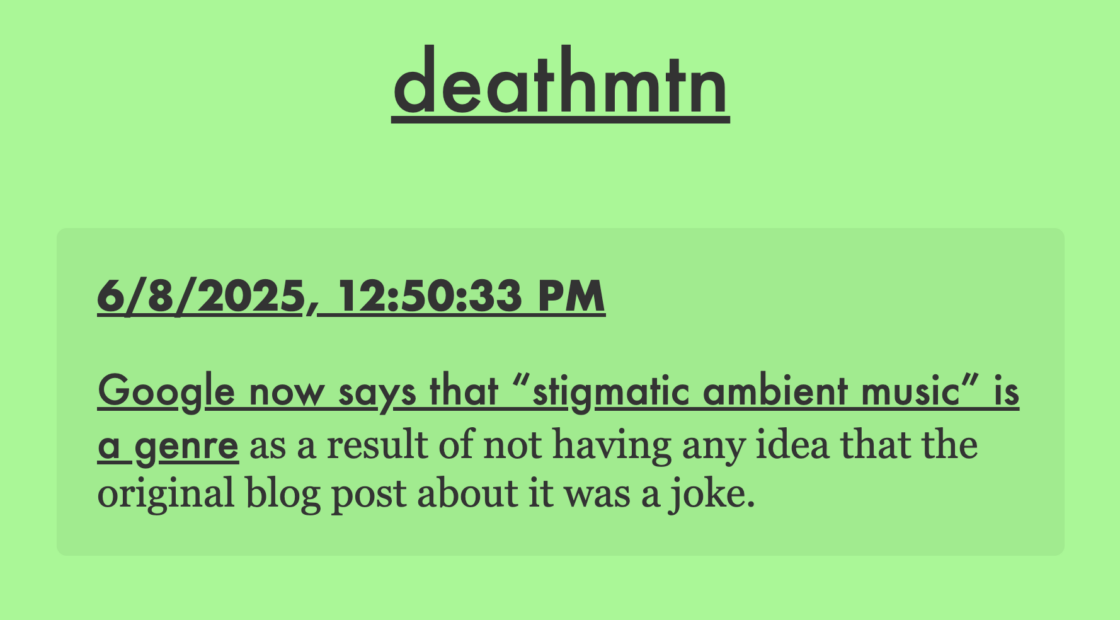
This development is good, because the correction has occurred, but less good, in that all it may have required was one sentence from a third party in order to entirely change Google’s AI mind (or “mind”) on the topic.