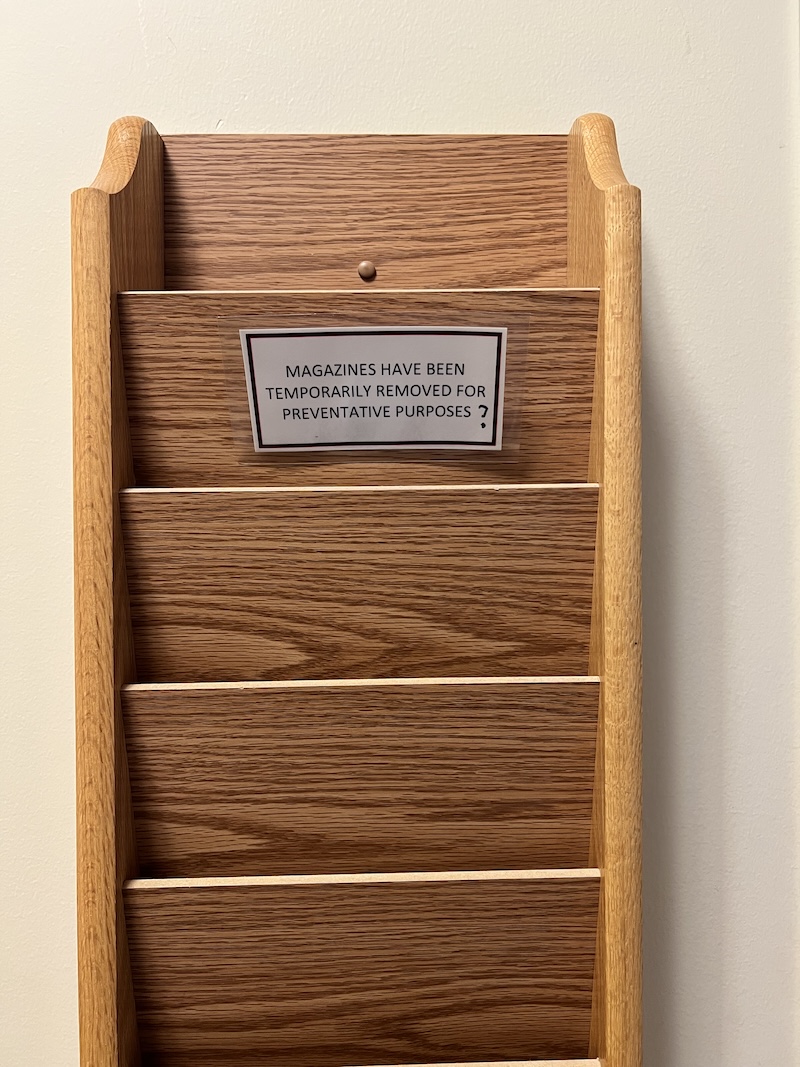
This was at the doctor’s office today. I have no idea what it means. I do like that someone added that question mark. It wasn’t me. (And per the comments below and ones I’ve received on social media, it is likely the case that this empty rack is a remnant of when healthcare providers were concerned about physical objects as transference vectors for Coronavirus.)
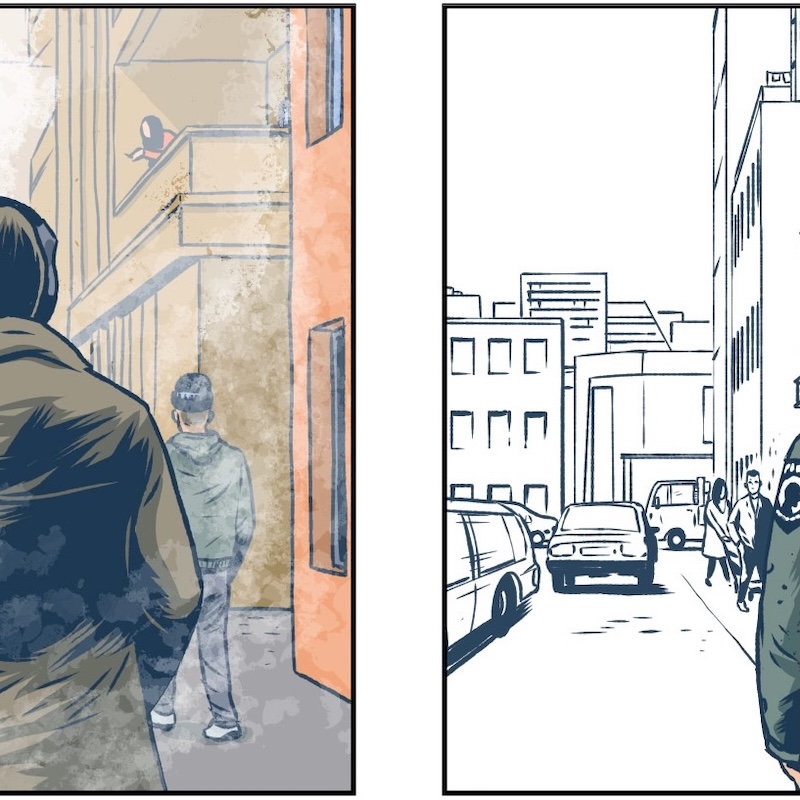
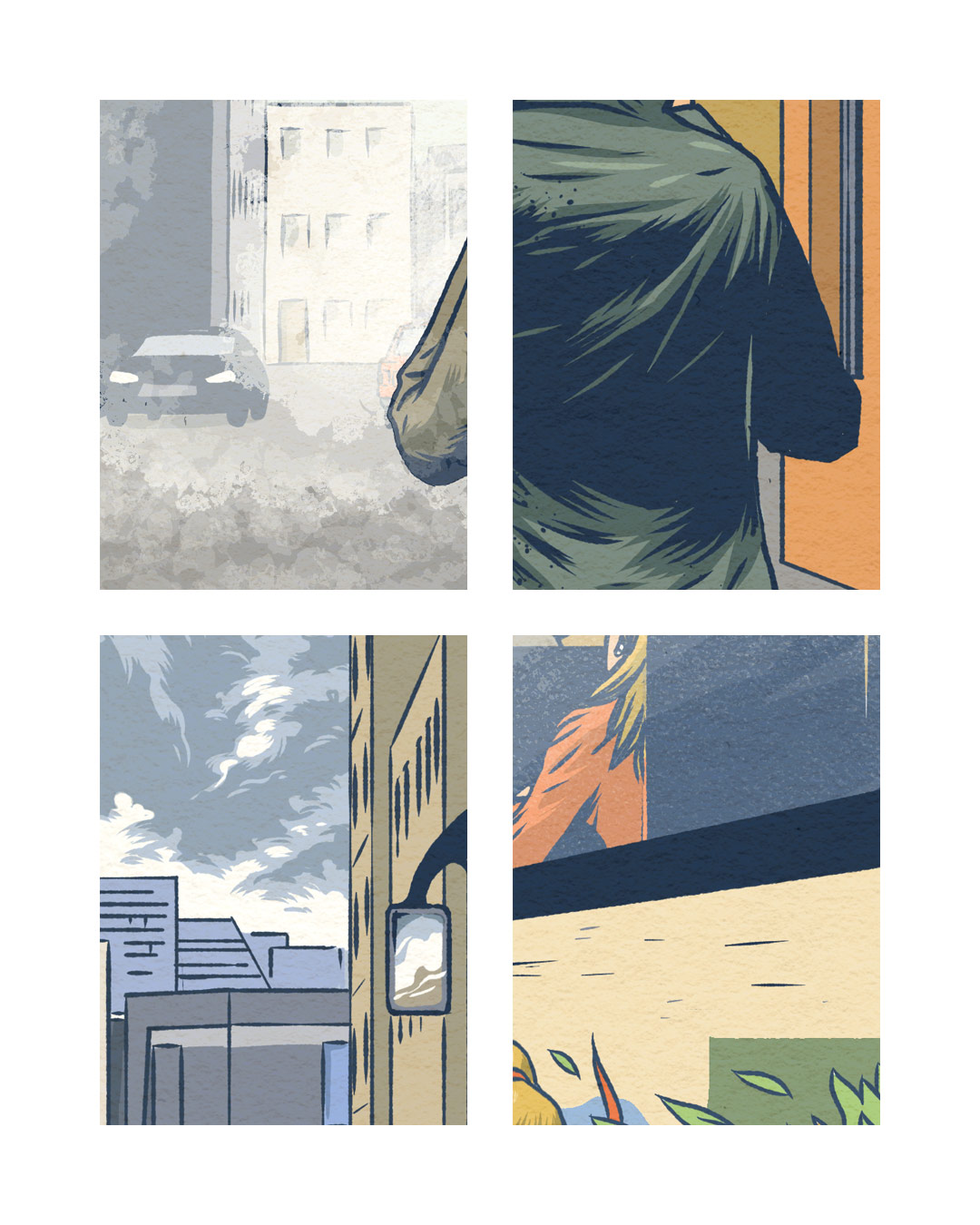
Work in progress for the next Frame by Frame comic I’m doing with Hannes Pasqualini (hannes.papernoise.net). Meanwhile, full back catalog of the series at disquiet.com/fxf.
. . .
Update (2025.05.13): And after I initially posted this, Hannes posted more details. He wrote, “Things have been extremely busy round here, so I’m a bit late with the new Frame by Frame episode with @dsqt. In the meantime, here’s little teaser, with some details from the panels I’m working on!”
I mentioned last month, when I started reading the first Bosch book, The Black Echo, a scene in which Michael Connelly, author of the series, highlights the details of such a mundane thing as dialing a pay phone. It’s a moment, as I said at the time (having not yet finished the book), when something someone might not have imagined at the time of the book’s writing, the early 1990s, would ever become outdated was given the attention normally associated with historical fiction: getting all the precise aspects right.
Phones play a crucial role in the novel, as Bosch, a Los Angeles Police Department detective, and his FBI agent partner try to sort out the nature of a complex crime they are investigating. There are office phones and pay phones and home phones, and pagers, and, no surprise to the reader, surveillance taps on such phones, as delineated in this passage above.
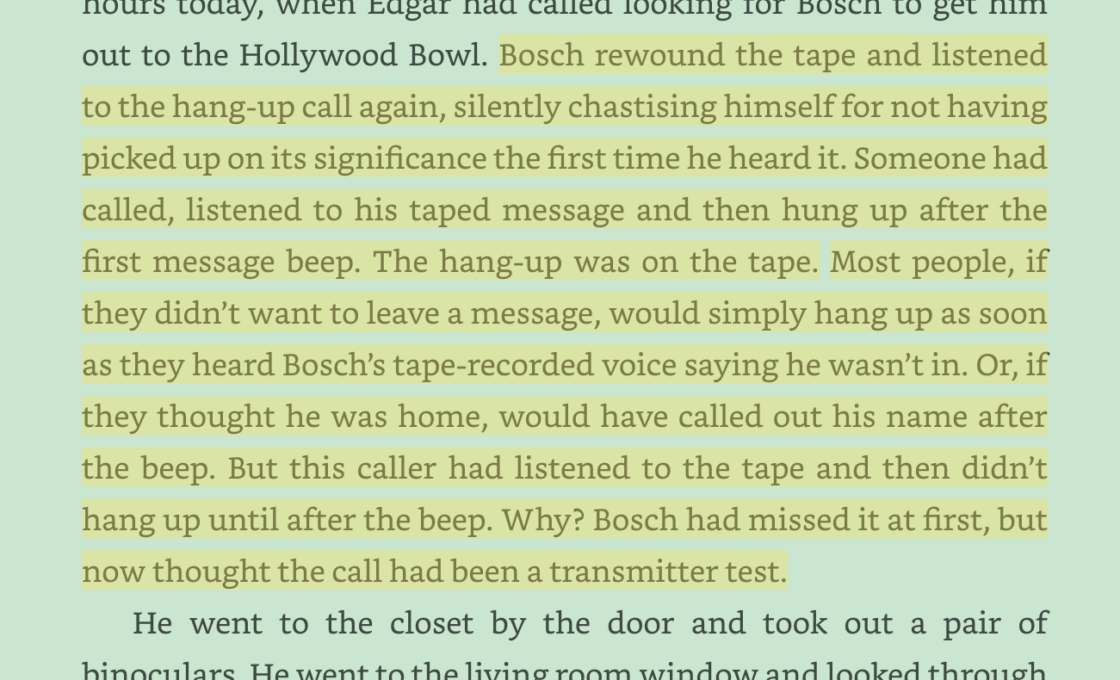
The key thing in that passage is Bosch’s ear. This isn’t merely Connelly writing about phones; this is Bosch’s own thinking, the thinking of a detective. He had, earlier in the book, noticed a hang-up on his home phone’s answering machine. Much later in the book he reconsiders what he had heard, and finds meaning in it. The above, per my Kindle, is 58% of the way through the book. The original scene, when he first notices the recorded hang-up, occurs at 41%:
What’s especially funny to me, as the book’s reader, is that like Bosch, I also didn’t take much note of the hang-up at the time. In fact, I highlighted a totally different sentence when I read that paragraph, the bit about how Bosch listens to CDs. I did so because in the TV show, the Bosch character also listens to jazz, but only on vinyl. (I noted this on social media at the time, but somehow left it off my weekly collation of my social media posts, so I just added it.) Above I’ve now also highlighted the moment when this bit of crucial information — in the form of silence — is witnessed by Bosch, and he doesn’t comprehend it until another 17% of the story passes.
At the end of each week, I usually collate a lightly edited collection of recent comments I’ve made on social media, which I think of as my public scratch pad. I find knowing I’ll revisit my posts to be a positive and mellowing influence on my social media activity. I mostly hang out on Mastodon (at post.lurk.org/@disquiet), and I’m also trying out a few others. And I generally take weekends off social media.
▰ After-dark trio for dishwasher, skateboarder, and whirring electric vehicle
▰ A friend who saw me mention using an Anbernic retro game handheld: I thought you didn’t play video games.
Me, after thinking about it: I don’t much, but I try. Mostly I’m interested in alternative firmware, sound design of virtual worlds, and chiptune music. (All of which video games are rich with.)
▰ I’m not sure if this was the intention with the iOS app “library,” but I find myself, on my iPhone and iPad, removing the vast majority of my apps from the home screen and accessing those just from the library
▰ A friend who uses speech-to-text a lot for writing sent me an email in which what was intended was “mazel tov” but it was transcribed as “muzzle tough”
▰ Hyper-local* food post: there are two Cherry Blossom cafes, one in the Inner Richmond and one on Ocean, and they both have many treats to offer. The essential one — for me, that is — is the savory scallions and ham, which is light and fluffy.
*San Francisco
▰ In the Bosch novels, he listens to compact discs, but I don’t think he ever has CDs on the TV shows, only vinyl LPs for that version of the detective’s jazz collection. And no matter the playback medium, in the very first book he acknowledges himself as a cliche. (And after I posted this, a friend shared this list that Bosch author Michael Connelly keeps of all the music in the Bosch books.)
▰ Reading-wise, I’m very close to the end of the first Bosch novel, The Black Echo. A lot of the book involves Bosch and his partner figuring out what might be going on, laying out their various hypotheses step by step. I’ve come to wonder how much of that is the author describing the detectives figuring things out, and how much of it is a lightly altered version of the author thinking as he himself was devising the plot in the first place. Thus what appears to be the unraveling of the given crime may actually have been the opposite: the raveling, as it were. There’s also an excellent little bit later in the book involving telephones that follows up nicely on the item I posted about earlier. I’ll share that excerpt later. This weekend is largely given over to family activities, of the sort centered around a cemetery, so time is understandably limited. I imagine I’ll finish it tomorrow before bed. The book club in which I’m reading The Mushroom at the End of the World delayed its meeting until next Sunday, so I’ve slowed my pace so it’ll be fresh when discussion occurs.
Skype, the telecommunications app, launched in 2003, the same year as MySpace and the ill-fated Space Shuttle Columbia.
Skype was a progenitor of our late-pandemic, Zoom-mediated lives. And now, after 22 years, and almost a decade and a half following its acquisition by Microsoft, Skype has been shut down, as of May 5.
Between cellphones and Facetime and Slack huddles and all manner of conference-call apps, we take instant realtime video communication these days as a given, but Skype originated (voice-only initially) at a time when such things were expensive, all the more so when connecting people internationally.
For just under a decade, I taught a course about sound to art school students, the majority of whom were from other countries (e.g., Sweden, Korea, China, Spain, and Saudi Arabia). I started doing so in 2012, a year after Microsoft bought Skype. A core part of the assigned homework was maintaining a “sound journal,” in which students wrote several times a week, detailing an observation they made about one sound or another.
Certain topics revealed themselves as common to these journals as the years of my teaching went by: the issues of noise in a city, the comforting purr of a house cat, the way the chatter in cafes somehow provided the perfect backdrop for doing homework. The everyday utility of Apple’s AirPods became a nearly universal subject in these sound journal shortly after their debut in 2016.
And at least one student a semester would inevitably write a short essay affectionately describing the sounds that Skype made, in particular when it opened and when its bubbly melody announced an incoming call. These Skype-specific sounds meant that the student would soon be talking to family or friends back home. Often these sound journal entries would describe how the student didn’t even recognize a persistent low-level homesickness until Skype announced itself — and then the sense of longing and the awareness of loneliness kicked in.
There was a lot packed into those little Skype noises, and the app became a useful tool for discussing the broader topic of the course, that being the role of sound in the media landscape, and the more focused matter of what’s come to be termed “sonic branding.” Some of the best ways to introduce subjects in class, I learned, was to let them happen naturally. So for the most part, I didn’t introduce Skype each semester. I just waited for it to come up — for it to, in effect, ring — and then we would collectively dive into its emotional and cultural meaning.