Disquiet Junto Project 0218: Sound Passage

The Assignment: Following the path of artist Kate Carr, explore sounds from a distance.

10338648_10153777198978360_2133192706192204240_o

Each Thursday in the Disquiet Junto group on [SoundCloud.com](https://soundcloud.com/groups/disquiet-junto/) and at [disquiet.com/junto](https://disquiet.com/junto/), a new compositional challenge is set before the group’s members, who then have just over four days to upload a track in response to the assignment. Membership in the Junto is open: just join and participate. There’s no pressure to do every project. It’s weekly so that you know it’s there, every Thursday through Monday, when you have the time.

Tracks will be added to this playlist for the duration of the project:

This project was posted in the early afternoon, California time, on Thursday, March 3, 2016, with a deadline of 11:59pm wherever you are on Monday, March 7, 2016.

These are the instructions that went out to the group’s email list (at [tinyletter.com/disquiet-junto](http://tinyletter.com/disquiet-junto)):

Disquiet Junto Project 0218: Sound Passage

The Assignment: Following the path of artist Kate Carr, explore sounds from a distance.

The artist and musician Kate Carr generously agreed to provide a prompt this week for the Junto.

Step 1: Consider the ways that sound changes as it travels across space, moving through specific human-built architectures and/or natural geographies. I live near Belfast’s major football stadium, and the roar that travels from the stadium, across the train tracks, up my street, and into my ears is a very different sound to the roar heard when standing in the stadium itself.

Step 2: Record a distant sound, and reflect on what frequencies have made it to your ears from the source, and which ones have bounced or decayed away.

Step 3: Compose a piece based on this recording, and your meditation on the ways its very journey to you has changed the sounds inherent in it.

Step 4: Upload your completed track to the Disquiet Junto group on SoundCloud.

Step 5: Annotate your track with a brief explanation of your approach and process.

Step 6: Then listen to and comment on tracks uploaded by your fellow Disquiet Junto participants.

Deadline: This project was posted in the early afternoon, California time, on Thursday, March 3, 2016, with a deadline of 11:59pm wherever you are on Monday, March 7, 2016.

Background: Kate Carr composes soundscapes based on field recording and non-conventional instrumentation to explore the relationship between people and place. Weaving together real and imaginary journeys , intensive explorations of sonic enclaves and the re-broadcast of sound in public places, her work is centred on both human and natural geographies. More on Kate Carr at gleamingsilverribbon.com.

Length: The length is up to you. Between one and four minutes seems appropriate.

Upload: Please when posting your track on SoundCloud, only upload one track for this project, and be sure to include a description of your process in planning, composing, and recording it. This description is an essential element of the communicative process inherent in the Disquiet Junto. Photos, video, and lists of equipment are always appreciated.

Title/Tag: When adding your track to the Disquiet Junto group on Soundcloud.com, please in the title to your track include the term “disquiet0218-soundpassage.”Also use “disquiet0218-soundpassage”as a tag for your track.

Download: It is preferable that your track is set as downloadable, and that it allows for attributed remixing (i.e., a Creative Commons license permitting non-commercial sharing with attribution).

Linking: When posting the track, please be sure to include this information:

More on this 218th weekly Disquiet Junto project (“Following the path of artist Kate Carr, explore sounds from a distance”) at:

https://disquiet.com/0218/

More on the Disquiet Junto at:

https://disquiet.com/junto/

Join the Disquiet Junto at:

http://soundcloud.com/groups/disquiet-junto/

Subscribe to project announcements here:

http://tinyletter.com/disquiet-junto/

Disquiet Junto general discussion takes place at:

https://disquiet.com/forums/

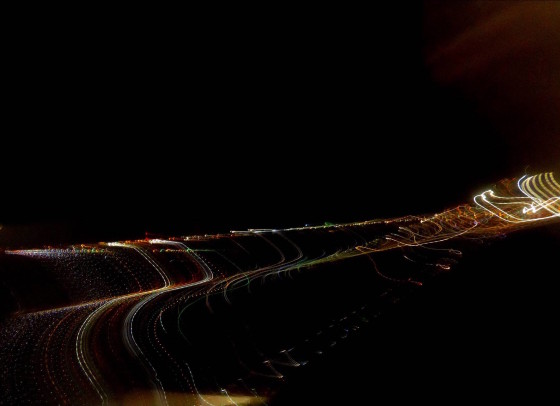
The image associated with this project is by Kate Carr, who also guest-crafted the project description.

A Sequence of Notes That Drift

Straight outta Modena, Italy

Marco Lucchi’s “Angel” is a synthesized slice of the ethereal. It is less a song than it is a sequence of notes that drift, occasionally hanging in midair before another sequence arrives. Sometimes that subsequent sequence emerges from a held note. Other times it occurs more suddenly, like a swift wind brought it into place. The instrumentation is broadly defined as synthesizer and mellotron. The effect is that of a distant organ and a tight string section.

Track originally posted at [soundcloud.com/marcolucchi](https://soundcloud.com/marcolucchi/red_angel). More from Lucchi, who is based in Modena, Italy, at [musichevirtuali.org](http://www.musichevirtuali.org/) and [marcolucchi.bandcamp.com](https://marcolucchi.bandcamp.com/).

A Broker Tour of Clint Mansell’s High-Rise Score

One track in advance of the J.G. Ballard adaptation

highrise-xlarge

*“The night passed noisily, with constant movement through the corridors, the sounds of shouts and breaking glass in the elevator shafts, the blare of music falling across the dark air.”*
—J.G. Ballard’s *High Rise*

Among the many promising aspects of the forthcoming wide-screen adaptation of J.G. Ballard’s classic novel *High-Rise* is that it’s set as a period piece. The film unfolds in the fabulous, wide-collar, garishly colored 1970s, the same era during which the book, a 1975 publication, was released. That is unlike recent filmed versions of, say, *Planet of the Apes*, or *The Fantastic Four*, or Jason Statham’s take on one of Richard Stark’s Parker novels, just to list a few examples, all of which original works were endemic to the era in which they were produced, and then yanked into the future when filmed.

With the new *High-Rise*, there’s no adjusting to today’s surveillance-media reality, no evocation of how 9/11 rewired America’s brain, no consumer-grade Internet, and no smartphones — all of which could easily lend themselves to Ballard’s urban fable of consumer convenience. The book is a characteristically harrowing Ballardian story in which the violence that humans do to each other, this time in a concrete and steel vertical manifestation of class differences, somehow manages to mask an even darker and deeper potential for violence. The more we play dress up, the more the animal in us, the animal that we are, comes alive.

Clint Mansell (*Black Swan*, *Stoker*, *Requiem for a Dream*) has provided the score to the adaptation, directed by Ben Wheatley and starring Tom Hiddleston, and judging by the first public track, “Cine-Camera Cinema,”it may be a willfully anachronistic act of underscoring — or maybe not. (One of the characters, played here by Luke Evans, is a documentary filmmaker, and “cine-camera” is the term in the novel for his equipment.) The piece is deeply subdued, chanting heard behind an enticing scrim of undulating drones. It has none of the symphonic grandeur of 1970s movie scores, nor the swagger of rock music at the time, though what sound like whistling does bring to mind Ennio Morricone’s westerns. Then again, [the post of the track on SoundCloud](https://soundcloud.com/silvascreen/cine-camera-cinema) quotes the *Hollywood Reporter*’s description: [“a lustrous retro-classical score.”](http://www.hollywoodreporter.com/review/high-rise-tiff-review-822996) So, perhaps the music will be as era-specific as Tom Hiddleston’s lapel. Either way, this excellent first taste of Mansell’s work sets expectations high.

Track originally posted at [soundcloud.com/silvascreen](https://soundcloud.com/silvascreen/cine-camera-cinema).

The One-Key Piano

And how Google Android explains itself in music

This one is certainly tailor made for the course I teach about the role of sound in the media landscape, which focuses often throughout its 15-week run on the way things — organizations, people, services — express themselves through sound. There’s a recent Android operating system TV commercial from Google in which pianist Ji-Yong Kim plays a piece of music, the third movement of Beethoven’s Moonlight Sonata, on a grand piano, and then alternates between a standard grand piano and a grand piano set up so that each key plays the same note. The “joke” in the ad is a tweak at the perceived uniformity of Apple’s product line. The tagline is “Be together. Not the same.”

One unintended consequence of the advertisement is the rising awareness that there’s an audience out there for such an uber-minimalist music in which rhythm is the closest expression evident to something that approximates melody. The video has had almost one million views since it was posted on February 15. The one-note piano approach, dubbed the Monotune, is now the subject of a 10-track album, available for free from Google Play ([play.google.com](https://play.google.com/store/music/album?id=Buza2bceei6pdd3igpcwtothvhe&tid=song-To6r7barrfjpylpwxn5b5i64uqa)). Oddly, the Moonlight Sonata doesn’t appear to be on the album, which includes “Three Blind Mice,” “Claire du Lune,” and “Take Me Out to the Ball Game.” All the compositions seem to be, like the Moonlight Sonata, in the public domain.

While the Monotune album is an entertaining peek into the one-note tweak on familiar music, the real pleasure in the TV ad is how it moves back and forth between the extroverted and muted performances. Perhaps a follow-up collection will attempt to capture that quality.

There’s a making-of interview, posted the same day as the Monotune commercial, of how the one-key effect was accomplished. The short version: you can’t tune an entire piano to one note. You have to shorten many of the strings first. There’s a great moment at 1:43 when pianist Kim responds the first time he hears the peculiar responsiveness of the stunted piano:

Found via [androidpolice.com](http://www.androidpolice.com/2016/02/26/the-people-who-made-the-monotone-android-commercial-recorded-an-entire-album-and-its-free-on-google-play-music/).

The Drain as Oscillator

A track from Brighton-based Danjec

The source of the audio is like a drain, watery sounds heard in fits and starts. The drain just happens to be hooked up to a next-gen synthesizer. This is Danjec’s “OBFP,” in which these occasional drips and drops are transformed into myriad backward-masked wisps and deeply echoing sonic objects. That echo defines the space, and Danjec’s sounds revel in the space’s rewarding reverberation. A few times a string can be heard ever so briefly, as if a guitarist has it in mind to join in the percolating rhythm. And then the string is muted, and the drain proceeds with its efforts.

Track originally posted at soundcloud.com/danjec. More from Danjec, aka Grant Wilkinson of Brighton, England, at twitter.com/_Muncky, danjec.com, and muncky.bandcamp.com.