Scratch Pad: Quiet, Architecture, Comics

From the past week

At the end of each week, I usually collate a lightly edited collection of recent comments I’ve made on social media, which I think of as my public scratch pad. I find knowing I’ll revisit my posts to be a positive and mellowing influence on my social media activity. I mostly hang out on Mastodon (at post.lurk.org/@disquiet), and I’m also trying out a few others. And I generally take weekends off social media.

▰ If you really want your neighborhood to feel quiet, have it host three-day music festivals two weekends in a row. The Monday after is eerily still.

▰ It’s funny the library is all “be quiet” ’cause this rattly old book cart a librarian is pushing across the floor is loud as heck

▰ They say that writing about music is like dancing about architecture — but what does that mean for architraves?

▰ Trying a new format on Instagram. I’m generally not into sharing without adding some sort of context, even a grace note, so this treatment may wither on the vine, or evolve. We’ll see.
▰ Me watching TV before bed: Hey, I’m halfway through the second episode of Alien: Earth and maybe this isn’t good to watch before bed. Hey, there’s a new Tyler, the Creator video, “Sugar on My Tongue,” so I’ll watch that. Hey, what’s up with that knife? …

▰ Annoying: accounts that list all their photo gear.

Also annoying: accounts that list none of their photo gear, so I have to email them to ask.

▰ I’ve spent much of my adult life trying to remember it’s Harriet Walter not Harriet Walker, and then she plays a character named Walker on Silo, and I’m trying to sort out if this will aid or hurt my attempts to keep it straight.

▰ Books read this week: I finished the four most recent (that is, in English translation) volumes of Masakazu Ishiguro’s Heavenly Delusion (through v7), and I’m pretty hooked. The 8th should be out by the end of the year. ▰ I finished volumes 2 through 4 of Kazuo Umezz’s My Name Is Shingo, with one more to go … before I have to wait until the 6th/final volume comes out. ▰ I read Will McPhail’s In. (yes, there’s a period in the title), about a young urban professional suffering from anhedonia, in one sitting. I especially appreciated how different pages used not just the structure of the panels but the overall amount and shape of the white margins differently. ▰ I read Erik Svetoft’ Spa, about the dark — in a supernatural sense — goings-on at the titular location. ▰ I’ve been looking forward to DC’s Absolute series coming out as collected volumes. I read the first two, Absolute Batman (from writer Scott Snyder and illustrator Nick Dragotta) and Absolute Wonder Woman (from writer Kelly Thompson and illustrator Hayden Sherman). I’m not sure I entirely get the point of the Absolute books. They’re reboots of famous characters, so sort of like the classic Elseworlds titles, but somehow distinct from that line (aside from being ongoing, how exactly is unclear). The “Absolute” Batman, for example, isn’t rich, but since O.G. Bruce Wayne’s playboy persona was a cover, the difference from an ethical perspective isn’t as stark as it might seem — at least not so far. Now, the Wonder Woman volume, on the other hand, was really something. I’ve never, in the past, been very interested in the character, and her story here seems much richer than the isolationist myth of the classic version. In contrast, Absolute Wonder Woman was sent, as a child, to the underworld, where she was raised by Circe. I’ll say this: Sherman has immediately become one of my favorite comics illustrators. I’ll be digging into his back catalog immediately. The guy puts in the work. Every page, every frame, is rich with detail, and every line with texture. (There’s also a side story illustrated by Mattia de Iulis, and some chibi strips drawn by Dustin Nguyen.)
Manga Tape Deck

Gazing at Masakazu Ishiguro

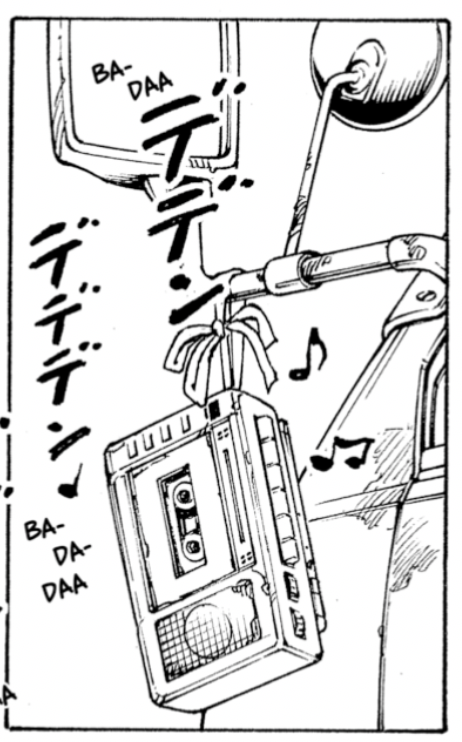
I’ve been on something of a manga bender lately, and so I share this one panel from Masakazu Ishiguro’s very enjoyable series Heavenly Delusion. There a light echo of Akira Toriyama’s work in Ishiguro’s, a gentle roundness to some of the technology, as in this depiction of a portable tape recorder.

Scratch Pad: 808, Holidays, Manga

From the past week

At the end of each week, I usually collate a lightly edited collection of recent comments I’ve made on social media, which I think of as my public scratch pad. I find knowing I’ll revisit my posts to be a positive and mellowing influence on my social media activity. I mostly hang out on Mastodon (at post.lurk.org/@disquiet), and I’m also trying out a few others. And I generally take weekends off social media.

▰ Stoked for the dub version of the Outside Lands Festival. That’s what it sounds like when you live a few blocks away.

▰ August 7 is (along with April 13) like Christmas Eve for a certain subset of electronic music fans

▰ Whew, just under 7,860 posts on disquiet.com in the past (just under) 29 years (site anniversary in mid-December)

▰ Wishing a happy 808 Day to all who celebrate

▰ I’m not clumsy. I simply have inapproprioception.

▰ Best sounds of Outside Lands: (1) layers of honking from passing cars, (2) people cursing that a nearby porta potty is for a construction site not for attendees, (3) keeping track of slang, which gets more slurred as the day goes on

▰ I was on a short vacation last (extended) weekend for my birthday and then under the weather much of this week, so I read a lot more than usual, and in particular a lot more comics/manga than usual. I read the first seven tankobon volumes of Satuski Yoshino’s Barakamon, about a fairly young (early 20s) calligrapher who leaves Tokyo for a rural island in order to find his own writing style. It’s a great example of why I think of much standard manga as “paper television.” This series is, essentially, a highly addictive, binge-able, fish-out-of-water comedy, capably and affectionately drawn and expertly paced. I wish there was more calligraphy in the story, but what calligraphy there is is pretty interesting. There are another dozen volumes of Barakamon, and a seven-book prequel, too. We’ll see if I get around to them. ▰ I read the standalone collection Rakuda Laughs, by Satuski Yoshino, about a hyperviolent and hypersexual yakuza. It’s over the top, but there are panels of city scenes that are so beautiful it’s worth it. Rakuda Laughs includes an afterword by director Takashi Miike, which tells you how violent it is. ▰ I read the first volume of Tsutomu Nihei’s Tower Dungeon, which is like reading a video game, right down to the mention of “levels” as the fighters make their way to, yes, rescue a princess. With a little more self-consciousness, it would count as LitRPG. The illustrations, which are a little rough, at least in this first volume, reminded me of Norihiro Yagi’s Claymore a bit. The depictions of the built environment are, as in the Yoshino, worth the price of admission, but are also totally different. ▰ I read the complete, seven-volume collection of Inio Asano’s Goodnight Punpun, which is quite a strange read, moving from fairly straightforward teen melodrama to something exceedingly nihilistic, akin to Terrence Malick’s Badlands, or Oliver Stone’s Natural Born Killers. It uses so much photography as backgrounds (albeit treated, so as to look like line drawings) that it almost counts as fumetti. Also, and this is a key factor in its style: several characters, including the main one, are drawn like stick figures. ▰ I don’t know when we stopped calling Kazuo Umezu that and started calling him Kazuo Umezz, but in any case I read the first collection of his My Name Is Shingo, an old-fashioned sentient-robot story that feels a bit like classic Osamu Tezuka (and Umezz’s own The Drifting Classroom, which is a decade older), and I’ll be finishing the series for sure. ▰ I read the first two volumes of Ishino’s Mujina into the Deep (dystopian story about young assassins), and I’m excited for the third volume, which is due out by the end of the year, I think. ▰ And I read the first three volumes of Masakazu Ishiguro’s Heavenly Delusion, which is a near-future dystopian road story that jumps back and forth between some children with heightened abilities stuck in an enclosed scientific environment, and some older kids (also with powers) wandering a post-apocalyptic Japan. I’ll continue to read this series, and explore some of its author’s earlier work. (The art made me want to revisit Jeff Nicholson’s Ultra Klutz.) ▰ And I didn’t just read manga. I read two western graphic novels: Wolverine: Revenge by writer Jonathan Hickman and illustrator Greg Capullo, who may be my favorite superhero illustrator these days, now that Frank Quitely and Chris Bachalo aren’t doing that much (far as I can tell). ▰ Quitely did draw the first volume of Mark Millar’s The Ambassadors (each of its collected issues has a different artist), which I also read and enjoyed, though I’m kind of a sucker for getting-the-band-together story lines; what happens after they get together is often another story. (I just started Hickman’s Imperial, a new series from Marvel, but only the first issue is out on the Marvel Unlimited app, so it’s gonna be four or five months before I complete the first collection.) ▰ If this seems like a lot of pages of comics, it is. The Goodbye Punpun septet alone was 2,952 pages. Like I said, I’ve been a bit under the weather, and when I am — which fortunately isn’t that often — TV can give me a headache and novels and non-fiction can take more concentration than I’ve got. So, I read comics. One of the first things I learned when I started working at Viz, back in 2004, was how quickly kids read Shonen Jump and similar magazines. It’s like eating ramen quickly and while slurping: it’s how it’s done.

The Art of Circuitry

Manga edition

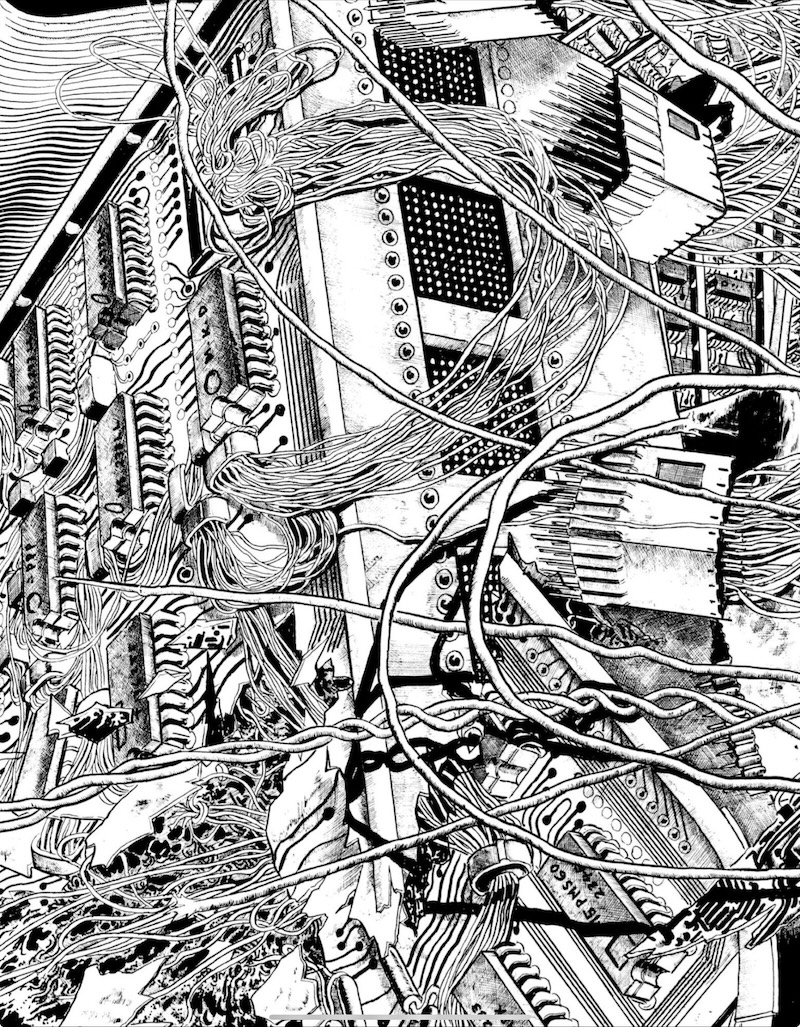
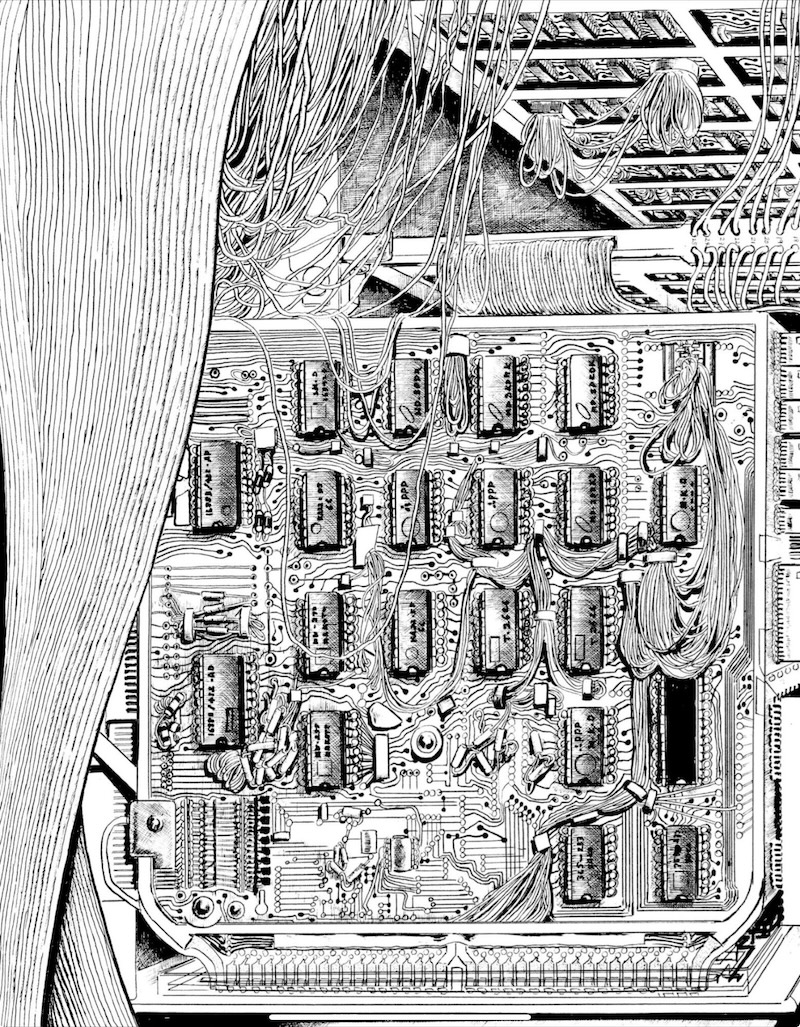
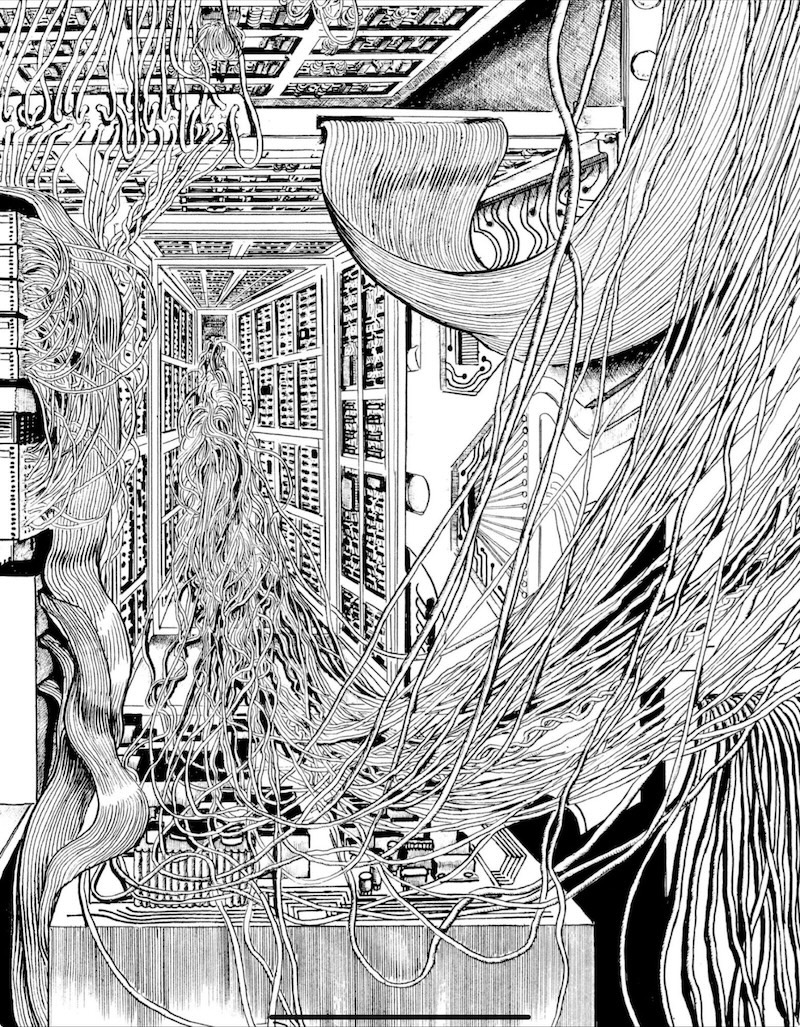
Incredible circuit board illustrations, all full-page, from the first volume of Kazuo Umezz’s manga My Name Is Shingo (1982–1986). A fairly common aspect of manga is to, after pages of sometimes casual and spare drawing, to be suddenly hit with a page or spread of intense detail, like cityscapes or nature scenes. Here the eye focuses on the detail inside a machine — a machine that is, at times, the story’s narrator. I worked in manga for a half decade, and moments like these thrill me to this day.