Since early February 2023, I’ve managed to post 26 interviews with participants in the Disquiet Junto music community. I thought I’d hit 25, and then realized I’d mis-tagged one of them along the way, an error that’s now been rectified. The series is called the Junto Profiles. The prerequisite to be interviewed for a Junto Profile is activity in the weekly projects for at least nine months. That doesn’t mean participating every week, just often enough to be a regular presence. The process for the Q&A is that I send the interviewee a document that consists of the same set of basic questions (where they’re from, what their musical activity is like, what’s a good music-making habit, etc.). When I get their responses to those questions, I read through the document, and then I send back one or two follow-up questions, exploring topics the interview subject has raised.
The answers to the standard questions are always of interest, and the follow-up questions are icing on the cake. The internet is awash in templated Q&As, and I get the attraction: for the interviewer, it’s easier than recording something and then transcribing and editing; for the interviewees, it can be done on their own time, and there’s a paper trail for what they said, so no surprises or errors pop up when the material is ultimately published. But every convenience comes at a cost, and I hope that the follow-up questions I include enliven the Junto Profiles Q&As a little bit, getting at some of the spirit of in-person interviews I so enjoy doing, but just don’t often have the time for. At the heart of this is a focus on the idea of conversation. These follow-up questions — albeit committed asynchronously in the cloud in a shared document — have a touch of conversation to them. And sometimes a touch is enough.
There’s a handy #junto-profiles tag that pulls up all the interviews to date, and they’re also listed in this website’s Conversations category index.
From Chicago, Illinois: making time, and the power of naming
/ By Marc Weidenbaum
This Junto Profile is part of an ongoing series of short Q&As that provide some background on various individuals who participate regularly in the online Disquiet Junto music community.
What’s your name? Coraline Ada Ehmke. I also record under the name Sudre’s Violin and, previously, A Little Fire Scarecrow.
Where are you located? I live in Chicago — technically, across the street from Chicago — which is a city full of music and art and culture. No place feels like home exactly, but I’ve been here longer than anywhere else so I guess this counts.
I came here when my daughter was just over a year old, and I was just getting started in my tech career. After she was born, I had to make a transition from living in Austin, Texas, where I was primarily playing live in bands, to being a parent in Chicago with only occasional time for music, now spent recording in brief and scattered bits of free time. I went from thinking about songs to thinking about albums, and really started taking my time with things. That’s how I spent a lot of years.
Now my daughter is grown, but the recording albums habit has stuck. That said, I’ve got a new project going now — called The Disaster Society — which will be performance-based. So I’ll have a chance to contribute back to some of that music and art and culture that I love so much here.
What is your musical activity? Today, I would call what I do a studio practice. It took some time for me to come to terms with considering my own work “art”, but once that happened I started taking it more seriously and pursuing music with more purpose and discipline. I have blocks on my calendar twice a week for dedicated, no-interruption studio time, on top of whatever free time I can find. The Disquiet Junto has been great for keeping me on a schedule, too.
I tend to organize my musical activities into different projects, each with its own constraints and context. Sudre’s Violin is the container for my (mainly) instrumental postpunk stuff, produced to create the illusion of a consistent musical lineup with consistent instrumentation. There’s the Drone Day project, “Gangs of Ireland”, which is a five-year sort of thing inspired by an interview segment on Irish TV in the early ’80s. And there’s always some sort of one-off project going as well.
What is one good musical habit? In my music (and in my life I guess) I like to leave plenty of room for serendipity. I regularly browse Wikipedia for rabbit holes, either technical or philosophical or metaphorical, and write down what I find. I also keep ambidextrous spiral notebooks, writing in one direction for specific projects, and abstract techniques or ideas in the other.
What was a particularly meaningful Junto project? My voice has always been problematic for me. I just can’t sound the way I want to sound and it really upsets me sometimes. I used to try to sing anyway, but I found that even if I didn’t hate it in the moment, I would hate it two months later when I heard it again. I had to come to terms with the fact that I just do not have a viable singing voice, and that led me to focus on instrumental music.
But one alternative that I’ve turned to in some pieces, including several of the Disquiet Junto pieces, is using AI-driven text-to-speech to create custom spoken vocals. I like what I’ve been able to accomplish with them just fine, but. But.
Then came Disquiet #0681, in which we were invited to turn a walk or run into something dramatic, like a scene in a thriller. I wanted to avoid the trope of a woman alone being followed at night, so I went with a story about the vengeful ghost of a hitchhiker. For story as well as aesthetic reasons, I needed the hitchhiker to be singing “Walkin’ After Midnight” to herself as she stalked along the highway looking for her next victim. I didn’t really think about it. I put on headphones, grabbed a mic, and played a part. I sang without making it about singing. I wasn’t trying to sing well or sound a certain way; I was just playing a part.
That was pretty transformative, and it’s inspiring me to find other ways to incorporate my natural voice into my work.
The track is here, and it would be criminal to listen without headphones:
I think many people reading this Q&A will register interest in what you describe as time “blocks” for studio work. Can you talk in some detail about how much time you block, and how you structure your studio time? First of all, I should confess that I live a life that combines precarity with flexibility, which is a fancy way of saying that I live paycheck-to-paycheck but do fascinating and diverse work that, for the most part, does not require working business hours.
Although I can work pretty much whenever or wherever, I keep “office hours” for interacting with people in a business context. But on Thursdays and Fridays I front-load my workdays, mark BUSY on my calendar, and spend from 2pm to 6pm doing work in the studio. That’s my studio time, it happens every week, and I take it very seriously.
And it can be anything in my home studio: from organizing cables, to noodling on the piano, to recording a song for the next album. It doesn’t matter, as long as I’m engaged with the context and space.
I’ve felt tremendous growth in my understanding, capabilities, and creative output since adopting a regular studio practice. I find that it creates more opportunities to get inspired and create new art: sometimes just being in the space primes me for creativity.
I recognize that not everyone has the privilege of flexibility that I do, but if you can try to set aside even a couple of hours a week on a regular day and time, you’ll reap a reward.
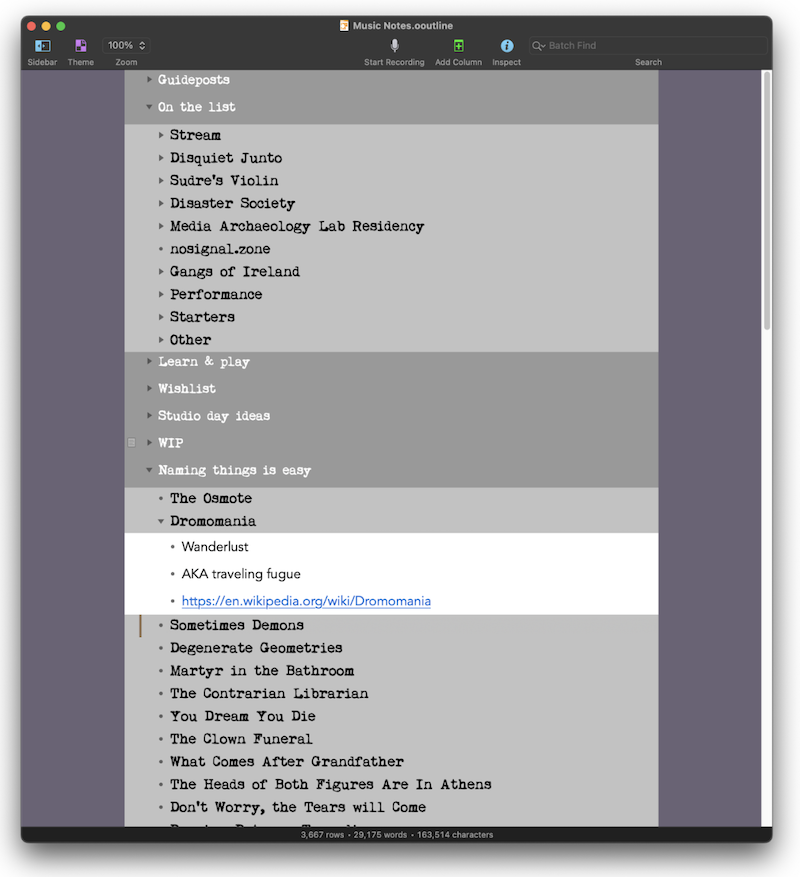
The names of your projects — Sudre’s Violin, A Little Fire Scarecrow, Disaster Society — are evocative. Can you talk a bit about how the process of naming helps you in developing these distinct musical efforts? I was a software engineer for many years, and there’s an adage in that field that “naming things is hard”. In my music doc (see screenshot below), I have a whole section called “Naming things is easy,” full of words and phrases that I come across in my wanderings and readings and conversations. Again, Wikipedia can be a great source for unique finds. (The name for Sudre’s Violin came from an article I found when I was researching artificial languages; Sudre was a 19th century musician and composer who could hold fluent conversations via violin.)
Strange words and phrases can come from anything really– it’s a matter of listening for things that are evocative or suggestive, especially when taken out of context. Things that have creative potential. Ideas that want a soundtrack.
In terms of projects, I typically have several going at once and move between them frequently, so having distinctive names for them helps me with context switching. The name has to contextualize and differentiate, and it has to reflect the individuality, constraints, goals, and character of the particular project. It’s an important part of how I maintain separation and cohesion between different creative endeavors.
For a piece of music, giving it a name is like recognizing that it’s alive. When I’m working on a new piece, even for a few hours, I don’t hit “save” for the first time until I feel like it’s ready for a name. Sometimes I’ll browse the “naming things” list to see if anything I’ve collected resonates with the music, while other times the piece evokes its own name.
Naming something takes a combination of attention and divination, seeing clearly what is there and having a sense of what is to come. The name and the shape of the thing intertwine as it unfolds, and you can’t always go back. It’s like quantum entanglement. Or maybe just psychology. But I prefer to think of it as magic.
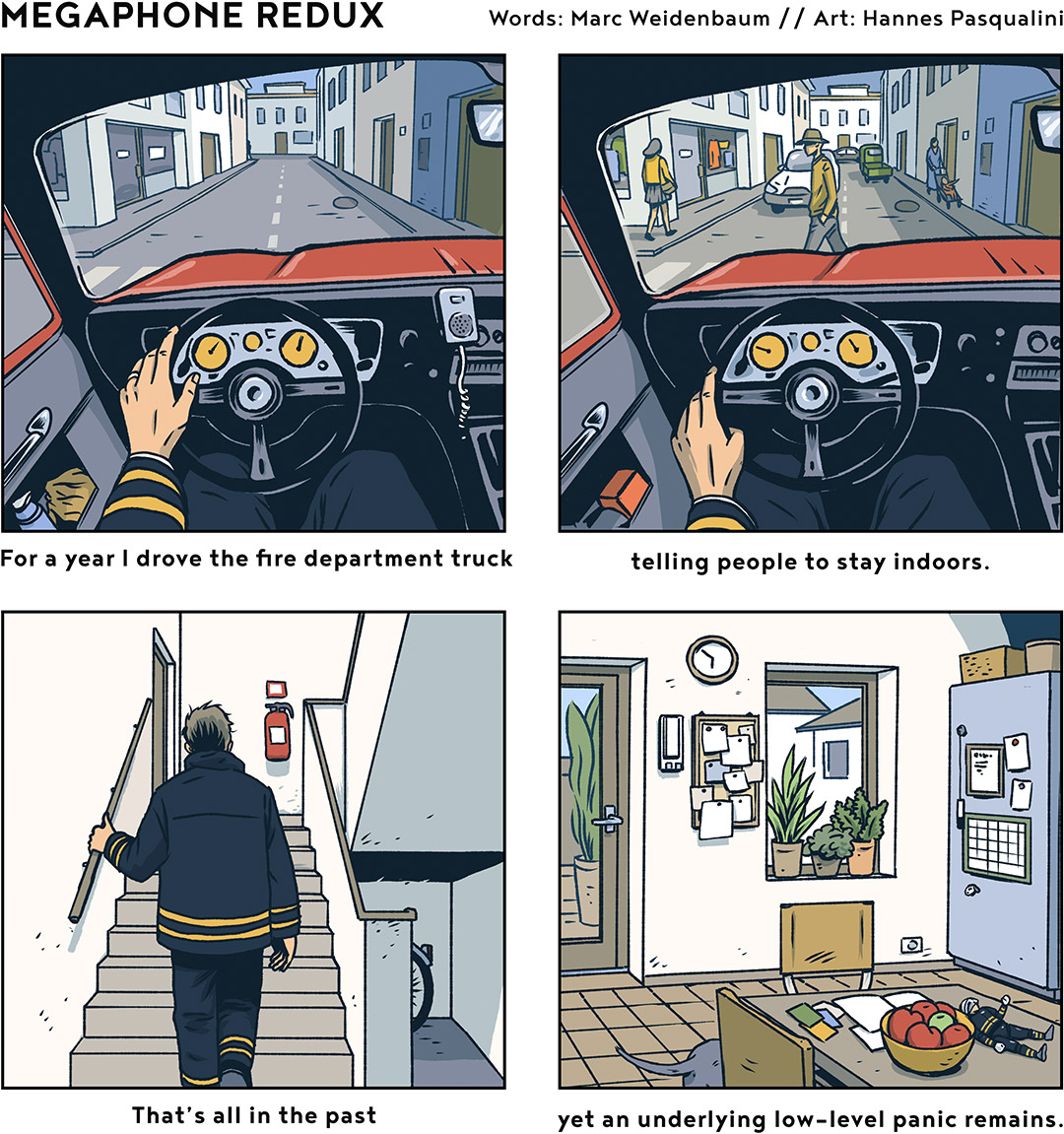
The illustrator Hannes Pasqualini and I revived our 2020 comics series in late December of 2024. We have posted two more comics since that one (“Audiobook” and “Stroll”), and today’s, “Megaphone Redux,” continues the run, revisiting both the cultural context and a specific comic from when we initiated the series. See a full index of Frame by Frame comics at disquiet.com/fxf, which features a special index page just for the episodes. And check out more from Hannes at hannes.papernoise.net.
On Sundays I try to at least quickly note some of my favorite listening from the week prior — things I would later regret having not written about in more depth, so better to share here briefly than not at all.
▰ With track titles like “a concrete corridor,” “jagged branches,” and “tungsten bulbs,” the excellent new score from Trent Reznor and Atticus Ross, for The Gorge, could be easily mistaken for a Nine Inch Nails album. (The Gorge is the one with the woman from the chess movie and the guy from the drumming movie. The best thing about it, besides the score and it having a very small cast in a very large landscape, is that Netflix positioned it as a Valentine’s Day movie.)
▰ Lawrence English’s new album, Even the Horizon Knows Its Bounds, is like an orchestra of pianos tuning up forever. Includes source material from Amby Downs, Chris Abrahams, Chuck Johnson, Claire Rousay, Dean Hurley, Jim O’Rourke, JW Paton, Madeleine Cocolas, Norman Westberg, Stephen Vitiello, and Vanessa Tomlinson.
At the end of each week, I usually collate a lightly edited collection of recent comments I’ve made on social media, which I think of as my public scratch pad. I find knowing I’ll revisit my posts to be a positive and mellowing influence on my social media activity. I mostly hang out on Mastodon (at post.lurk.org/@disquiet), and I’m also trying out a few others. And I generally take weekends off social media.
▰ Yes, I was standing near three people and near-ish to a half dozen other people when an elder alert went out to phones this afternoon. Quite the readymade spatial sound installation.
▰ Two new Steven Soderbergh movies and a new Luc Besson movie? I appreciate this cumulative opportunity to convince myself not only that it isn’t 2025, but that the previous millennium hasn’t yet ended.
▰ The rain in San Francisco falls mainly everywhere
▰ I thought the printer had decided to just print out something on its own initiative, but that sound turned out to be a street cleaning machine coming up the block slowly in the pouring rain
▰ An earthquake during a rainstorm (which we just experienced) is like an elevator pitch by a Hollywood executive who already knows he’s being put out to pasture
▰ I finished reading my second novel of the year, that number masking the substantial amount of pages I’ve actually read, ’cause I’m nearly done with Neal Stephenson’s massive Cryptonomicon (I’d give it two more weeks), and continuing apace, if more slowly, with George Eliot’s Middlemarch. The novel I finished reading — which, like the first one I read this year, I read to attain a little desired closure amid the open-endedness of reading two roughly 900-page books — was Dead Money by my old friend Jakob Kerr. It’s a fun corporate thriller that takes place mostly right here in San Francisco, and it is twisty. And this week I finished reading one graphic novel, Superman: Year One by Frank Miller (writer) and John Romita Jr. (illustrator). And I just realized that at some point I stopped being one of those people who puts commas before and after the “Jr.” in names that have a Jr. in them. I don’t know when that happened.