
“What makes the thing play?” That’s the simple question asked by Charles Amirkhanian early in the first of two hours of interviews he and Bill Schechner did with player-piano enthusiasts back in the early 1970s. They’re now available as a pair of MP3s from archive.org (MP3, MP3). A few sentences into the answer from a member of the Automatic Musical Instrument Collectors Association (AMICA), Amikhanian asks to back up a bit, from the mechanisms of playback to the recording process itself. He compares the piano rolls to a mix between Torah scrolls and computer punch cards, and the conversation quickly gets into the realm of “impossible” music produced on the player piano, of composers interested in “doing piano work separate from the pianist,” things that even things two pianists working in tandem couldn’t coordinate. It’s a great glimpse not only into an early form of high-tech home entertainment, but into the passions of the vacuum-powered form’s preservationists. And the recordings include the audio of numerous old rolls.
Dark Hour MP3
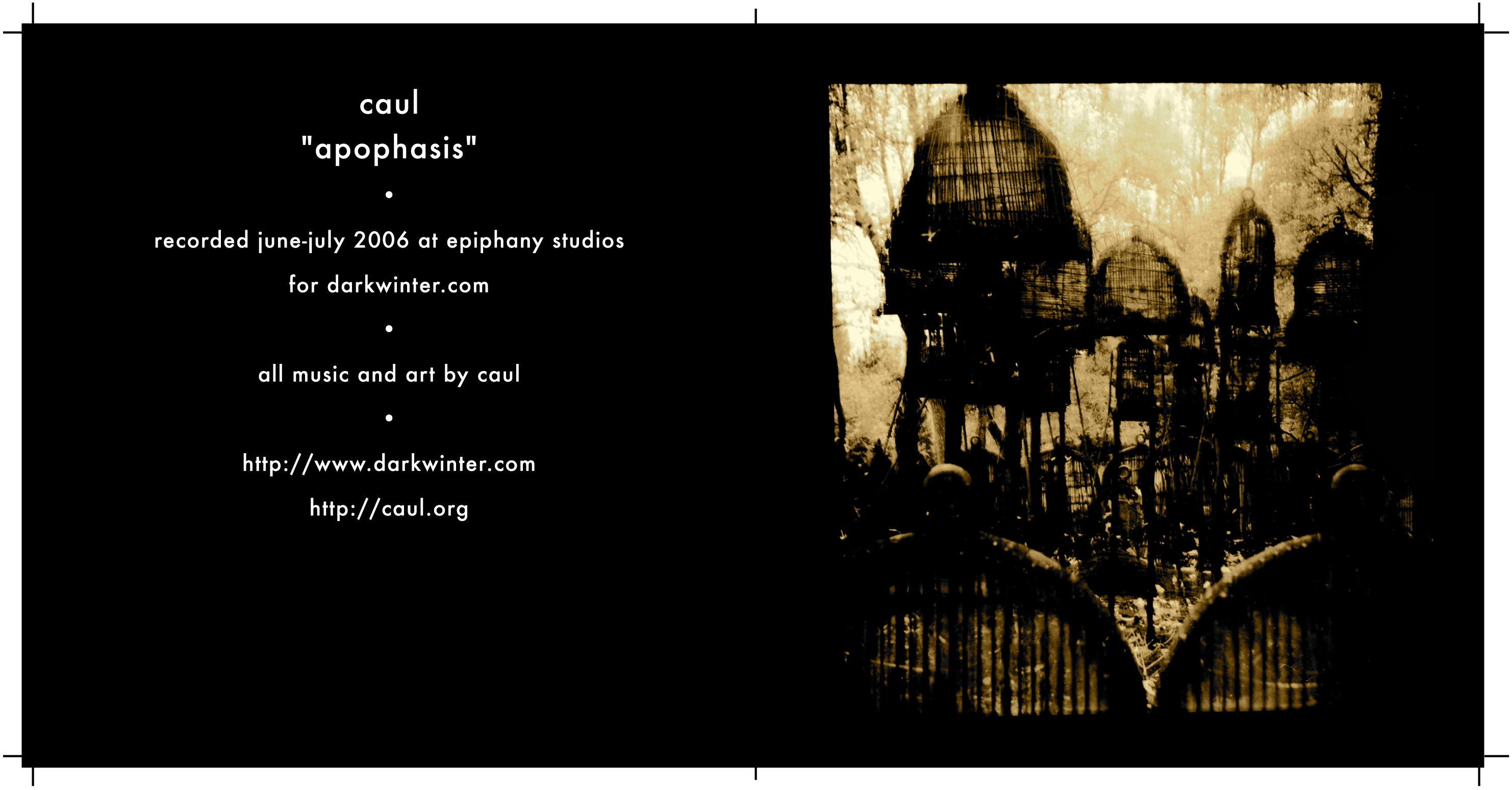
Apophasis by Caul is the latest release from the estimable darkwinter.com netlabel. It’s a single, nearly hour-long track of pop-minded decay, all the threatening ambience of a horror film with none of that bothersome plot (MP3). Dark Winter also includes downloadable cover art with its releases, should you want to print out a booklet and burn the files (or, this case, single file) to CD. The art for Apophasis (JPG), done by the musician, is a contemporary spin on Brueghel. Imagine the Tower of Babel drawn by Dave McKean or Ben Templesmith and you’ll have a sense not only of the art, but of how the track sounds. More info and music at caul.org.
Japanese Minimalist MP3
The 12k label, run by musician Taylor Deupree, has posted a full-length preview track off Letter of Sounds, the forthcoming album by Fourcolor (born Keiichi Sugimoto, part of the quartet Minamo and the duo Fonic). “Vignette” (MP3) is a through-composed marvel, developing from digital underbrush of sharp bleeps and warm tones to incur its own slowly motivated sense of rhythm, which has a funky kind of hesitance to it, to eventually provide a setting for a cautious guitar line. Great stuff. And to keep up to date on all things 12k-related, keep an eye on Deupree’s blog, 12kblog.wordpress.com.
Trimpin Sound-Art MP3
The first two syllables in “Conloninpurple,” the name of Trimpin‘s current installation at the Ojai Valley Museum in California, are indeed in reference to composer Conlon Nancarrow. The late Nancarrow is best known for having used the player piano to write music largely unplayable by human hands. Trimpin, a Seattle-based musician/inventor whose work has gotten attention from the New Yorker in the past year, created a computer-propelled musical instrument that fills a room. According to the museum’s website, “It consists of sixty sounders covering five octaves. Each sounder is driven by an electrical solenoid, which, when triggered, strikes a block of wood of a given length. The note given off is naturally amplified and directed by a tuned, resonant tube of anodized aluminum. Each pipe consists of an inner and outer sleeve, allowing the length to be adjusted as the inner sleeve slides in or out of the other.” One sample audio recording is available for download (MP3), a kind of Fourth World calypso. More info at ojaivalleymuseum.org, the website of the museum where the piece will remain until August 31. (Via musicthing.blogspot.com.)
Generative Monolake MP3s
A new version of the popular music software Ableton Live has been announced. Ableton is gearing up to release Live 6. Musicmakers will be happy to check out the Ableton website, ableton.com, and read about drag’n’drop movie importing, project management tools and “multicore” processing, not to mention its massive “library of meticulously sampled and selected instruments” and a new emulator of vacuum tubes.
Now, whenever there’s a new edition of Live due out, a release by the musician Monolake (aka Robert Henke) isn’t far behind. This is because Monolake is one of the programmers on Live, and the Ableton company was founded by Gerhard Behles, who was Henke’s partner in Monolake for its early releases. Monolake music releases are almost always timed to the arrival of a new Live software release, but Henke is more than just the company’s marquee clothes horse; he’s also its most celebrated alpha-tester, working the software hard in advance of it being offered to the general public.
A quick check of Monolake’s website, monolake.de (look at the “download music” page), indeed reveals two MP3s that appear to have been built on early versions of Live 6. Under the heading “generative ambient,” Monolake lists two freely downloadable files, explaining, “these are pieces created using random operations in Ableton Live (six tracks with Random>Scale>Chord>Operator>Audio FX, triggered via Follow Actions, sets will be posted in software section after Live 6 is out.) They run forever. I just made a recording while they were running.”
By “generative,” Henke means that the files contain music that was less composed in a traditional sense than that it is the result of systems he put together in Live 6 and let run freely. According to his post, once Live 6 has been released, he’ll make some of these patches, or subroutines, available for download as well. In other words: an impending software upgrade engenders experimental music, which engenders more software. (Though Live 6 isn’t commercially available yet, a beta version will be posted for free download and further testing. More info at ableton.com.)
Judging by the file names of the generative Monolake tracks, the shorter of the two, a bouncy, 14-minute round of ping-pongy restraint (MP3), was produced on June 26 and the longer piece, an hour-plus excursion into far more subtle, gently vibrating tones that suggest a tour of an imaginary landscape (MP3), was done as recently as July 6.