Scratch Pad: Polyrhythms, Fonts, Obsidian

From the past week

I do this manually at the end of each week: collating most of the recent little comments I’ve made on social media, which I think of as my public scratch pad. I also find knowing I will revisit my posts to be a positive and mellowing influence on my social media activity. I mostly hang out on Mastodon (at post.lurk.org/@disquiet), and I’m also trying out a few others. And I generally take weekends off social media.

▰ Afternoon trio from grumbling tummy, squawking crows, and the distant rumbling of internal combustion vehicles

▰ Vehicular polyrhythm of a car alarm going off and then the owner causing it to emit additional bleeps during ongoing failed attempts to sort out which button sequence turns off the car alarm

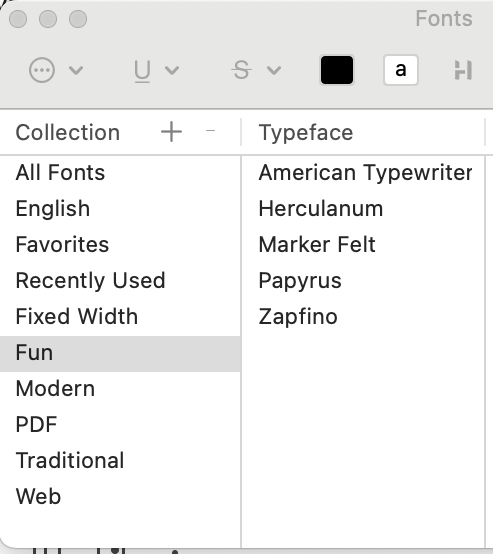
▰ I love that “fun” is a font category on my computer’s OS. Somewhere there’s a typographer thinking: “My font’s friggin’ fun. Why the heck isn’t it on that list?!”
▰ I didn’t expect, when I started using Obsidian, that I’d use its native daily notes, since I’d already been compiling my own into monthly docs. But I’ve switched. This is about as big a change to my note-taking as I can recall in many years. And it’s great. One tip: I recommend adding the abbreviated day of the week (YYYY-MM-DD-ddd) to the file name so they’re more easily identifiable. It really does help me to understand some notes when I consider the day of the week they were written.

▰ And another Obsidian thing: tables. The recent(ish?) upgrade makes them so simple to use, and now I find myself using them all the time: for little to-do lists, to organize key points, to correlate related information. The ability to move rows and columns manually on a whim is fantastic.

▰ Not sure when I became a person who pre-orders books fairly frequently but I’m a person who now pre-orders books fairly frequently. Recently: the new Robin Sloan (Moonbound), the imminent China Miéville/Keanu Reeves (The Book of Elsewhere, related to the Brzrkr graphic novels, which I read earlier this year), and the later-this-year Neal Stephenson (Polostan). Which makes me realize: as much non-genre stuff as I read, I’m not “following” non-genre writers as way I once did. Dunno. Just sort of observing my own reading trends. Currently really digging Ed Parks’ Same Bed, Different Dreams and Virginia Woolf’s Mrs. Dalloway. Yes, she’s dead. I know.

▰ The YouTube video recommendation algorithm generally has my number (or numbers: synthesizers, guitar tutorials, non-comedic TV/movie previews, comics/scifi/literary author interviews, gadget news), except it persistently exhibits an impression that I’m interested in Pink Floyd and Frank Zappa

▰ Who ruled that YouTube videos need to be lit like they were filmed on a Virgin Airlines flight?

▰ How many videos are in your YouTube “watch later” playlist? I’ve got 2,070.

▰ Obsidian-heads: I’ve begun using the inter-file linking, which is quite remarkable (like how files names update within docs). However, I worry that if I use that, I’m locking myself into Obsidian (which runs contrary to its plain-text appeal). Are such links more “portable” than I think they are?

▰ Happiness is waking up to a photo in your email inbox of a sneak peek of a CD insert featuring liner notes you wrote

▰ Reading: apparently I haven’t registered here some of the books I’ve finished reading recently, not since June 8. I’ve read a lot, but just — well, not “just,” but relative to how much I’ve read it feels like just — finished three novels, or a novella and two novels. The novella: The Jade Setter of Janloon by Fonda Lee, set in the world of her excellent Jade trilogy. I hope she puts out one of these every year or so forever. Then Moonbound (more on which this coming week) by Robin Sloan, whose Mr. Penumbra’s 24-Hour Bookstore I re-read in advance of this coming out. And then Max Barry’s Lexicon, which has a lot in common with R.F. Kuang’s Babel: Or the Necessity of Violence: An Arcane History of the Oxford Translators’ Revolution (they’re both about language as a form of magic), which I read earlier in the year. Currently working my way through a bunch of books, of which I’m likely to finish Ed Park’s Same Bed, Different Dreams and Cal Newport’s Deep Work: Rules for Focused Success in a Distracted World first. But we’ll see.
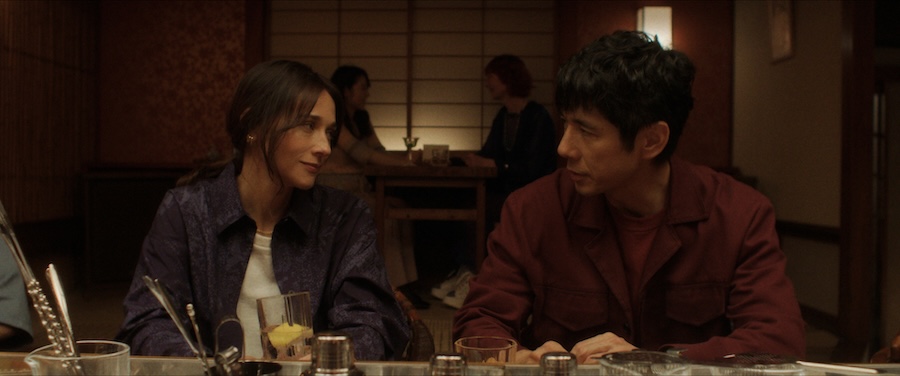
The Intimate Sound Technology of ‘Sunny’

Audio interfaces get their own voice in the new Rashida Jones TV series

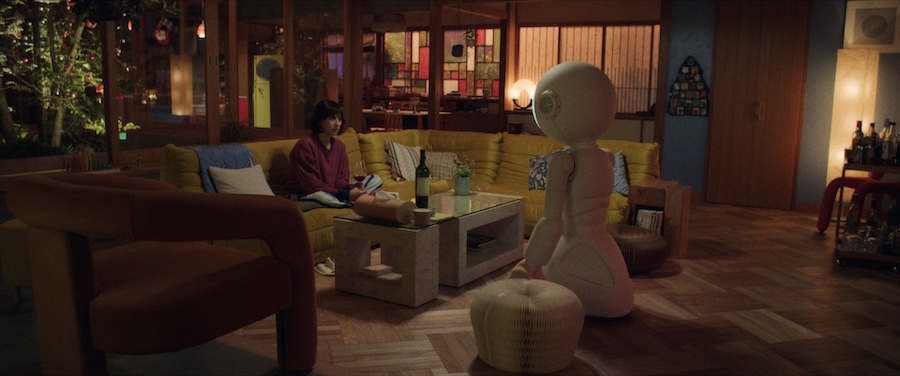
The new TV series Sunny, from Apple, stars Rashida Jones as an apparent widow in Japan, her husband and son having disappeared during a plane crash. I say “apparent” because as of this writing we’re two episodes in and very little is certain. Jones’ grieving character, Suzie, is left alone in the family’s Kyoto home until a robot, named Sunny, is delivered by a colleague of Suzie’s husband. The robot is quite advanced, nudging the story from our own Roomba-and-Alexa present to something slightly further into the technological future — along the lines of WALL-E meets Severance

There is an array of unfamiliar gadgetry in Sunny, from ambiguous handhelds to textile-like product design, and sound is a factor in many of the interfaces. Yes, there’s no small irony to this being an Apple production, all the more so given how fraught some of this technology’s presence is, at least as far as Suzie is concerned. (The series is based on the novel The Dark Manual by Colin O’Sullivan.)

In the first episode of Sunny, the emphasis is on a secondary device, an earbud translator, which lets Suzie, who doesn’t speak much Japanese, participate more freely in society than she might otherwise. The show, which grapples with various forms of new technology, has moments when unintended consequences surface, such as when someone accidentally overhears Suzie and then admonishes her for speaking within earshot while they still have their earbuds in. This happens, as well, with Suzie’s mother-in-law, a fierce yet sympathetic Judy Ongg, and the moment marks Ongg’s character as more stranger than relative.

In the second episode, we witness the meet-cute moment between Suzie and her husband, Masa, who may or may not be an inventor of the robot Sunny and its ilk. At one point Masa, played by Hidetoshi Nishijima (who was fantastic in the movie Drive My Car, by Ryusuke Hamaguchi — who has his own intense relationship with sound in filmed narrative), struggles with the correct English words for something he wants to express, and Suzie reaches for her earbuds to make it easier for him to communicate. 

They’re both damaged people. Masa has emerged from his own dark period, whereas Suzie seems to be just now entering her own. Masa stops Suzie from using the earbud, and it’s a touching moment. We see that Masa would rather risk being seen as ineloquent than have their fledgling relationship get mediated by technology. (Maybe he knows something she doesn’t.) I don’t want to give too much away, so let’s just say it’s a double effort on his part, in this scene, to be seen as struggling — and that his concern about technology rubs up against what we at least seem to know about him in the story’s present tense. Again, this scene is their origin story, set a decade earlier.

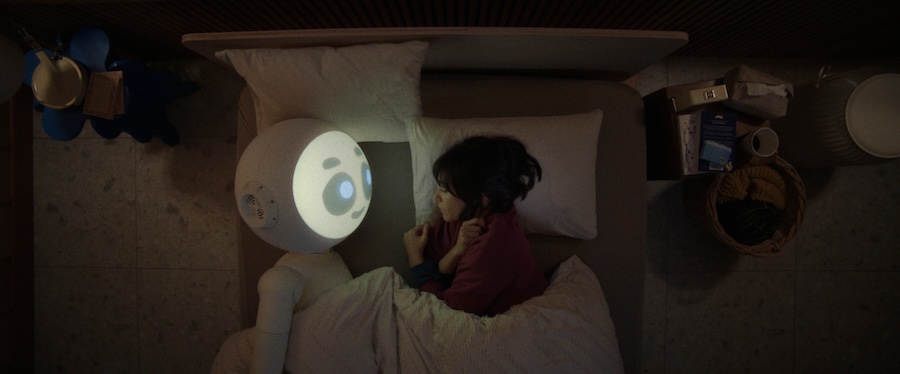
And then there is, also in the second episode, Suzie’s other main relationship so far — not the one with her nuclear family or her somewhat distant mother-in-law, but the newly arrived robot, Sunny. With Suzie’s husband and son out of the picture, so to speak, most of Suzie’s relationships are with women (there’s also the bartender Mixxy in the first episode), of which Sunny appears to be adjacent, as is de rigueur, problematic as such e-gender modes may be, for domestic virtual servants (not least among them, Apple’s own Siri). At the end of the second episode, Suzie and Sunny end up next to each other in bed — it’s not sexual — and the following brief conversation occurs:

Suzie: “Are you breathing?”

Sunny: “Just a sound effect. I thought you’d like it. I can stop.”

Suzie: “No. I like it.”

Now, Sunny was introduced to us, and to Suzie, as primed for Suzie as her user. There are lingering questions as to whether Masa himself was part if not of Sunny’s overall development and design, then at least of its optimization and personalization for Suzie. In this moment, though, it is not a third party, but Sunny itself/herself who is doing the interpersonal-alignment fine-tuning: adjusting tone to match the needs of not just her interlocutor but, for all intents and purposes, her owner. (The character is voiced by Joanna Sotomura.) It says something about their interaction that Sunny can employ a term as purely functional as “sound effect” without negating the realism of its/her own seeming humanity. 

. . .

VOICE ACTIVATED
On the topic of voice, technology, and culture — more items:

▰ AI Tolerance: There’s an actual robot bartender — combining, as it were, two of Sunny’s characters — by a company called Cecilia.ai

▰ Chat Trick: The in-the-works higher-end Alexa, called Remarkable Alexa, may be in jeopardy if it can’t deliver results. 

▰ On Background: Google’s Gemini assistant/service/chatbot may have an always-on mode, stoking privacy concerns, based on a peek at the underlying code that revealed “a string that mentions a ‘background_mode.’”

▰ Speaker Box: The Mayo Clinic reports the “first known successful total larynx transplant.”

▰ Logic Branch: Mat Eric Hart wonders What Sounds Do Trees Make? — opening with a quote from Richard Powers’ novel The Overstory: “they speak on frequencies too low for people to hear.”

This originally appeared in the July 12, 2024, issue of This Week in Sound.

Obsidian Graph View

A use case at last

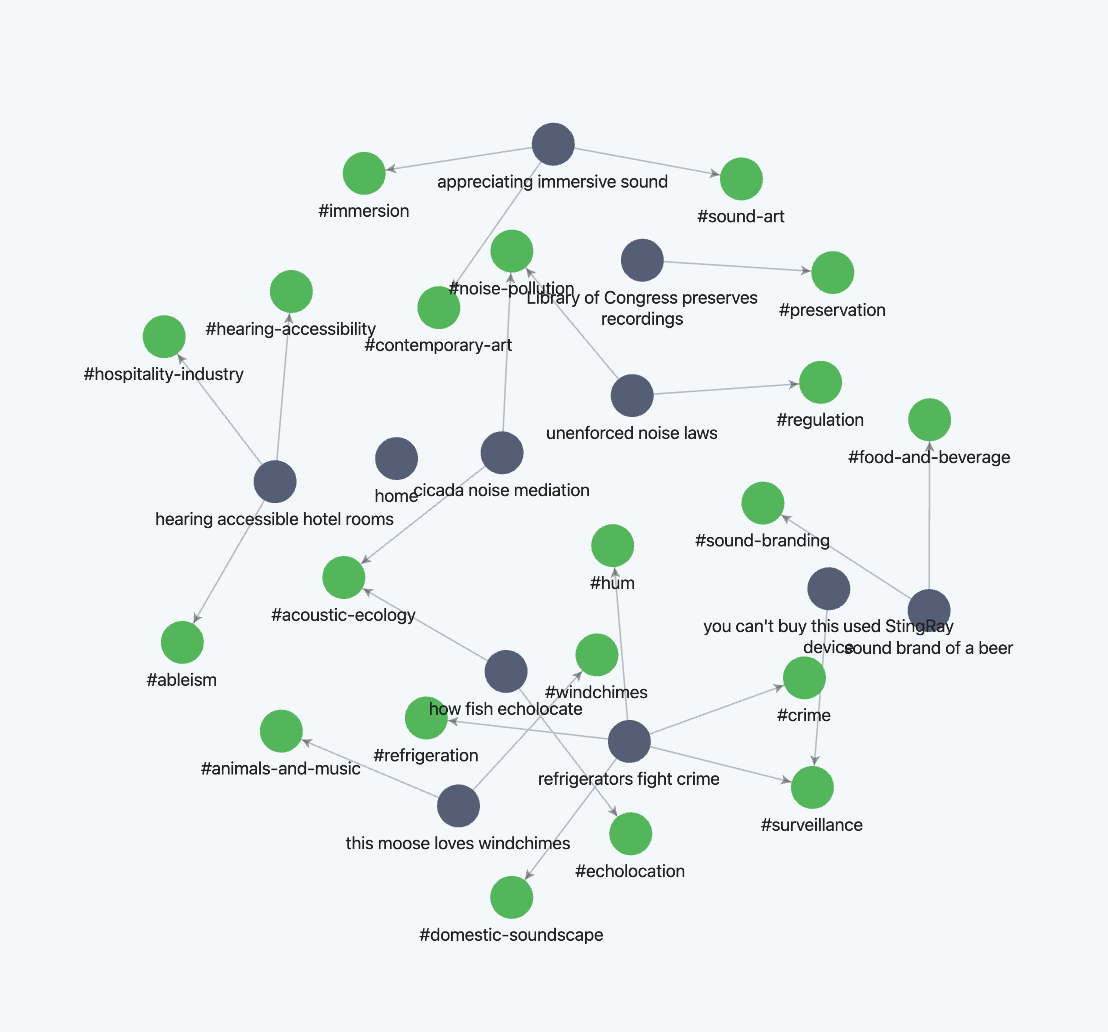
One last note before going quasi-offline for the weekend: I finally found utility in the Obsidian feature called “graph view,” which is that I put a ton of my recent sound studies news items in and I tagged ’em, and that helped me locate clusters of related information by visualizing connections for my This Week in Sound email newsletter. Those examples shown here, by the way, are not from this week’s issue but instead from the previous issue.

Experimenting with Format

In my This Week in Sound email newsletter

As you can tell from the piece on the TV series Sunny in this week’s issue, I’m experimenting with format. I want the newsletter to feel less like I’m offloading homework onto the reader. Much as I like being fairly upstream with news, much as I like observing topics coalesce over weeks and years, data points not necessarily evident as a through-line except in retrospect, I think there’s value in my clustering these sound studies findings. Thus in this issue I have, among other things, a “lead” story about digital voices in Sunny, followed by a variety of other current stories that engage with voice, technology, assistants, and culture but that have no direct ties to Sunny. It’s an experiment.