Disquiet Junto Project 0166: Slow by Steps

Take a pre-existing track, slow it in descending states, and then add something to it.

20150305-dj166

Each Thursday in [the Disquiet Junto group on SoundCloud.com](https://soundcloud.com/groups/disquiet-junto/) and [at Disquiet.com](https://disquiet.com/tag/junto/), a new compositional challenge is set before the group’s members, who then have just over four days to upload a track in response to the assignment. Membership in the Junto is open: just join and participate.

Tracks will be added to this playlist for the length of the project:

This assignment was made in the evening, California time, on Thursday, March 5, 2015, with a deadline of 11:59pm wherever you are on Monday, March 9, 2015.

These are the instructions that went out to the group’s email list (at [tinyletter.com/disquiet-junto](http://tinyletter.com/disquiet-junto)):

Disquiet Junto Project 0166: Slow by Steps

Take a pre-existing track, slow it in descending states, and then add something to it.

This week we’re slowing down an ancient piece of audio, dating from 1910, and adding sounds atop it to create one continuous composition.

Step 1: Download at http://goo.gl/aMlHXm a public-domain recording of Eugène Ysaÿe performing “Rondino” by composer Henri Vieuxtemps. (Note: If you land on the new archive.org site and can’t figure out how to download, click on the “exit beta” button in the upper-right-hand corner of the webpage to go to the original archive.org site design, where the downloading is self-evident.)

Step 2: Choose a short segment of the recording, roughly between three and five seconds. Label it as Segment A.

Step 3: Create a Segment B by slowing Segment A to half its original speed.

Step 4: Create a Segment C by slowing Segment B to half its original speed.

Step 5: Create a Segment D by slowing Segment C to half its original speed.

Step 6: Create an underlying foundational track by stitching instances of A, B, C, and D together in that order. Recommended for a five-second segment is Ax4, Bx2, C, D (or AAAABBCD), which would be 100 seconds.

Step 7: Create a new piece of music by recording accompaniment to add to the foundational track, which will otherwise remain unadulterated.

Step 8: Upload the combination of your accompaniment and the foundational track to the Disquiet Junto group on SoundCloud.

Step 9: Then listen to and comment on tracks uploaded by your fellow Disquiet Junto participants.

Deadline: This assignment was made in the evening, California time, on Thursday, March 5, 2015, with a deadline of 11:59pm wherever you are on Monday, March 9, 2015.

Length: The length of your finished work should be roughly between one and three minutes.

Upload: Please when posting your track on SoundCloud, only upload one track for this assignment, and include a description of your process in planning, composing, and recording it. This description is an essential element of the communicative process inherent in the Disquiet Junto. Photos, video, and lists of equipment are always appreciated.

Title/Tag: When adding your track to the Disquiet Junto group on Soundcloud.com, please include the term “disquiet0166-slowbysteps”in the title of your track, and as a tag for your track.

Download: It is preferable that your track is set as downloadable, and that it allows for attributed remixing (i.e., a Creative Commons license permitting non-commercial sharing with attribution).

Linking: When posting the track, please be sure to include this information:

More on this 166th Disquiet Junto project — “Take a pre-existing track, slow it in descending states, and then add something to it”— at:

Disquiet Junto Project 0166: Slow by Steps

More on the Disquiet Junto at:

https://disquiet.com/junto

Join the Disquiet Junto at:

http://soundcloud.com/groups/disquiet-junto/

Disquiet Junto general discussion takes place at:

https://disquiet.com/forums/

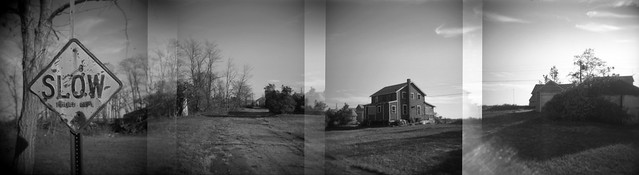
Image associated with this project by Bruce Berrien, used thanks to a Creative Commons license:

Slow Road

This Week in Sound: Misophonia, Fridays Are the New Tuesday

Also: Google crowd-surfing and Wikipedia activism

A lightly annotated clipping service:

— Misophonia Home: At the New York Times, Barron H. Lerner, M.D., a professor at the NYU Langone Medical Center, writes about the condition that makes some individuals hypersensitive to specific sounds, often sounds associated with the human mouth. He discusses how the existence of the diagnosis is itself a source of comfort to sufferers, an idea that connects to something I often focus on in relation to noise pollution complaints: to the cultural context that makes noises seem louder or quieter.

http://well.blogs.nytimes.com/2015/02/23/please-stop-making-that-noise/

— Aphex Activity: I was happy that Flavorwire’s Jesse Jarnow covered my proposed Selected Ambient Works Volume III, a playlist culled from the 173 tracks currently up on Aphex Twin’s rogue SoundCloud account. As Jarnow notes, one particularly effusive collation of Richard D. James’ off-label activity is a crowd-sourced effort to identify characteristics, such as era and source audio, for the numerous tracks. The hive mind’s tool of choice? A massively shared Google spreadsheet:https://docs.google.com/spreadsheets/d/11ouNaaVrNp60Ib34Kp0TO1n1XSc7-9DvfiZ9ZiTiD2c/edit?pli=1#gid=0

http://flavorwire.com/507391/alternate-routes-aphex-twin-gives-it-away-the-dude-sleeps

— Industrial Calendar: Whether with a whimper or a bang, it is as of yet unclear, but the “global music industry” has decided, as reported in Billboard, that Friday is now the official release date for record albums, in order to fight piracy. In the U.S. it has historically been Tuesdays, followed the next day by comic-book Wednesday. What effect this will have, aside from making lower-level record-industry employees work over the weekend playing whack-a-mole with piracy sites, is not clear. What effect this will have on the growing legion of musicians who post their releases as they see fit to Bandcamp, SoundCloud, and other such services, or who pre-sell through campaigns on Kickstarter and PledgeMusic and the like, is all the more unclear. Quite likely they’ll simply ignore it:
http://www.billboard.com/biz/articles/news/retail/6487290/industry-sets-friday-as-global-record-release-day

— Wikipedia Activism: At ArtNews, Robin Cembalest covers an effort by 600 volunteers to contribute to an “edit-a-thon” to significantly increase the presence of women artists on Wikipedia, among them Cosima von Bonin and Aviva Rahmani, both of whom work with sound. This is a tremendous effort, and one worth emulating in various fields and disciplines. (Found via Shane Myrbeck.)

http://www.artnews.com/2014/02/06/art-and-feminism-wikipedia-editathon-creates-pages-for-women-artists/

*This first appeared in the March 3, 2015, edition of the free Disquiet “This Week in Sound” email newsletter: [tinyletter.com/disquiet](http://tinyletter.com/disquiet).*

Sound Class, Week 5 of 15: Product Design

Soundscape, soundmark, acoustemology -> potato chips, Harley engines, Windows 95

A potato chip, an electric car, and a TV network all walk into a classroom …

Well, not the best start to a joke. Nor is, “What do a motorcycle, an alarm clock, and an operating system have in common?” But however poorly crafted the jokes, the extent to which consumer products not considered inherently sonic often have strongly considered, and sometimes legally contested, sonic profiles is a rich topic to explore.

The role of sound in product design is the subject of week 5 of the 15-week course that I teach on the role of sound in the media landscape at the Academy of Art in San Francisco. After three weeks spent studying listening, we now spend seven weeks on the second arc of the course: “sounds of brands.”(A third and final arc, “brands of sounds,” begins week 11.) After spending week 4 on the history of the jingle, we proceed to “product design.” Each week of the 15-week course my plan is to summarize the previous class session here. Please keep in mind that three hours of lecture and discussion is roughly 25,000 words; this summary is just an outline, in this case less than 10 percent of what occurs in class.

Before we dive into particular products and their respective sonic design components, I back up to a broader subject, one that we then use to consider the role of sound in product design. I start by exploring the word “soundscape,” as developed by composer and acoustic ecologist R. Murray Schafer. I share this definition of soundscape: *”[W]e regard the sounds of the environment as a great macro-cultural composition, of which man and nature are the composer/performers.”* I explain how the definition appears in a document developed by Schafer’s World Soundscape Project, which he founded in 1969 at Simon Fraser University. The quote is from the *World Soundscape Project Document No. 4 of 4: A Survey of Community Noise By-Laws in Canada*, published in 1972. We talk about “soundscape” frequently in the class, and today we focus on it for the longest time of the semester, discussing how the term is rooted in the idea of a “landscape,” and how the terms differ. I mention that the “composer/performers” description might be helpfully expanded to “composer/performers/audience.”

From “soundscape” we move to “soundmark,” utilizing this helpful employment, also by R. Murray Schafer, from his 1977 book *The Tuning of the World*, later re-titled *The Soundscape*: “Once a soundmark has been identified, it deserves to be protected, for soundmarks make the acoustic life of a community unique.” We discuss how much as “soundscape” is rooted in the term “landscape,” the term “soundmark” is rooted in “landmark” — and also, arguably, in “trademark,” which comes up later in today’s class. One of the great things about teaching at the Academy of Art is the international make-up of the student body, and we spend time today with people noting soundmarks from their own hometowns. I mention Big Ben in London, and the streetcars of New Orleans, and the Tuesday noon siren in San Francisco as examples.

Whenever I introduce a new term in class — from “ambient” to “anechoic” to “room tone” to “retronym” — I make a point that I ultimately don’t care if the students remember the specific words. I care that they remember the ideas the words represent. That’s a helpful distinction. It’s easy to remember specific definitions of terms, but harder to learn how to really employ a word, an idea, in one’s thoughts and writings. We do exercises where we explore the ideas inherent in a given term, without using the words at all. I don’t care if they remember the word “anechoic” years from now; I care that they remember the concept of the anechoic chamber, and perhaps have to scratch their head to remember what the actual word is.

I introduce the day’s third major new vocabulary term by explaining that it is the most complex of all the terms we’ll discuss, and the one they’re likely to have the greatest difficulty with. The word is “acoustemology,” and I find it highly useful. Here is the definition: “local conditions of acoustic sensation, knowledge, and imagination embodied in the culturally particular sense of place.”That’s from Steven Feld’s “Waterfalls of Song”in the collection *Senses of Place*, published in 1996. The term is a useful expansion of the idea of a “soundscape.” One of the complications of talking about a soundscape with students is the difference between, say, the soundscape one experiences in a given moment from the Platonic ideal soundscape associated with that same place. Feld’s concept of “acoustemology” gets at the inherent sonic potential, the sonic potential energy, of a place, and the term’s focus on culture gets at how humans don’t just contribute sound to an environment; they inherently lend meaning to sound, hence his emphasis on “imagination.”

After the mid-class break we talk through various examples of sound in product design, utilizing the idea of soundscape, soundmarks, and acoustemlogy. We discuss Dr. William E. Lee III, as quoted in a Discover article by Judith Stone, on the role of sound in potato chips. It’s an article I’ve been using ever since I started teaching this course, back in 2012. Dr. Lee says, at one point, “People will move snack food around the mouth to maximize noise. Kids have what I call noise wars — they crunch in such a way that they’re throwing noise at each other.”

I show a brief promotional video from the car manufacturer Audi talking about the role of sound in electric vehicles. We discuss the notion of sonic “skeuomorphism.” A skeuomorph is a design element that in its initial appearance had some functional role, and is later retained for largely decorative purposes. The term is often discussed in regard to Apple’s OS design prior to Jonathan Ive’s promotion from hardware design to also lead software design. We talk about the original shutter sound of a camera, later employed on digital cameras, and connect those sounds to the engine noises being produced by companies such as Audi for their electric vehicles.

As Michael B. Sapherstein wrote in a 1998 analysis of Harley Davidson, as of that year of the nearly three quarters of a million trademarks enforced in the United States by the Patent and Trademark Office, the number related to sounds was … just 23. We discuss a suit against Honda by Harley regarding its engine noise, and Harley’s failed attempt to trademark that noise. And, among other examples, I bring up, by way of contrast, a sound not directly resulting from engineering, but one added consciously to a product: the startup sound of an operating system. Brian Eno developed a startup sound for Windows 95, and he famously was given by Microsoft a list of “about 150 adjectives”that the sound should encompass.

How product design connects to soundscapes, soundmarks, and acoustemology has to do with utilizing those frameworks as a means to consider the environment in which specific products are experienced, consumed, active.

One way I find helpful to consider such a thing is to draw a four-quadrant grid with “explicit” and “implicit” on one axis, and “product” and “category” on the perpendicular axis. We explore what sounds are “explicitly” associated with a given product, such as the “Snap, Crackle, and Pop” of Rice Krispies, and the engine noise of a Harley motorcycle, and those sounds that are more “implicit,” such as the lock of a car door or the beep of an external hard drive. One thing we explore is how such “implicit” sounds can become “explicit” through creative executions that tie the product to the sound, such as the click of the Microsoft Surface tablet.

We usually discuss Jacques Tati’s film *Playtime* at the end of this class, but this week was short due to a student-faculty event.

* Homework

As for homework, for the coming week students write four times in their ongoing sound journals, they propose subjects for in-class presentations, and they develop “brand playlists.” A this point in their sound journals, students are expected to have ceased doing journal entries that are simply lists of sounds, and instead be writing longer entries about fewer sounds — and, importantly, focused not on description as much as on meaning. For their presentation subjects they are instructed as follows: “It should be something personal to you, something important — a hobby, a favorite place you like to visit, a sport you play, etc. In your presentation you will discuss the role of sound in relation to that subject.” And this is the longest of the week’s homework assignments, the development of a “brand playlist”:

“You will develop three in-store “playlists”: sets of pre-recorded songs to be played in retail establishments. Each playlist is to be formatted as follows: (1) the name of the retail brand, (2) a brief slogan (ten words or fewer) summarizing your playlist’s approach, (3) a list of six example songs from the playlist (for each song note the artist, song title, album source, year of release), (4) a summary (approximately 200 words) of the creative approach you are taking and how it aligns with the store’s products, category, and audience — in particular, in some way the playlist should connect to either the implicit or explicit sounds of the given brand.”

Next week: The sound of retail space.

*Note: I’ve tried to do these week-by-week updates of the course in the past, and I’m hopeful this time I’ll make it through all 15 weeks. Part of what held me up in the past was adding videos and documents, so this time I’m going to likely bypass that.*

*This first appeared in the March 3, 2015, edition of the free Disquiet “This Week in Sound” email newsletter: [tinyletter.com/disquiet](http://tinyletter.com/disquiet).*
New William Basinski Track

A "Cascade" in the works

20150303-wb

Earlier today, William Basinski updated his [soundcloud.com](https://soundcloud.com/william-basinski) account for the first time in roughly a year. The track is “Cascade Excerpt.” It is characteristically elegant, somehow both angelic and desolate. As the track’s title suggests, and is often the case in Basinski’s music, the sound is that of a deeply echoing, richly refracted environment. Each sound is heard retreating and decaying in warbling stages, and the routine yet variegated nature of this decay makes the exact start point of a given cycle increasingly difficult to focus on, as if collected distant echoes in turn combine to form a new initial step of the ongoing process. The sound is like that of some majestic crystal cathedral shattering in exceedingly slow motion, forever.

According to the brief accompanying liner note, the track was posted as a result of the “premium direct to fan solution” website limitedrun.com, so perhaps Basinski has something new coming. A longer video of “Cascade” was posted at [the website of the New Yorker](http://video.newyorker.com/watch/annals-of-sound-william-basinski-s-cascade) late last year:

Track originally posted at [soundcloud.com/william-basinski](https://soundcloud.com/william-basinski/cascade-edit). More from Basinski at [mmlxii.com](http://www.mmlxii.com/).

Randomness in the Hand of a Composer

More from Caitlin Rowley's "Year of Fear"

Caitlin Rowley has committed chance actions to a fixed document, making something not so much from nothing as from a collection of of things with nothing in common — nothing except her desire to challenge herself. The result is a narrative sequence of sonic snapshots, with the occasional striking moment, such as the glass-chime ping at 1:09, that evidence the constructing hand of a composer.

She writes:

>”This piece experiments with a number of things I usually avoid when working with recordings – a very tight deadline (4 hours), loops, rhythmic material, voices, musical material and sounds from a variety of sources rather than a single location. … The bulk of the material for this piece was recorded at Borough Market, but there are also recordings from rehearsals at Trinity Laban, from the Kent County Fair and from Pompeii in Italy, as well as object recordings I made at home.”

Track originally posted at [soundcloud.com/caitlinrowley](https://soundcloud.com/caitlinrowley/random-study-no-1). More from Rowley, who calls 2015 her “Year of Fear,” in which she’s challenging her artistic process by “seeking out new areas of insecurity,” at [caitlinrowley.com](http://caitlinrowley.com/). More power to her.