

These sound-studies highlights of the week originally appeared in the May 30, 2023, issue of the Disquiet.com weekly email newsletter, This Week in Sound. This Week in Sound is the best way I’ve found to process material I come across. Your support provides resources and encouragement. Most issues are free. A weekly annotated ambient-music mixtape is for paid subscribers. Thanks.
▰ HAZARD LIGHTS: The PionEar is the name of a little device that alerts drivers visually on the chance they can’t hear an emergency siren. The device, intended in part for deaf and hard-of-hearing drivers, is part of the 2023 Hackaday Prize. It was created by Jan Říha of Brno in the Czech Republic. It uses machine learning to identify sirens amid any other noise that penetrates a moving vehicle.

▰ CUSTOMS CLEARANCE: Toward the end of an interview with Danielle Venne of Made Music Studio about the sounds of the Nissan Leaf electric car is this tidbit: “And in case you’re wondering why we can’t make our own sounds for our electric vehicles: After the U.S. Department of Transportation finalized its ‘quiet car’ rule in 2018, there was some hope among EV owners that the new regulation would bring with it the option to fully customize the sound of an individual car. For a few years, it seemed like drivers would someday be able to select from a catalog of sound effects to signal when their car is backing up or slowly pulling forward. … But last summer, safety regulators scrapped that plan, saying there was a lack of data illustrating exactly why that level of customization would be necessary.” (Thanks, Rich Pettus!)
▰ NIGHTY NIGHT: The latest from the great Cities and Memory series of crowdsourced projects is “seeking field recordings from all over the world that reflect your interpretation of sleep, rest and tranquillity – these restful soundscapes could be drawn from the natural world or man-made sounds, rural or urban.” Tracks are due by June 30. “Artists will reimagine recordings from a treasure trove of birdsong, wave sounds, nature, song, bell chimes and other calming sound sources to develop a suite of brand new pieces that will help listeners all over the world to find sleep.”
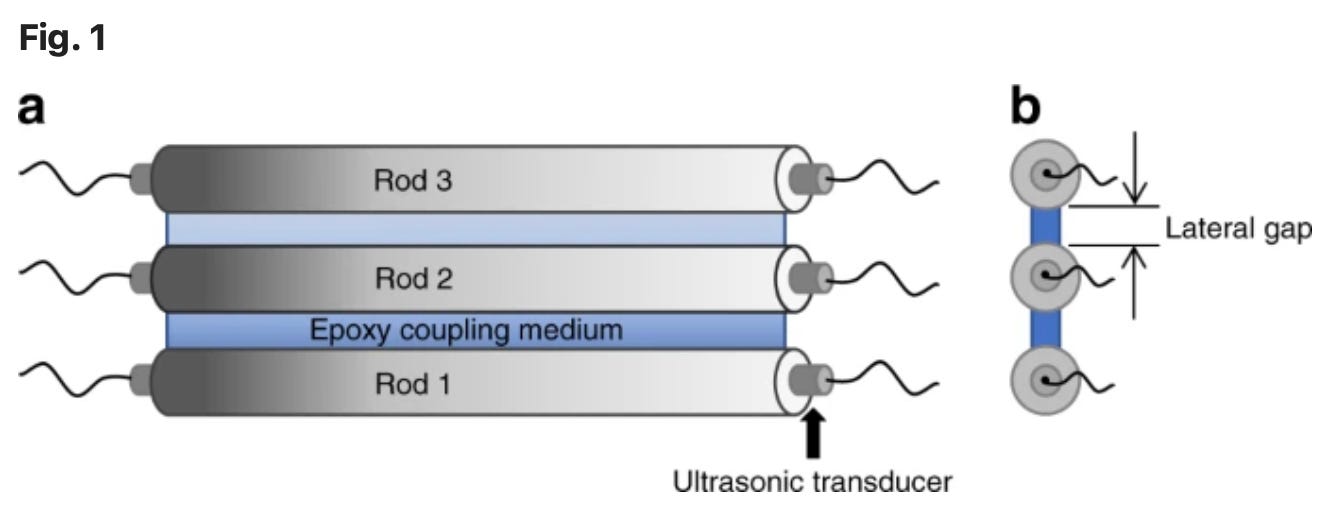
▰ ACOUSTIC COMPUTING: If you think quantum computing is confusing, how about using non-quantum resources to simulate quantum computing … using sound? Welcome to the “phi-bit,” per work presented at the Acoustical Society of America in Chicago earlier this month: “Some properties of quantum computers can be imitated with sound trapped in a simple mechanical device. This has the advantage of being less fragile than quantum computers, while still replicating some of their properties. … Pierre Deymier at the University of Arizona and his colleagues glued together three aluminium rods, each a little over half a metre long, to create something that could act like a quantum bit, or a qubit, but with a much larger device. Qubits differ from conventional bits because, in addition to encoding information as 1s and 0s, they also have many so-called superpositions that are both and neither at once. … The researchers used speakers to create vibrations at one end of the stack, and detected them at the other. When the sound frequencies were tuned just right, localised ‘chunks’ of sound formed in the rods – the researchers named them ‘phi-bits’. Deymier says that information could be input into the phi-bits by tuning the sound.” Members of the team back in 2019 reported progress on using such rods in the development of ultrasonic transducers.
▰ COMB FILTER: How do you find a bird no one has recently seen and for which “no definitive recording of the bird’s call exists?” When it comes to the South Island kōkako, of New Zealand, you turn to math: “[I]t’s thought to sound something like its North Island cousin, and to be a haunting call with organ and flute-like notes and some other sounds mixed in. … Using this as a starting point, mathematician Stephen Marsland at Victoria University of Wellington algorithmically generated every conceivable variation of this kind of call, and has used these to comb billions of hours of audio recordings from different locations for possible South Island kōkako calls. In this way, his team was able to identify 250 possible calls, and then narrowed these down further to only five, which are now under review by experts.”
▰ THUNDER FROM DOWN UNDER: A letter to the editor at NewScientist proposes an explanation for animal awareness of earthquakes: “As to animals being scared before a quake, infrasound (sound below the audible range) creates fright, even in us. It can be used in soundtracks to arouse fear. But we tend to live in places where it is drowned out. The early rumblings of an earthquake would produce such sounds and perhaps these scare horses and other animals.”
▰ QUICK NOTES: Another Dimension: Andy Price reports on the promise of a “post-stereo world,” (musicradar.com) — and yes, variations on the word “immersive” appear over 30 times on the webpage. ▰ Tatooine You: On the 40th anniversary of The Empire Strikes Back, here’s Ben Burtt and Randy Thom (at starwars.com) discussing some of the sounds from the film, including the voice of Jabba the Hutt (“a made-up language … based on the Peruvian-Incan dialect, Quechua”). ▰ Pole Position: From the latest update to the video game Minecraft: “Environmental Audio Changes – Audio positioning for ambient sounds is now emitted relative to the camera’s location” (sportskeeda.com). ▰ Just Browsing:Learn about a Chromium extension called Chrome Hotword Shared Module that reportedly appeared in version 43 of Google’s open source browser platform, and that is said to have disappeared as of version 46 (makeuseof.com). ▰ High Pitch:Read up on the sonic branding of the women’s Rugby World Cup 2021 in Aotearoa (New Zealand), an “audible memento by embedding the live sounds of the match — such as young female superfans’ voices, play-by-play commentary and the stadium atmosphere” (thedrum.com). ▰ Egged On: Ordinary everyday chickens served as the source material for the sound of ferocious dinosaurs mating in Apple TV’s Prehistoric Planet (variety.com). ▰ Let’s Submerge: “Bubble curtains” can reduce the impact of sound in the ocean (hackaday.com). ▰ Color Code: The “Shriek of the Week” is that of the greenfinch, which produces “a sudden drawn-out wheeze. Often this makes an abrupt change of tone in the middle of the trilling conversation, as in the recording above” (shriekoftheweek.substack.com). ▰ Air Fare: Which airlines have the best boarding music (travolution.com)? ▰ Voiceover Kill: If you think there are already too many podcasts, just wait for impact of AI-produced ones (wired.com). ▰ Medallion Cartel: The debate about the magical qualities of the taxi whistle in the final episode of The Marvelous Mrs. Maisel was pretty wonderful. (And the way she stared at that microphone was something else.)