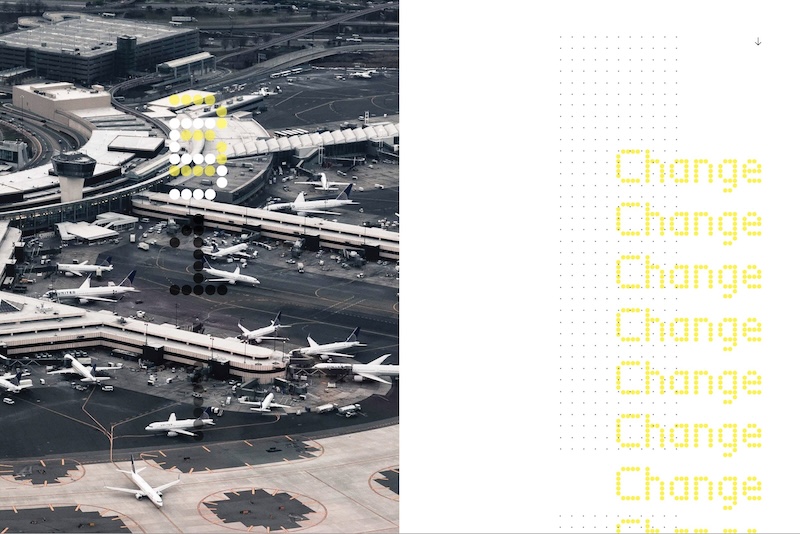
This short essay was part of the set of liner notes commissioned for the Audio Obscura album Music for Airports in the Age of Climate Change, released today, Friday, February 2, 2024. Design by David Barrington.
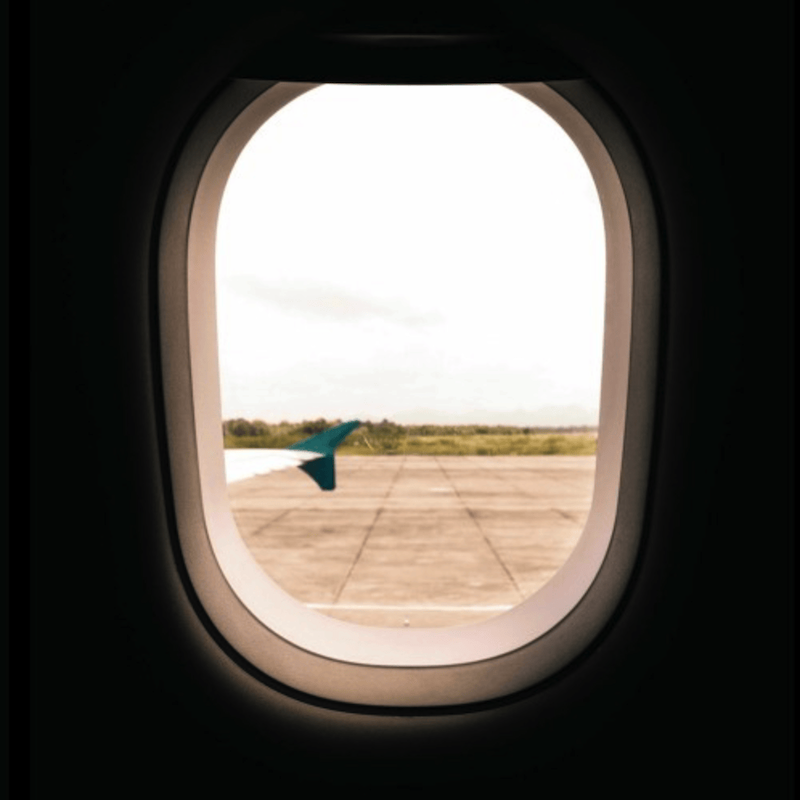
Brian Eno recorded his secular psalm to the protracted liminal state of mid-journey — that is, the album Music for Airports, released back in 1978 — for a very different world than today’s.
Flying — or, more to the point, preparing to fly as well as lingering afterward — is no longer a placid, refined, out-of-body experience, nor for at least a generation of travelers has it ever been.
Flying — by which we’ve always meant not merely the time spent airborne, but also when engaged in the overall multi-stage process of air travel — is no longer widely viewed as an extended moment filled with opportunities for reflection and, alternately, anticipation.
Flight is, quite the contrary, fraught — and inherently so.
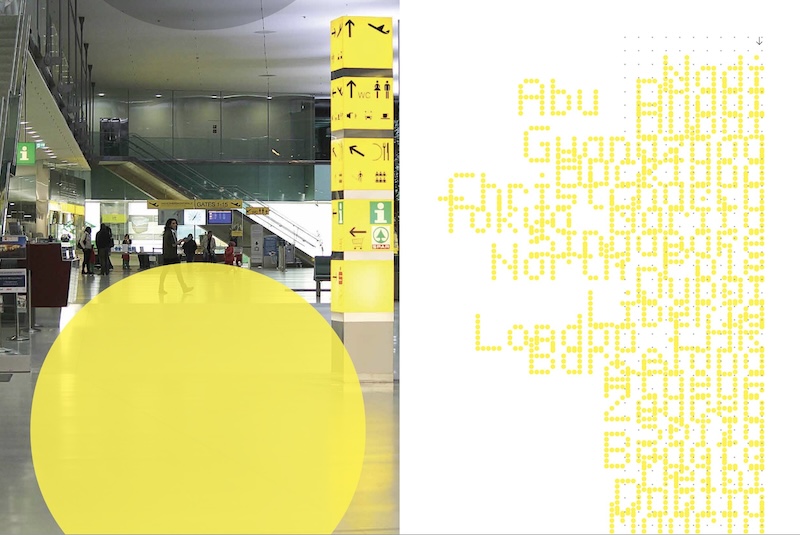
The host of causes for this significant cultural shift in attitudes are numerous, ranging from the existential (air rage, terrorism, disease) to the practical (cramped quarters, cost, privacy).
All of which concerns pale in comparison to the stated focus of the return trip that Audio Obscura has embarked on to Eno’s original work: climate change.
For what once was a weightless experience is now freighted with the matter of carbon emissions, among various other environmental factors.
The result of which is that the time-passing wait for a flight is no longer inherently a form of enforced stasis.
Instead, the wait is, for many, a ticking clock, its second hand echoing on an epochal scale; it is a countdown to rising temperatures, to rising seas, and to the impact they will have not just on humanity, but on the planet as a whole.
Like much science fiction — and what was Music for Airports other than a work of very-near-future science fiction, a concept album about technology’s ability to elevate humans not just physically but philosophically — Eno’s long-ago vision is now a portrait of an alternate future, one from which our present, nearly half a century on and well into the subsequent millennium, has irreparably diverged, tragically so.
Our present is one in which the damage incurred by travel is as easily assessed as — if less easily addressed than — the calorie count on a box of chocolates.
And yet …
And yet, for all that anxiety, the tension that fleshes out Music for Airports in the Age of Climate Change is seductive, meditative, and even comforting in its own way.
Built from field recordings, digital effects, new music, and copyleft creative reuse of pre-existing takes (composting being apropos), the new album summons up its own form of reflective state. The voices of flight alerts combine with glitchy textures to layer not merely apprehension but also experienced aesthetic factors onto the original work — and in those additional facets, Audio Obscura finds new sources for philosophical consideration.
Where the original was leavened by bits of “Frere Jacques” courtesy of pianist Robert Wyatt, a nursery rhyme this modern retelling isn’t, not by a long shot — but nor is it trafficking in fear-mongering or catastrophe porn. Audio Obscura instead finds beauty in the fraught, loveliness in the tension, and peace in the tight quarters.