
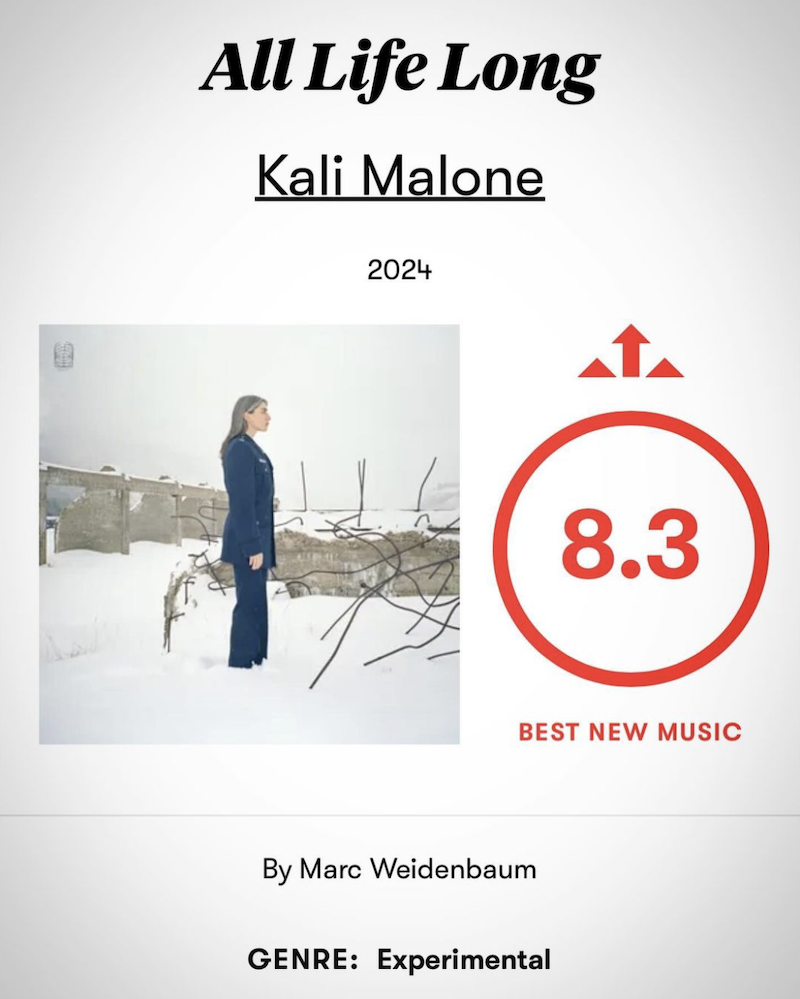
I had the great pleasure of reviewing All Life Long, the new album from Kali Malone, for Pitchfork, and when the editing was complete, I was informed the album would be part of the latest Best New Music lineup, which was fantastic news. It’s a great record, especially if you like organ music, early polyphony, and David Byrne’s The Knee Plays. The album marks a major step forward for Malone. Much of her catalog to date has consisted of exploratory drones. As I say in the review, “Malone’s latest work challenges today’s drone musicians to retain the delectable, psychedelic whir of drones while using them in the service of something melodically engaging.”
Here are the first three paragraphs:
A held chord on a pipe organ can signal a looming arrival—of a Boris Karloff character or, in a brighter register, the bride-to-be. Such a stately chord encapsulates anticipation. It makes its listener cognizant of waiting, because the instrument can sustain such a chord forever. That is how pipe organs function, and it is one reason they are perfect for churchly representations of heavenly—that is, eternal—choruses.
By contrast, if you hear a sustained note on a piano or saxophone, let alone sung by a singer, you know it has a finite lifespan: until the instrument—or lungs—give way. The limitless sustain of an organ is an innate superpower. Since you sense the organ’s stamina is inexhaustible, you know the player has complete discretion as to when whatever happens next will … actually … occur.
When that musician is Kali Malone, be prepared to wait—and, following momentary activity, to wait again. Malone is a poet of attenuation. The compositions on All Life Long proceed at the considered pace of a chess-by-mail match. Each step is a marker of choices made. As a listener, you pay attention not just to those steps but to the overtones that fill the air in between. Each chord is a burr of wonderment. To listen closely is to find compositions within, as waveforms meld, tones circle, and patterns shift with a dynamism initially belied by the seeming stasis.
Read the full piece at Pitchfork. And check out the record on Bandcamp.