
“Shouldn’t you have supersonic hearing or something?” asks the widow of the robot.
That is the question that Suzie directs at Sunny, after Sunny, having been just told not to, goes ahead and opens the door. Suzie (played by Rashida Jones) is a recent widow, Sunny (voiced by Joanna Sotomura) an even more recently arrived robot. The door is the one to the bedroom of Suzie’s son, who may very well at this moment be dead, along with his father, Suzie’s husband, Masa (Hidetoshi Nishijima). We have heard about but not witnessed a plane crash that is assumed to have claimed both. Suzie has been grieving inside the child’s room. Sunny, namesake disposition notwithstanding, is pushy, and quite likely did hear what Suzie said, and is simply acting in the owner/guardian’s perceived best interests.
As with its first two episodes, sound remains a key topic in the Apple TV series Sunny, which takes its name from the robot. The two other key sonic moments in episode three, titled “Mmmm, Hinoki,” belong to Suzie’s mother-in-law, Masa’s mother, Noriko (Judy Ongg), who is pushy in her own right. In fact, there is a sense that if Masa is responsible for having originally programmed Sunny, then Noriko may have provided something of an emotional template. In fact, in this episode we see a flashback to Noriko waiting outside Masa’s room when he was much younger, just as we see Sunny now waiting outside Suzie’s. (Masa, we learned in episode two, was a hikikomori — or shut-in — for several years.)
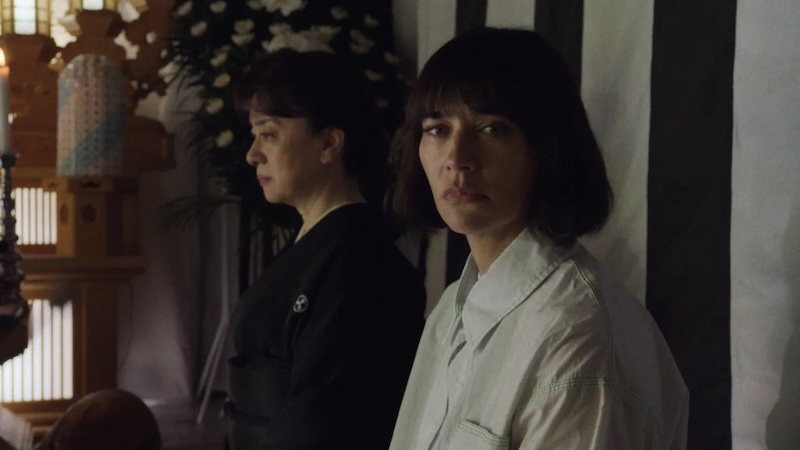
In the first of this episode’s two essential Noriko sonic moments, we see her talking, seemingly to herself, while two of other elderly Japanese women are one room away. The women listen in, as do we. However, to us viewers, it is only when Noriko’s monologue takes a sudden turn that we realize she has not been talking to herself. She might well have been practicing for a difficult conversation, but she is actually engaged in that conversation: she is on the phone — using one of the ubiquitous earbuds that have become a signifier of the near future where Sunny is set — negotiating the details of Masa’s upcoming funeral.
The other Noriko sonic moment occurs about halfway through the episode, when we again see her in the midst of a form of communication that is initially opaque. She has just finished a call, again using her earbud; it is one among many such calls she is making to inform people about Masa’s funeral. Then, as she straightens a small stack of paper, she freezes, almost as if she has remembered something disturbing, or even had a stroke. An instant passes speedily, and it only becomes clear that she has herself received a call when we hear her say, partially in Japanese and then in English: “Call: Do not answer.”
That inbound call, however, appears to connect nonetheless, and Noriko’s practiced facade drops. She pulls out the earbud, slamming it to the table. Interestingly, while we didn’t hear the call — hence the earlier ambiguity — we do hear the connecting tone, perhaps simply to reinforce what is happening, or perhaps because the earbud is no longer in Noriko’s ear. More likely it’s the latter, because throughout Sunny thus far, earbuds (both during in-person instantly translated communication and during phone calls) are depicted as societally embedded mediators of interactions between humans. (Recall how in episode two, we see Suzie and Masa on their first date, and he declines her suggestion that she use an earbud’s translation feature to make it easier for him to speak to her; we know Masa knows something is up, because he doesn’t want a device to come between them.) This TV series clearly has the unintended impact of technology as one of its subjects, and the earbuds serve as a focal point, as an example of how much such an impact plays out at a daily level — and that the robots, like Sunny, are just part of a larger problem. What’s at the root of it, exactly, we don’t yet know.
One sensory side note: the episode takes its title, “Mmmm, Hinoki,” from a different sense other than hearing. The word hinoki is Japanese for cypress, a scent that is being discussed at the opening of the episode. Now, as far as we know, robots can’t smell. The aficionado of hinoki here is a violent crime boss — which is to say, just because the enjoyment of smells may remain the unique province of living things (in contrast with robots), a refined sense of smell itself isn’t necessarily a sign of any actual underlying humanity.
Another sensory side note: we also know that Sunny the robot can experience inebriation, not through drinking but through digital psychedelic patterns displayed on large video screens.