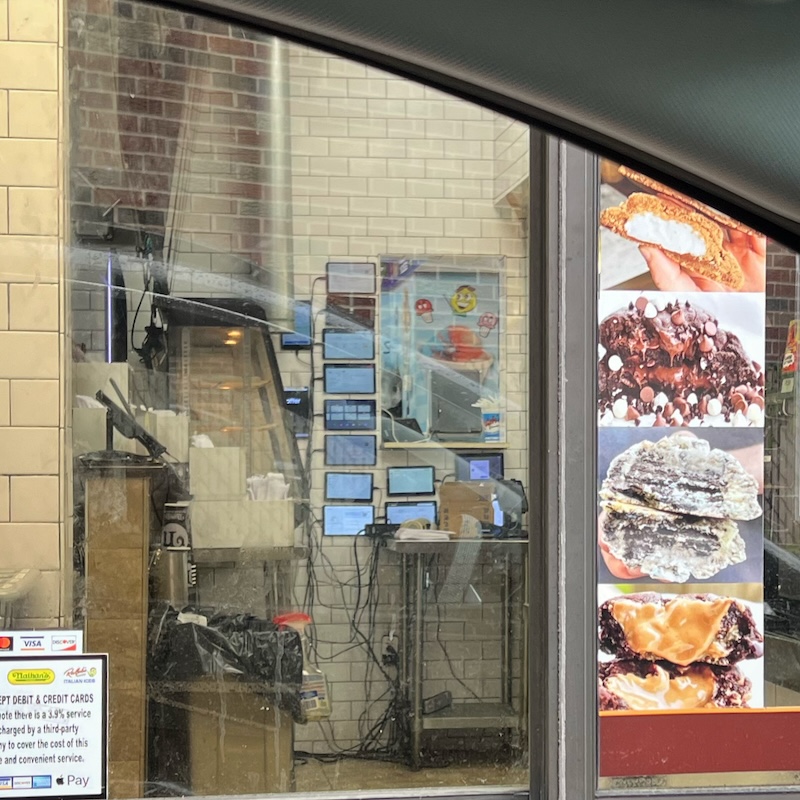
Nothing today is quite as cyberpunk as a dozen or so cheap tablet computers attached to the interior wall of a fast food joint that, in its tiny kitchen, manages to pump out the menu offerings of four different restaurant franchises. This truly could be a comics panel from Katsuhiro Otomo, Geof Darrow, Giannis Milonogiannis, or Paul Pope.
I do this manually at the end of each week: collating (and sometimes lightly editing) most of the recent little comments I’ve made on social media, which I think of as my public scratch pad. I mostly hang out on Mastodon (at post.lurk.org/@disquiet), and I’m also trying out a few others. And I take weekends off social media.
▰ I’m on day 157 of Duolingo German and year six(ish) of guitar lessons, and I’m looking forward to giving this upcoming Duolingo Music tool a go.
▰ Not a tragedy of the commons
▰ Even before Duolingo Music has been released, the app is doing wonders for my music education, because my inability to grok German sentence structure makes me realize how far my (still limited) grasp on guitar chords has come
▰ Nothing quite like purchasing an album at 35,000 feet, in this case Andrew Tasselmyer’s diary #1, methodically glitchy combination of Octatrack and iPad, on the French record label Sonic dialogue
▰ I’ve been trying out this social network called Pebble (pebble.is). If it’s of interest, I’ve got some invites, apparently. It’s being built by people who used to work at Twitter. Nothing fancy so far, but I’m keeping an eye on it. DM me if you want an invite. I’ve also got a few from Bluesky. And as for Threads, the site seems fairly quiet (in a negative sense) to me, but to remain active there is a simple matter of copy and paste, so for the time being I am expending those three or four seconds.
The Assignment: Fall short again, this time on purpose.
/ By Marc Weidenbaum
Each Thursday in the Disquiet Junto music community, a new compositional challenge is set before the group’s members, who then have just under five days to upload a track in response to the assignment. Membership in the Junto is open: just join and participate. (A SoundCloud account is helpful but not required.) There’s no pressure to do every project. It’s weekly so that you know it’s there, every Thursday through Monday, when you have the time and interest.
Deadline: This project’s deadline is the end of the day Monday, October 12, 2023, at 11:59pm (that is, just before midnight) wherever you are. It was posted on Thursday, October 16, 2023.
Disquiet Junto Project 0615: Introspective Failure The Assignment: Fall short again, this time on purpose.
Thanks to Junto member XHG (aka Alex) for having proposed this week’s project.
The goal of this project is to purposefully produce an unsatisfactory piece of music in a systematic way, in the hope of potentially learning from the experience. Your approach should be introspective and technical but also lighthearted and humorous.
Step 1: Think about a piece of music you have produced that you were not satisfied with.
Step 2: Try to analyze why this was the case. Is it possible to identify a main reason — like the concept, the process, the instrumentation, or simply the outcome?
Step 3: Take a break and let these thoughts simmer for a while.
Step 4: Try to produce a different unsatisfactory piece of music than you analyzed in Step 2, purposefully replicating the failure. (It might be sensible to keep it short so as to torment yourself not too much.)
Note: Before you start the process, plan something fun and gratifying to do after you finish your piece of music, in case the process lowers your mood.
Eight Important Steps When Your Track Is Done:
Step 1: Include “disquiet0615” (no spaces or quotation marks) in the name of your tracks.
Step 2: If your audio-hosting platform allows for tags, be sure to also include the project tag “disquiet0615” (no spaces or quotation marks). If you’re posting on SoundCloud in particular, this is essential to subsequent location of tracks for the creation of a project playlist.
Step 3: Upload your tracks. It is helpful but not essential that you use SoundCloud to host your tracks.
Step 4: Post your track in the following discussion thread at llllllll.co:
Step 5: Annotate your track with a brief explanation of your approach and process.
Step 6: If posting on social media, please consider using the hashtag #DisquietJunto so fellow participants are more likely to locate your communication.
Step 7: Then listen to and comment on tracks uploaded by your fellow Disquiet Junto participants.
Step 8: Also join in the discussion on the Disquiet Junto Slack. Send your email address to [email protected] for Slack inclusion.
Note: Please post one track for this weekly Junto project. If you choose to post more than one, and do so on SoundCloud, please let me know which you’d like added to the playlist. Thanks.
Additional Details:
Length: The length is up to you.
Deadline: This project’s deadline is the end of the day Monday, October 12, 2023, at 11:59pm (that is, just before midnight) wherever you are. It was posted on Thursday, October 16, 2023.
Upload: When participating in this project, be sure to include a description of your process in planning, composing, and recording it. This description is an essential element of the communicative process inherent in the Disquiet Junto. Photos, video, and lists of equipment are always appreciated.
Download: It is always best to set your track as downloadable and allowing for attributed remixing (i.e., a Creative Commons license permitting non-commercial sharing with attribution, allowing for derivatives).
For context, when posting the track online, please be sure to include this following information:
Thanks to Junto member XHG (aka Alex) for having proposed this week’s project.
More on this 615th weekly Disquiet Junto project, Introspective Failure (The Assignment: Fall short again, this time on purpose), at: https://disquiet.com/0615/