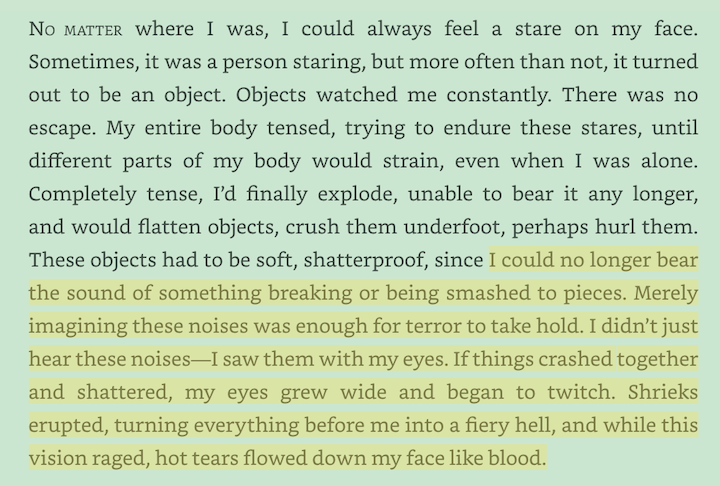
This passage is one of the clearest depictions of synesthesia I’ve read in a novel in a long time. It’s from Lemon, by the South Korean writer Kwon Yeo-sun. The book tells the story of a young girl’s mysterious death — more to the point, the stories of her death, numerous ones described from different points of view at distant stages of the extended, dire denouement of her passing. In this moment — and the less said regarding this narrator the better — a character is approaching a psychic break. The impact of that early sentence, “Objects watched me constantly,” is too unhinged to merely be paranoia. By the time the character gets around to the brutality of overheard sound, all bets are off. What makes this scene work isn’t merely the way it shifts from sound to synchronous sight (“I saw them with my eyes”), but how much of a jumble follows. It isn’t merely a one-to-one mapping of sound and vision, but a whole mashup of physical experiences. It’s one of the most visceral moments in the book, and it’s all an interior monologue.
When in doubt as to what to read, I sometimes just pick something from Steven Soderbergh’s end-of-year reading lists, which is how I came upon this book (and why I also recently read Kirstin Chen’s Counterfeit). I steer clear, generally, of stories that begin with a kid dying (which seems to be about 80% of television and 20% of popular fiction), but somehow this one slipped past my filters and I’m glad it did.
The Assignment: Use a picture of the clouds as a plan for adjusting your sound.
/ By Marc Weidenbaum
Each Thursday in the Disquiet Junto music community, a new compositional challenge is set before the group’s members, who then have just over four days to upload a track in response to the assignment. Membership in the Junto is open: just join and participate. (A SoundCloud account is helpful but not required.) There’s no pressure to do every project. It’s weekly so that you know it’s there, every Thursday through Monday, when you have the time and interest.
Deadline: This project’s deadline is the end of the day Monday, July 31, 2023, at 11:59pm (that is, just before midnight) wherever you are. It was posted on Thursday, July 27, 2023.
Tracks are added to the SoundCloud playlist for the duration of the project. Additional (non-SoundCloud) tracks appear in the lllllll.co discussion thread.
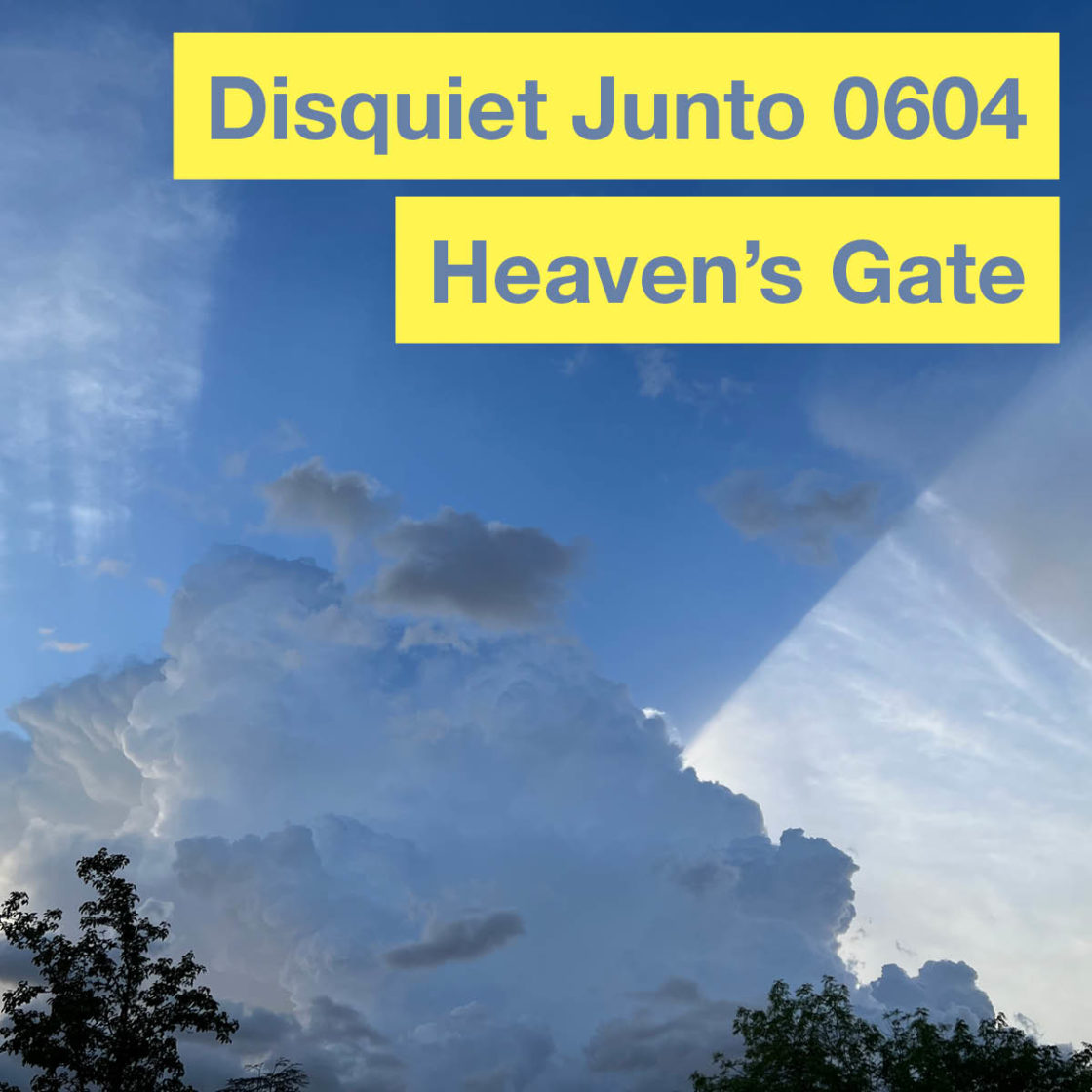
Disquiet Junto Project 0604: Heaven’s Gate The Assignment: Use a picture of the clouds as a plan for adjusting your sound.
Step 1: Think about the use of a gate in music production. A gate can be described as an “on/off switch, allowing signals over threshold to pass while muting everything below.” (It’s likely that discussion will occur during this project regarding useful explanations of the concept.)
Step 2: Take a picture of some clouds.
Step 3: Think of how to interpret the clouds as a model of a gate.
Step 4: Record a track employing the approach you determined in Step 3 using the picture from Step 2.
I took the cover photo in Ashland, Oregon, earlier this year; no filters were employed. Regarding the title, I’m a Michael Cimino admirer.
Step 1: Include “disquiet0604” (no spaces or quotation marks) in the name of your tracks.
Step 2: If your audio-hosting platform allows for tags, be sure to also include the project tag “disquiet0604” (no spaces or quotation marks). If you’re posting on SoundCloud in particular, this is essential to subsequent location of tracks for the creation of a project playlist.
Step 3: Upload your tracks. It is helpful but not essential that you use SoundCloud to host your tracks.
Step 4: Post your track in the following discussion thread at llllllll.co:
Step 5: Annotate your track with a brief explanation of your approach and process.
Step 6: If posting on social media, please consider using the hashtag #DisquietJunto so fellow participants are more likely to locate your communication.
Step 7: Then listen to and comment on tracks uploaded by your fellow Disquiet Junto participants.
Step 8: Also join in the discussion on the Disquiet Junto Slack. Send your email address to [email protected] for Slack inclusion.
Note: Please post one track for this weekly Junto project. If you choose to post more than one, and do so on SoundCloud, please let me know which you’d like added to the playlist. Thanks.
Additional Details:
Length: The length is up to you. How fast are those clouds moving?
Deadline: This project’s deadline is the end of the day Monday, July 31, 2023, at 11:59pm (that is, just before midnight) wherever you are. It was posted on Thursday, July 27, 2023.
Upload: When participating in this project, be sure to include a description of your process in planning, composing, and recording it. This description is an essential element of the communicative process inherent in the Disquiet Junto. Photos, video, and lists of equipment are always appreciated.
Download: It is always best to set your track as downloadable and allowing for attributed remixing (i.e., a Creative Commons license permitting non-commercial sharing with attribution, allowing for derivatives).
For context, when posting the track online, please be sure to include this following information:
More on this 604th weekly Disquiet Junto project, Heaven’s Gate (The Assignment: Use a picture of the clouds as a plan for adjusting your sound), at: https://disquiet.com/0604/
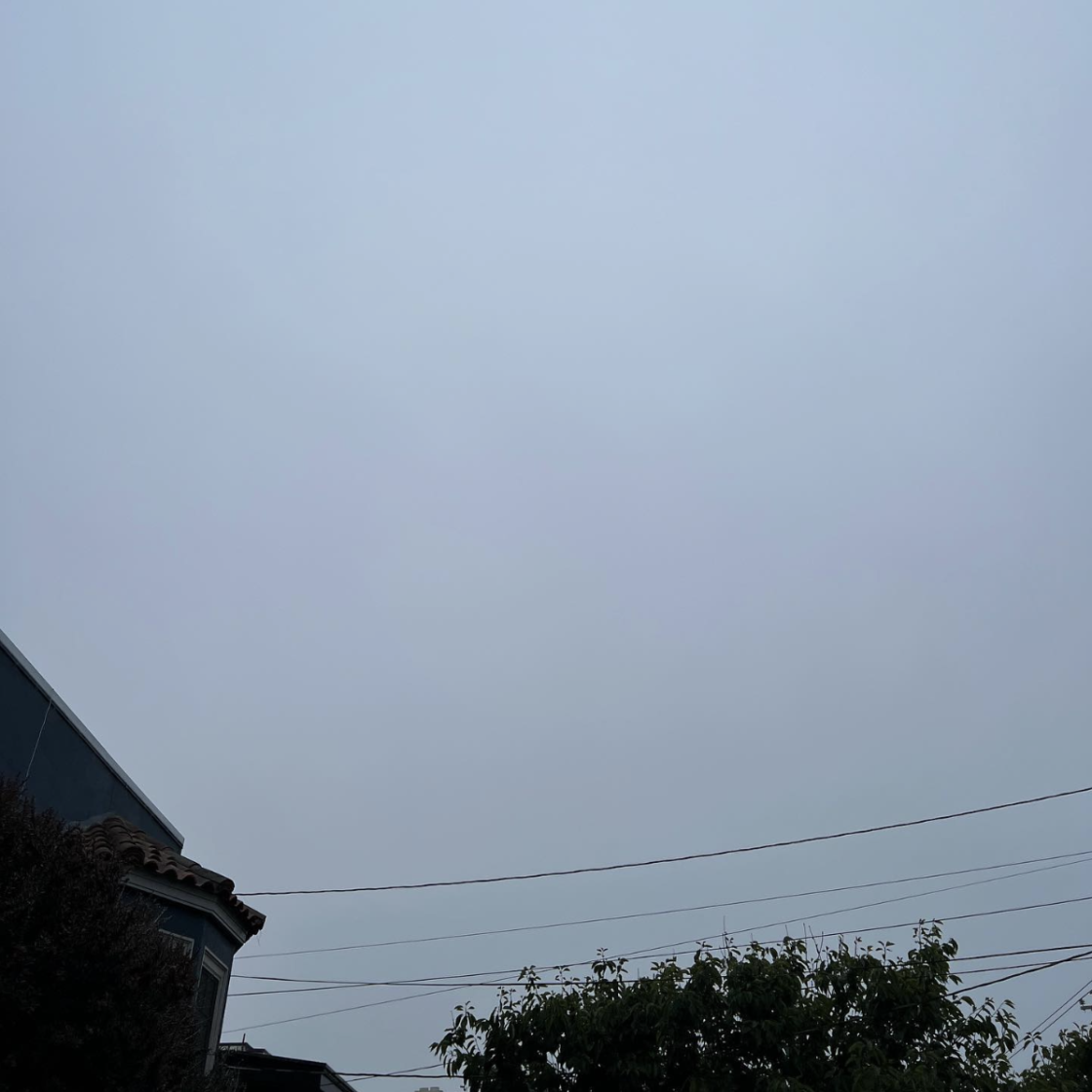
Went outside to take a walk — and to take a photo of some clouds for tomorrow’s Disquiet Junto project. Guess I’ll be using an old one. Admittedly, it is 57° out (Fahrenheit).
These sound-studies highlights of the week originally appeared in the July 25, 2023, issue of the Disquiet.com weekly email newsletter, This Week in Sound. This Week in Sound is the best way I’ve found to process material I come across. Your support provides resources and encouragement. Most issues are free. A weekly annotated ambient-music mixtape is for paid subscribers. Thanks.
▰ SOUND OF SILENCE: Every once in a while, there is a story that so many people send me, I don’t just include it; I also find myself considering what made it stand out (see: smithsonianmag.com, nytimes.com [gift], jhu.edu). One such story is a recently published study that reveals that “we literally hear silence,” in the words of Chaz Firestone, a co-author of the study who is based at Johns Hopkins University. In essence, “While the study offers no insight into how our brains might be processing silence, the results suggest that people perceive silence as its own type of ‘sound,’ not just as a gap between noises.” The one thing I’m trying to understand in this research is what we mean by “silence,” because much of the coverage of the new study persists in treating silence as a blank, whereas much modern sound theory of silence derives from the sense that, as John Cage explored, there is no such thing as silence. The study, in contrast, consistently refers to silence as “nothing” and as “absences of sound.”
▰ WE ALL SCREAM: “I listened. And there it was. That tinny little sound twinkling somewhere nearby” — Souvankham Thammavongsa, the Laotian Canadian poet and short story writer, remembered a youth in thrall of the ice cream truck for The New Yorker. “When you hear an ice-cream truck on your street, it means that someone has thought of you. It means that someone thinks you deserve something good in the world, and you don’t have to imagine that for yourself all by yourself.” … Somewhat related: Nissan has made a zero-emission ice cream van; the promotional video leaves it ambiguous as to whether it plays a tune. It’s got to, right?
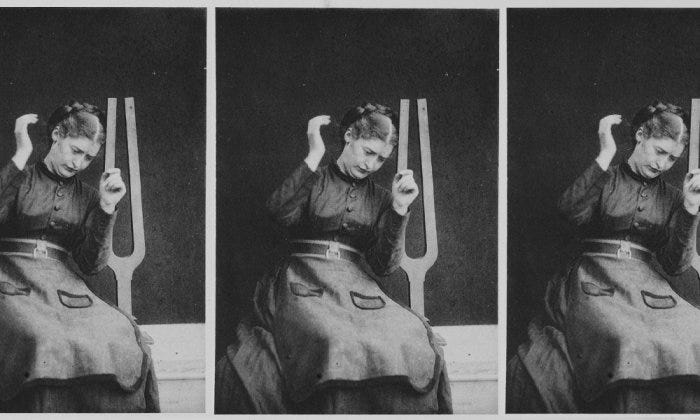
▰ TUNE IN: There’s a fantastic essay by Carmel Raz, a Research Group Leader at the Max Planck Institute for Empirical Aesthetics in Frankfurt, Germany, on the history of the tuning fork, and how it connects to conceptions of the “vibratory nature” of human brain and nervous system. She writes: “To summarize, the popular reception of 18th-century vibrating nerve theory seemingly depended to a large extent on two attributes that were closely associated with music. First and foremost was the well-known fact that music — regarded as consisting, physically, of nothing more than sonorous vibrations — can fundamentally alter our emotions. The idea that the mental changes brought about by music might somehow relate to material changes in the nerves in response to sound thus seemed highly intuitive. The second attribute was the phenomenon of sympathetic resonance, which — since at least the Renaissance — was intimately linked with, and often paradigmatically demonstrated by, sound. Vernacular understandings of vibrating nerve theory thus conflated music’s powerful effects on the mind with an acoustic phenomenon familiar from the domain of music to account for a diverse range of cognitive and affective experiences.” Raz’s piece, “Of Sound Minds and Tuning Forks: Neuroscience’s Vibratory Histories,” is from the freely available multi-author collection The Science-Music Borderlands: Reckoning with the Past and Imagining the Future. (Below image: a 19th-century photo, from the article, illustrating an individual reportedly struck by “catalepsy” due to the massive tuning fork.)
▰ CORDLESS: So, Marc, is there a sound angle on the ongoing SAG-AFTRA strike? Why yes, there is. What follows is National Association of Voice Actors president Tim Friedlander (Record of Ragnarok, One Punch Man) speaking at a Comic-Con panel this weekend:
“As a human voice actor, I can walk into a room and get a script that says something that I didn’t either agree to say or something that I would never say, I personally have that ability to walk out of that room,” Friedlander said. With AI cloning the voices of actors, however, “We’ve lost control over what our voice could possibly say,” he said.
There’s a related recent story about “NSFW mods for open-world classic Skyrim” who used “AI tools to clone the voices of the game’s original actors.”
▰ TURBO APPEAL: The car maker Renault hired famed synthesizer musician Jean-Michel Jarre to develop sounds for its vehicles. There are some short films about the collaboration (fortunately, for monolingual me, with English subtitles). Jarre talks about the importance of symbolizing “mobility,” in contrast with “speed.” Andrea Cera, another composer on the project, discusses challenges, such as suggesting mobility without being too aggressive. Industry films like these are, of course, promotional, but you can still get a sense of an organization’s approach from details. (Via synthtopia.com)
▰ QUICK NOTES:On Call: Meet the woman who composed a ubiquitous bit of hold music. (Thanks, Brian Biggs!)▰ Live Rail: There’s a 90-minute film by Vincent Woo, Tunnel Vision: An Unauthorized BART Ride, made from a camera affixed to one of the San Francisco Bay Area Rapid Transit trains; I love this bit of description from an sfgate.com story on it: “finally, there’s the sound: a dull, grinding hum, constant but endlessly modulating.”▰ Three of a Perfect Pair: A new approach to “decomposing” sound to its core components looks at three elements: sines, transients, and noises (article and video — thanks, Glenn Sogge!).▰ Club Sandwich: Check out this playlist of binaural — that is, recorded as if by two ears on either side of your head — documents of jazz kissas (or jazz cafes) in Japan by the indefatigable Craig Mod: youtube.com (via kottke.org — thanks, Scott Fletcher!)▰ Screen Time: A list of five films that “put sound in the spotlight”includes two I know nothing about, and will be checking out: The Wolf’s Call(2019) and The Stone Tape (1972).▰ Cheerio, Siri: Two more British voices have been added to Siri, bringing the total to four.▰ Rock Steady: YouTube is thankfully adding a tool that can provide stable volume between tracks from different sources.▰ Twice Is Nice: Audiobook revenue has shown double digit increase for the 11th straight year.
I mentioned this in advance of its publication, but mistakenly not afterward. Last month I had the pleasure of reviewing the great new Caterina Barbieri album for Pitchfork. Titled Myuthafoo, it’s a follow-up to her 2019 album Ecstatic Computation, with the added benefit of muting her voice in favor of a sound-first exploration (per the review, nothing against her voice in general — the simplicity just works well here). Here’s my opening paragraph:
Nothing signals synthesizer psychedelia quite like the combination of an arpeggio and a delay. The arpeggio divides a chord into looping sequences of notes. The delay allows those sequences to overlap. Once set in motion, the pairing can sound like a hall of mirrors receding toward infinity. When employed by dilettantes, it’s a simple trick that gets tired fast, but in the right hands, it’s magic. Caterina Barbieri is a wizard—and she knows a lot of other spells, as well.