On Sundays I try to at least quickly note some of my favorite listening from the week prior — things I would later regret having not written about in more depth, so better to share here briefly than not at all.
▰ The musician keinseier posted this gorgeous little ambient glitch recording on YouTube, and I had it running in the background for much of the week. He’s based in Hamburg, Germany. More of his music at keinseier.bandcamp.com.
▰ Tom Whitwell, the inventive London-based guy behind various music technological wonders — like the Turning Machine, the 8MU MIDI controller, and the Music Thing Modular Workshop System — posted nearly 60 short recordings of shortwave radio frequencies. Shortwave Scan May 2025, as the collection is titled, comes with a great licensing statement: “NO rights reserved, use these sounds how you like” (albeit with a qualifier: “Raw radio recordings include audio material that might be copyrighted by other people – no license to use that material is implied”).
▰ The Internet Archive (archive.org), about half an hour by foot from where I live in San Francisco, is now live-streaming its archival activities, and when it’s not business time, they put up archival footage. I vote for ASMR hours, during which they just put mics next to some of the equipment.
At the end of each week, I usually collate a lightly edited collection of recent comments I’ve made on social media, which I think of as my public scratch pad. I find knowing I’ll revisit my posts to be a positive and mellowing influence on my social media activity. I mostly hang out on Mastodon (at post.lurk.org/@disquiet), and I’m also trying out a few others. And I generally take weekends off social media.
▰ The wind made it difficult to sort out from which direction the ice cream truck’s bell was coming.
▰ Happy 10th birthday to Lines, or llllllll.co, the online community I spend the most time on (it’s mostly about the making of electronic music, and especially about the making of the things that in turn are tools for making electronic music).
▰ As of Wednesday, May 21, at 11:20am, SoundCloud seems to be having technical issues. I hope this situation is cleared up soon and doesn’t mess up the Disquiet Junto project due to start in a little over half a day. (It cleared up.)
▰ From the trailer to the new Darren Aronofsky movie, Caught Stealing. How did this joke never occur to me before, and how was this not the natural successor to Google Reader?
▰ Anyone know if you can install the beta of Obsidian alongside the latest stable release? (Apparently the answer is no.)
▰ Read a bunch, finished reading nothing. Also wrote a bunch, which got in the way of reading, which certainly is ironic.
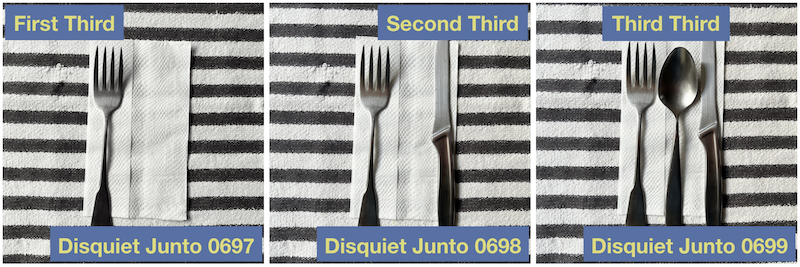
We’re just a week from the milestone 700th consecutive weekly project in the Disquiet Junto, but right now all my attention is focused on the closing phase of the (semi)annual three-part “trios” sequence, in which, over the course of three consecutive weeks, musicians around the globe collaboratively, and asynchronously, create trios one third at a time. I have fun each year sorting out a new way to use a simple image to depict this process, and I’m happy wiht how 2025’s turned out.
Each Thursday in the Disquiet Junto music community, a new compositional challenge is set before the group’s members, who then have five days to record and upload a track in response to the project instructions.
Membership in the Junto is open: just join and participate. (A SoundCloud account is helpful but not required.) There’s no pressure to do every project. The Junto is weekly so that you know it’s there, every Thursday through Monday, when your time and interest align.
Disquiet Junto Project 0699: Third Third The Assignment: Record the final third of a trio.
There are two versions of the instructions for this week’s project — one very short, the other very long.
Very short version (roughly 25 words): Select a track from last week’s duet project (disquiet.com/0698) and add a third part dead center between the left and right stereo channels to complete a trio.
. . .
Very long version of the instructions (about 550 words):
These instructions are fairly lengthy. Please read carefully.
Please note: While this is the third part of a three-part project sequence, you can participate in one, two, or all three of the parts, which have occurred over the course of three consecutive weeks.
Step 1: This week’s Disquiet Junto project is the third in a sequence that encourages and rewards asynchronous collaboration. This week you will be adding music to a pre-existing track, which you will source from the previous week’s Junto project (disquiet.com/0698). Note that you are finishing a trio: you’re creating the third part of what two previous musicians began, filling the space between them. Please keep this in mind.
Step 2: The plan is for you to record an original piece of music, on any instrumentation of your choice, as a complement to a pre-existing track. First, however, you must select the piece of music to which you will be adding your own music. There are tracks by numerous musicians to choose from. The majority of these tracks, 55 at the time of publishing this post, are in this playlist:
To select a track, you can listen through all those and choose one, or simply look around and select, or you can come up with a random approach to sifting through them.
When choosing a track, consider checking out the two previous projects’ discussion threads, as there may be additional information in them that could be of use, such as BPM or key signature:
Step 3: Record a piece of music, roughly the length of the piece of music you selected in Step 2. Your track should complement the piece from Step 2, and it should be placed dead center between the left and right stereo channels. When composing and recording your part, do not alter the original piece of music at all. To be clear: the track you upload won’t be your piece of music alone; it will be a combination of the track from Step 2 and yours.
Step 4: Also be sure, when done, to make the finished track downloadable, because it may be used by someone else in a subsequent Junto project.
Step 5: In normal circumstances, Junto projects have a one-track-per-participant limit. However, as with the preceding project that led up to this one, you can contribute more than one track this week. You can do up to three total this time. For your first, you can choose any track from the duets, no matter how many times others may have employed it. If you choose to do a second or third, please do a track no on else has used yet (it’s understood that between when you select a duet track and finish your trio, someone else may have popped up and used it, which is perfectly fine). Throughout the project I will keep an updated list in this Google Drive document of what has been utilized:
The goal is for many as people as possible to benefit from the experience of being part of an asynchronous collaboration. That, foremost, is the spirit of this project.
Tasks Upon Completion:
Label: Include “disquiet0699” (no spaces/quotes) in the name of your track.
Upload: Post your track to a public account (SoundCloud preferred but by no means required).
License: It’s preferred (but not required) to set your track as downloadable and allowing for attributed remixing (i.e., an attribution Creative Commons license).
Please Include When Posting Your Track:
More on the 699th weekly Disquiet Junto project, Third Third — The Assignment: Record the final third of a trio — at https://disquiet.com/0699/