Italy Glitch

From Artiom Constantinov

A nice little slice of glitchy atmospheric IDM, all done up in the visual audio programming language Pure Data. Watch (and listen) along as text and graphic elements are navigated in service of this sci-fi–tinged excursion, in which the pace is ever-shifting. The piece is by Artiom Constantinov, who’s based in Italy. More at artiomconstantinov.bandcamp.com and artiomconstantinov.wordpress.com.

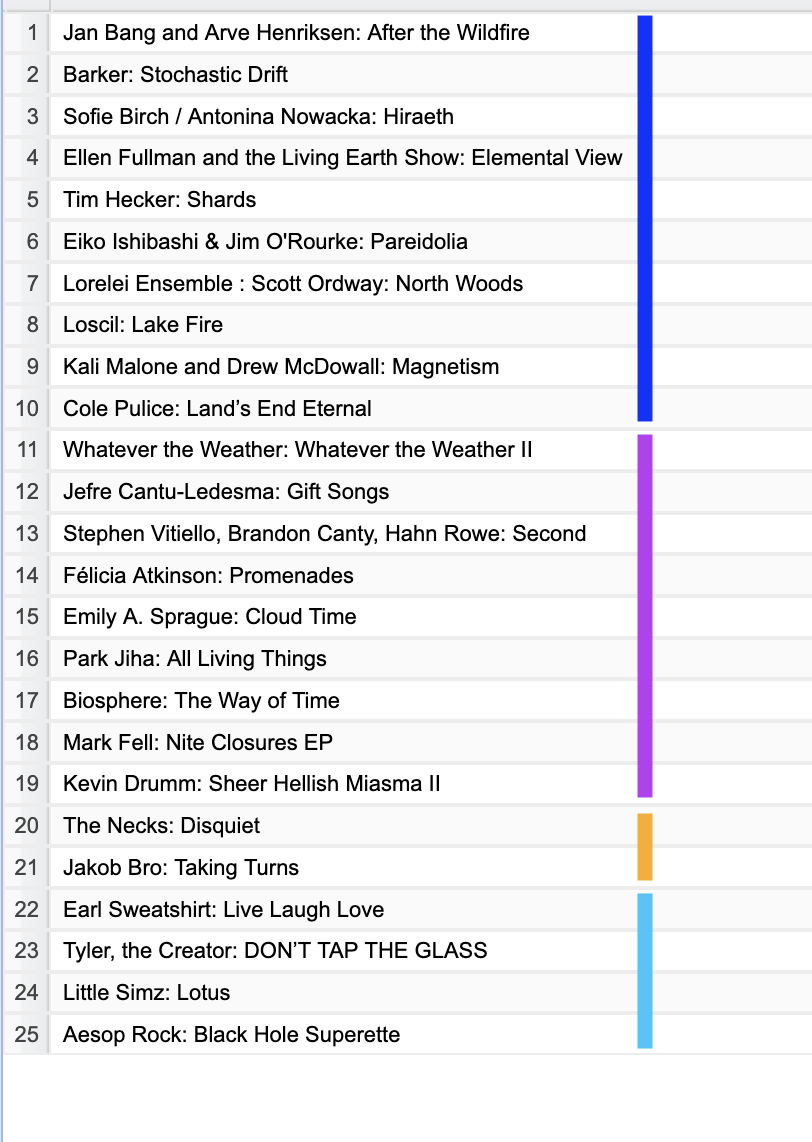
5 Albums to Work To (Ambient Zone)

When in Listville, it can help to learn how to talk lists

I’m not much of a list-maker, especially lists with “best” in the name. I do submit lists, at the end of the year, to The Wire and to Pitchfork, but I don’t take a lot of pleasure in compiling them. For each record I name, there are a dozen I could slot in, and a hundred I haven’t heard. I participate because it’s nice to be asked, and because I do want to root for albums that might not otherwise be noticed, and to add my voice in favor of those that have been, especially those only by a few other people. I find end-of-year lists are all the more interesting years later, when I might look back and spot things I no longer listen to, and gaps that seem canonical in retrospect but hadn’t, to me, at the time. In other words, they’re especially interesting in the ways I find them lacking, not necessarily for what they include.

Also, lists are also a cornerstone of all kinds of online activity. When in Listville, it can help to learn how to talk lists. By way of example I’ve been peeking around, lately, both Amaya Lim’s Turntable (see: turntable.amayalim.com; her newsletter is recordstore.substack.com) and record.club (which I mentioned this past weekend), two means of reinvigorating the social media aspect of listening to recorded music. I’m @disquiet on both, and both are focused on lists. To that end, I put a little list together of music that I habitually have playing during daylight hours — what I described, at record.club/disquiet, as “five albums to work to when you need music that can create the sonic equivalent of a wool-lined space in which to get stuff done.”

First and foremost on this list is Nils Frahm’s Music for Animals, which benefits from a combination of consistency and length, and how its ambient quality has a rhythmic pulse. Then comes Brian Eno’s Thursday Afternoon, which used to be my headphones-during-work go-to, until it became too familiar, and thus a little distracting. Considering that Thursday Afternoon came out in 1985 (and was one of the first CDs, if not the first, I ever bought), the thing took decades for me to penetrate it to the point where I could consider it familiar, let alone knowable. The three others on my work-listening list are Max Richter’s Sleep, which despite the title need not be thought of as somnolent, Éliane Radigue’s glacial Trilogie de la Mort, and that proto-ambient-jazz classic, Miles Davis’ In a Silent Way.

On Repeat: Jakobsons, Reider, Stars of the Lid

Home/office playlist

On Sundays I try to at least quickly note some of my favorite listening from the week prior — things I would later regret having not written about in more depth, so better to share here briefly than not at all.

▰ Marielle V Jakobsons has a new album due out on Thrill Jockey. The record, The Patterns Lost to Air, doesn’t arrive until late February 2026, but a first track, the opener, “Warm Spring,” is up now. It was made with, primarily, violin, Fender Rhodes, and Moog Matriarch, and it is a fully formed exploration of slowly evolving melodies and broken reflections.

[bandcamp width=640 height=208 album=1496638844 size=large bgcol=ffffff linkcol=0687f5 artwork=small track=2294056861]

▰ Autechre’s music is sometimes described as the sound of things breaking down, so it is somewhat ironic that C. Reider, who opened for Autechre on their October 1 Denver tour date, found afterward that “the recording of the performance was ruined by a bad cable.” Unruffled, he set about re-recording the set, now titled New Impossibilities, and then uploaded it to his Bandcamp account. It’s a half hour of rhapsodic noise table activities: buzzing whirs, churning substrata, crunching irritants. Good stuff.

[bandcamp width=640 height=208 album=3166185096 size=large bgcol=ffffff linkcol=0687f5 artwork=small]

▰ There is a new Stars of the Lid fan site at starsofthelidforever.com that documents, to date, nearly 20 live shows by the ambient duo, which consisted of Adam Wiltzie and the now deceased Brian McBride. Definitely check out the 2008 set from Echoplex in Los Angeles, for which they performed, along with other pieces, Arvo Pärt’s “Frartes” and some of Alexandre Desplat’s score for the film Syriana. (Thanks, Paul Ashby, for letting me know about it.)

Disquiet Junto Project 0725: Rack It

The Assignment: Change the "focus" of a track as it plays.

Each Thursday in the Disquiet Junto music community, a new compositional challenge is set before the group’s members, who then have five days to record and upload a track in response to the project instructions.

Membership in the Junto is open: just join and participate. (A SoundCloud account is helpful but not required.) There’s no pressure to do every project. The Junto is weekly so that you know it’s there, every Thursday through Monday, when your time and interest align.

Tracks are added to the SoundCloud playlist for the duration of the project. Additional (non-SoundCloud) tracks also generally appear in the lllllll.co discussion thread.

Disquiet Junto Project 0725: Rack It
The Assignment: Change the “focus” of a track as it plays.

Step 1: There is a concept in photography and filmmaking called “rack focus,” which can be understood as the process of altering depth of field so as to draw attention to one or another element.

Step 2: Record a track in which you apply the concept of “rack focus” to sound.

Approach: You might, for example, take a preexisting track for which you already have the various layers separated, and then at any given moment, put all but one through a low-pass filter. That’s just a suggestion.

Tasks Upon Completion:

Label: Include “disquiet0725” (no spaces/quotes) in the name of your track.

Upload: A person participating in the Disquiet Junto should post only one track per weekly project (SoundCloud account preferred but not required). If on occasion you feel inspired to post more than one track (whether to a single account or across multiple accounts), you should clarify which is the “main” rendition for consideration by fellow members and (if on SoundCloud) for inclusion in the SoundCloud playlist.

Share: Post your track and a description/explanation at https://llllllll.co/t/disquiet-junto-project-0725-rack-it/

Discuss: Listen to and comment on the other tracks.

Additional Details:

Length: The length is up to you. 

Deadline: Monday, November 24, 2025, 11:59pm (that is: just before midnight) wherever you are.

About: https://disquiet.com/junto/

Newsletter: https://juntoletter.disquiet.com/

License: It’s preferred (but not required) to set your track as downloadable and allowing for attributed remixing (i.e., an attribution Creative Commons license).

Please Include When Posting Your Track:

More on the 725th weekly Disquiet Junto project, Rack It — The Assignment: Change the “focus” of a track as it plays — at https://disquiet.com/0725/.

Virtual Synthesis

From Nvra

A gorgeous, slow-moving, haunting stretch of virtual synthesis, courtesy of the musician who goes by Nvra. There’s a growing category of online footage of tracks documented underway in real time using the VCV Rack software platform. VCV is a software emulator of modular synthesizers, meaning one can, affordably, patch together multiple instances of modules that, in the real/physical world, would add up to a pretty penny. Instead, there’s a pretty visualization of what’s happening. The developer of VCV has commented that despite it being an audio production tool, the graphics challenge is in some ways the greater one, due to the sheer amount of elements that might be shown at a given time. As the tool has matured, it’s provided more options to stylize the way the modules appear, and that has, no doubt, helped encourage people to post videos of their work online, and in public. Nvra’s track, titled simply “Collider,” is a lush, carefully paced series of swells, some tonal, some seemingly vocal, and then occasionally highlighted with little sonic glints and melodic snippets.