There is no instrument quite like a no-input mixer, which to say: a mixer with no instrument going into it. That may sound like the end of the story, but it’s really just the beginning. By building sounds from feedback loops — that is, patching the mixer’s outputs back into itself — a no-input mixer, as in this extended live performance by Phonets, can create something from what might mistakenly be thought of as nothing.
In Phonet’s hands, it’s a carefully balanced progression of noise swells that edge slowly toward the abrasive, and combing discernible layers. Phonets says the results “are loosely inspired by plate tectonics, slow development, and the sense of being in a landscape,” and that the plan was “to play around with resonance and picking out harmonics from an underlying pitch set.”
Despite a lingering reputation for stasis, ambient music does not all necessarily proceed at the same pace. Even putting aside ambient recordings that engage with a pulse or a beat, there is ambient that sounds like time is standing still, and there is also ambient that sounds like time is rushing by — and everything in between. This live performance by Nick Lisher, who records as Lesjamusic, edges toward the latter. The video has an internal momentum that, in combination with a gently grating form of sonic processing, suggests the whir of countless small machines making extended and continued work of some intractable problem. A hovering drone amid the delicate noise is almost a soundtrack to the soundtrack: a shadow of the frantic sounds.
On Sundays I try to at least quickly note some of my favorite listening from the week prior — things I would later regret having not written about in more depth, so better to share here briefly than not at all.
▰ A fantastic Norwegian trio — Arve Henriksen: trumpet, piano and electronics; Eivind Aarset: guitars and electronics; Terje Isungset: drums and percussion — explore on Uncharted Waters varied territory, from mellifluous jazz (“The Drowned Beat”) to Fourth World atmospherics (“Echoes from the Shore”) to propulsive improvisation (“Jazz for Drowned Cities”).
▰ The two tracks of En Mi contain heightened soundscape drones from Spanish composer Susana López, part of the Fifteen Minutes of Anonymity postcard series.
The Assignment: That's your band's name; now record something.
/ By Marc Weidenbaum
Each Thursday in the Disquiet Junto music community, a new compositional challenge is set before the group’s members, who then have five days to record and upload a track in response to the project instructions.
Membership in the Junto is open: just join and participate. (A SoundCloud account is helpful but not required.) There’s no pressure to do every project. The Junto is weekly so that you know it’s there, every Thursday through Monday, when your time and interest align.
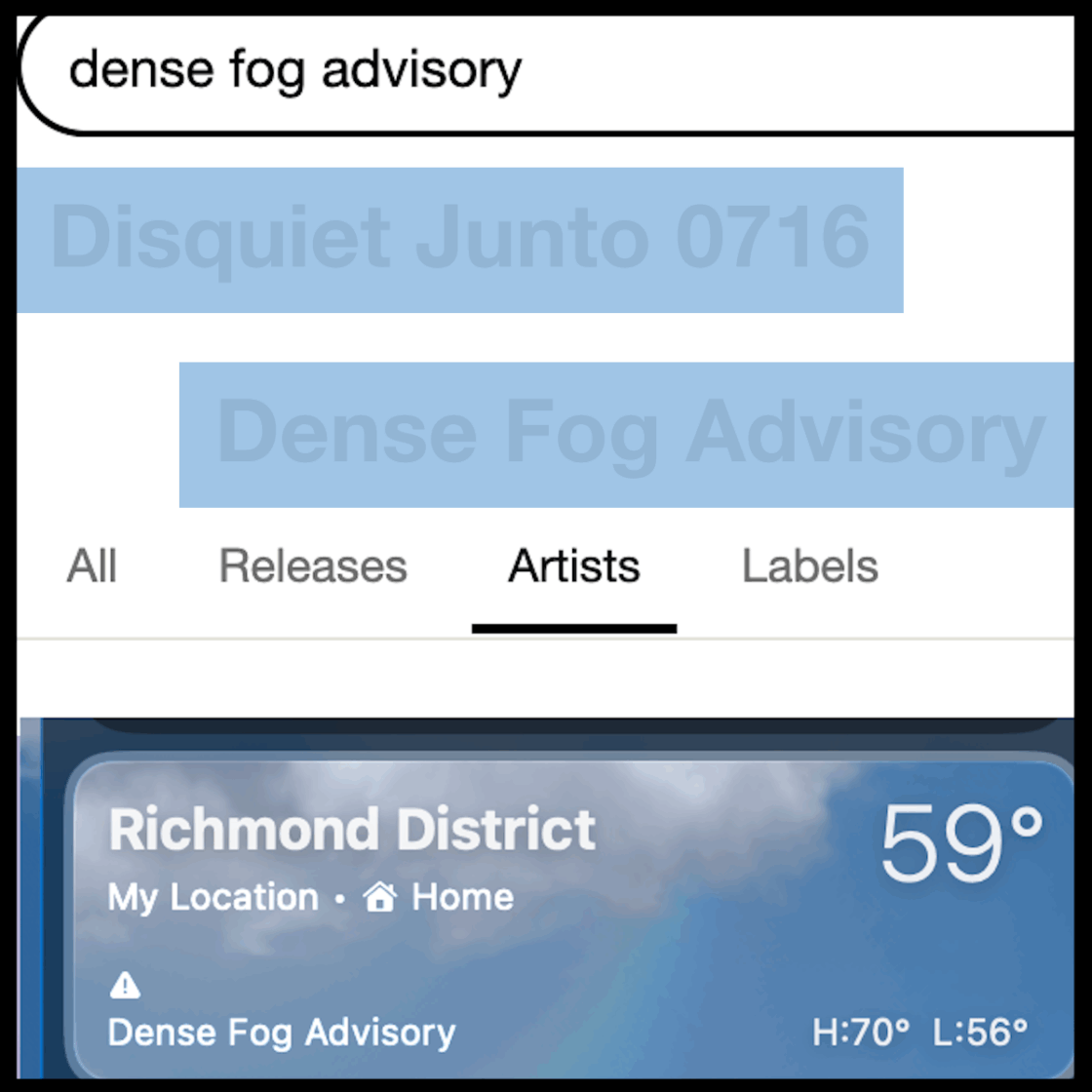
Disquiet Junto Project 0716: Dense Fog Advisory The Assignment: That’s your band’s name; now record something.
There is just one step this week. You’re now recording music under the name Dense Fog Advisory. Record a new track, appropriate to your name.
Tasks Upon Completion:
Label: Include “disquiet0716” (no spaces/quotes) in the name of your track.
Upload: A person participating in the Disquiet Junto should post only one track per weekly project (SoundCloud account preferred but not required). If on occasion you feel inspired to post more than one track (whether to a single account or across multiple accounts), you should clarify which is the “main” rendition for consideration by fellow members and (if on SoundCloud) for inclusion in the SoundCloud playlist.
License: It’s preferred (but not required) to set your track as downloadable and allowing for attributed remixing (i.e., an attribution Creative Commons license).
Please Include When Posting Your Track:
More on the 716th weekly Disquiet Junto project, Dense Fog Advisory — The Assignment: That’s your band’s name; now record something — at https://disquiet.com/0716/.
A fantastic, pop-minimalist use of a classic E-Mu synthesizer. The footage has received a treatment that might make you think it’s from the early days of synthesizers (the elbow patches don’t hurt — I imagine they’re also a “patch” joke, as in “synthesizer patches”), but this is a contemporary recording. That is Benge, aka Benjamin David Edwards, a specialist in vintage/retro synths, performing. He manages to summon up a lovely little melody that plays out in very simple tones, lovely little sounds that bring to mind some of Aphex Twin’s more subtle work. (I am likely mistaken, but I think that equipment is original, and not the mos-lab.com replica.)