
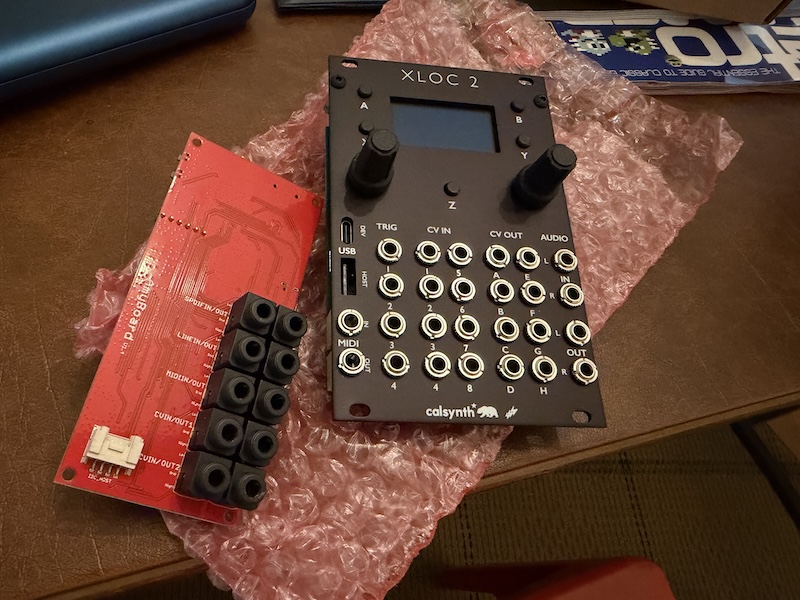
Came home to two new modules I’ve been looking forward to checking out, the AMYboard and the XLOC 2.
Video, audio, patch notes
There is an apartment building on Long Island, in New York, where I stay over on occasion. When the place first opened, the fire alarms had a tendency to go off. There was one trip I took where both there and at a hotel where I spent a few nights in Brooklyn, fire alarms ruined multiple nights of sleep. That experience — of the alarm along with the flashing light that accompanies it — set me on edge for the entirely of the trip, and the impact has lingered. The apartment building’s alarms haven’t gone off for some time now, at least when I was present, but I still bear a bit of a grudge, and my latent concerns were brought to the surface when one suddenly rang out during a recent trip, in late January 2026. At least by recording the sounds, as I did here (on my iPhone Pro 17), the incident served some purpose, provided some utility. By recording the alarm, I transformed it from annoyance to object of study, from nemesis to item in a Petri dish. The pause after every third instance is what I find myself focused on, and not just because the brief quiet offered a respite. The silence suggested a rhythmic pattern, something I may put to musical use down the road. I made a second recording, shortly after this one, when the alarm had ceased but the light that blinked along with it kept on blinking. The blink was audible, a sharp, persistent cut in the air. I tried to upload the second audio file to Freesound, but the site kept rejecting it, likely because my recording was too low-volume. The click was quite evident in person. Guess you had to be there, though I can’t recommend it.
The track is on Freesound and SoundCloud.
I’m posting these rail field recordings while I’m on an airplane, headed home to San Francisco after a mostly frigid week in New York, first in Manhattan and then out on Long Island, from Wednesday to Wednesday, the end of January to the start of February. I have a few more such recordings to share, including two from a restaurant and two from inside an apartment building. The following three were recorded during my initial approach to the city, first on the AirTrain, which connects John F. Kennedy International Airport to the Jamaica station of the Long Island Railroad, and then on the LIRR proper. The excitement of my anticipation was dulled by the low temperatures, the late hour, and the rocky flight earlier in the day. The conscious act of recording sounds rooted me in the moment, even if at that moment I was moving pretty fast.
▰ AirTrain as the Temperature Approaches 0º: This is one of several recordings I made with my phone, an iPhone 17 Pro, while riding the AirTrain from the JFK airport to the Jamaica station of the Long Island Railroad. This occurred the evening on Wednesday, January 28, 2026. Being based in temperate San Francisco, I was not looking forward to the cold that had consumed the northeast. Days had passed since the snow had fallen, and the low temperature meant little if any had melted. My ears couldn’t help connect the brittle quality of the air with the shrill chime of the rail. The slow rhythmic thud is a nearby door that, despite being shut, rattled noisily as we sped along. I had difficultly recording 30 straight seconds that weren’t interrupted by an announcement on the public address system. Eventually I managed to do so. The field recording is posted on Freesound and SoundCloud.
▰ Slowing LIRR in Advance of Approach to Station: Manhattan’s expanded Grand Central Station, which now includes, deep underground, stops for the Long Island Railroad, was approaching — or we were approaching it. Some distance was yet to be covered, and yet already the train seemed to slow. The sound of this segment is nowhere near as loud as other, earlier phases of the trip, a straight shot from the Jamaica station with, if memory serves, just one other stop that time of night. The audio was recorded late on Wednesday, January 28, using an iPhone 17 Pro. The train was close to empty of passengers, perhaps owing to the fierce cold, which was closing in on single digits. The field recording was posted to both Freesound and SoundCloud.
▰ Hitting 95.8 Decibels on the LIRR: I’ve experienced a lot of loud noise lately, and the volume of the Long Island Railroad as it traveled from Jamaica station to Grand Central Station was beyond any in my recent memory — the volume, that is, in combination with the high pitch. I pulled out my phone to register the decibel level, and it pushed closer and closer to 100, maxing out at 95.8, by my (and my device’s) estimation. This snippet was recorded in the evening on January 28, 2026, on my iPhone 17 Pro. Even now, a week later as I post it, the sound is sharp and fierce and implicitly dangerous in a way that makes it a difficult listen. This field recording was posted to Freesound and SoundCloud.
After a break, as the work year kicked in, I did another five days of #Jamuary in a row. Again, the mode I’ve adopted is starting a patch in VCV Rack, and then tweaking the patch each day as I learn more about the given modules. If I this past week yielded one takeaway, it’s that I need to stop only thinking of patches as performances or compositions, and to also use them as source material within a DAW, such as Ableton, or even within Audacity, a multitrack editor. I do this on occasion, but I don’t focus on the approach enough. I’ll either push this patch a bit further, or move on to a new patch for the coming week.
▰ 19\31 — “Done Broke”: Breaking up the same sample actively into cues, having it play those cues random, and when it gets to a specific cue it repeats, a momentary centering, and then sets off in random mode again. Round and round.
▰ 20\31 — “Step Wide”: Another day with the same sample, building on the same patch, this time using one snippet on the 1, 2, and 4, and filling the 3 with a random bit from elsewhere in the source audio, always shorter than the main sample, so it repeats a bit and gets cut off sometimes. And on the 2, the main sample goes through a bit of distortion that’s always a little different from the previous time.
▰ 21\31 — “16 Stuff”: Same basic patch, pushed a little further, this time the sampling module replaced with a 16-step sequencer in which each step the sample is tweaked one way or another: pitch, volume, effect, etc.
▰ 22\31 — “Stride Gate”: Took a different approach this time, though still with the same sample and a sample player, but what happens is a square wave turns on and off the freeze effect, with the original audio passed through, and the mix set so if there’s freeze, that’s all you hear, and if there’s no freeze, you just hear the original. The alternation sets the pace, such as it is. This is all in VCV Rack.
I’d gone for a walk and was listening to an audiobook, one that is largely set in London. I’d been alternating between reading the book and listening to it. Now I was walking through San Francisco while my head was in London, a different sort of alternating. At one point in the audiobook, I heard something, the sound of a violin, and I thought that was an interesting creative choice on the part of the recording’s producer or director. Except the sound wasn’t a violin, nor was it part of the audiobook. The sound was a buzz saw from a construction site, a residence half a block away. I paused the audiobook and took a few recordings of the buzz saw until I got one with the minimum of wind, chatty passersby, and traffic. This is on a clear, quiet day, no planes overhead, and the wind pretty chill, if not entirely still. The more I listened to the buzz saw on its own, the less it resembled a violin, but it was never any less musical than when I’d first heard it.
Recorded around 11:15am on an iPhone 17 Pro on Thursday, January 22, 2026, in San Francisco. Posted to SoundCloud and Freesound. This post is part of an ongoing series of field recordings that generally last for roughly 30 seconds and are collectively titled #30s.