
A stomp box by Japanese artist Yoshihiko Satoh:

More on Satoh at tbb.t-com.ne.jp/hipopo-art. Visit the site for numerous additional such art-boxes. (Via sound designer Tim Prebble‘s blog, substation.co.nz.)
A stomp box by Japanese artist Yoshihiko Satoh:
More on Satoh at tbb.t-com.ne.jp/hipopo-art. Visit the site for numerous additional such art-boxes. (Via sound designer Tim Prebble‘s blog, substation.co.nz.)
From the San Francisco Chronicle review of the documentary film Surfwise:
Advisory: This film contains profanity and strong sexual material and a really unfortunate industrial electronic tune that sounds too much like Greg Brady covering a Nine Inch Nails song.
The film was directed by Doug Pray. The review (at sfgate.com) is by Peter Hartlaub. I haven’t seen Surfwise yet, so I’m not sure which song among those listed at movies.yahoo.com is the offending one. The quote reminded me that there’s some elegant Erik Satie, “Trois Gymnopedies,” in an earlier surf film, Riding Giants (2004) directed by skateboard figure Stacy Peralta (Dogtown and Z-Boys), and the performance was by Peralta’s son, Austin Peralta, who must have been about 13 or 14 years old when the track was recorded.
On Turns in the South, his recent two-CD set, Aaron Ximm delivers raw and filtered documentation of his travels. The highlight is a 40-minute track titled “Madurai Mani Fold” (MP3). Described by Ximm as an “epic of introspection,” it is an exercise in minimalist process. The lengthy track is built from but a mere few seconds of a recording he made in India. The piping sounds, which gain momentum, only to occasionally relax, over the course of the piece bring to mind the linear chords of Philip Glass’s instrumental compositions and the pulsing work of Steve Reich. It’s one of four tracks on the album, all of which are available for free download at Ximm’s website, quietamerican.org.
Sound designer Tim Prebble keeps a prolific, enthusiastic and informative blog at his substation.co.nz website, often sharing experiences from the set of film productions. It’s the sort of place where he’ll link to a Fatboy Slim video one day, and then theorize on the value of temp tracks the next.
Late last month, he went into detail on what he calls the “backwards reverb” effect, in which an echo of a sound is heard before the sound itself comes into focus. “I think why the technique is very useful when applied in an appropriate context,” he writes, “is because it essentially generates interesting tonal sounds that are directly related to the sound they precede.” He also provides step-by-step visualization of how the effect is produced:
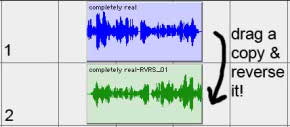
It’s a sound often utilized in horror films, to signify a supernatural state, and in scenes in which individuals regain consciousness as they come out of a black out. It’s also something I associate with some of the eerier Led Zeppelin tracks, in which Robert Plant’s voice seems to arrive ahead of schedule.
Prebble uploaded two audio examples to his blog, one brief vocal (MP3) and one from the sound design for the film Perfect Strangers, on which he worked (MP3). Perfect Strangers opens with the image of an onion being cut by a knife. He describes how he accomplished the final audio as follows:
I realised that when its seen in a theatre that onion would be HUGE so I started experimenting with accentuating the sound of the knife cutting into the onion and the pieces of onion almost dancing as they came off the knife. I recorded a lot of very close up onion cutting sounds, at various speeds & got the sequence working kind of as I imagined”¦ After I played it to the director, she liked it so much she decided to extend it prior to the film starting, starting off very slow & almost abstract & then becoming more real until it reveals onscreen”¦ So I pitched down some of my onion cutting sounds and recorded more, slower ones but I needed a means of pushing them away from reality a bit – ahar! Time to try a backwards reverb on it. So I reversed a number of the sounds – the cutting sound and especially the wooden clunk as the knife hit the cutting board – applied various length reverbs, then reversed those reverbs & resynced them with the other ”˜real’ effects”¦ magic! It took some manipulating to make the elements all feel a part of the same moment, but it worked a treat and i remember playing the sequence to the composers on the film and they couldnt work out how I had done it”¦. when we mixed it we also had some fun by placing the start of the onion cut in the surrounds, so the slice basically passed through the audience, until it impacted at the front”¦. have a listen, its not quite as coherent without the images but you can get a feel for merging backwards reverbs with real effects”¦. You’ll notice we start introducing elements of the ambience during the transition from surreal to real, by the third chop you can hear the fridge and then you start to hear the kitchen etc”¦. bear in mind this is a stereo crash down of the 5.1 FX stem”¦ crunched to mp3”¦.
Read the full post at substation.co.nz. More on Prebble’s film work at his imdb.com listing.
 A new collaboration between Rutger Zuydervelt and Stephen Vitiello has been released on the 12k label. It’s a collaboration in, with one exception, a purely conceptual sense — but since creative collaboration often has more to do with casting than with curation, more with people than with process, their innovative approach is especially appreciated.
The album, Box Music, takes its title from the duo’s unique mode of working in tandem while toiling separately. Each musician sent to the other a box of generally “non-musical” items (according to the album’s write-up at 12k.com) and then set about making musical constructions from provided materials. Imagine Joseph Cornell at work with a laptop sampler, and you’ll have a sense of what lurks beneath track names such as “Bells, Book, Tin Foil, Buttons” and “Crackle Box, Thumb Piano.”
The fifth and final entry on the album is the only one of the tracks on Box Music that is attributed to both Zuydervelt (who records as Machinefabriek) and Vitiello, the only one that was created by both of them. Titled “Chocolate Sprinkles, Tape, Egg Cutter, Rice, Plastic Bag,” it is a mix of quietly documented activity beneath what sound like ceremonial bells (MP3). The MP3 clocks in at 4’33, which may or may not be a nod to John Cage, who certainly would have appreciated this effort to locate aural beauty in the mundane physical world. More on Zuydervelt at machinefabriek.nu and Vitiello at stephenvitiello.com.