Have Mercy

The latest from James S. A. Corey

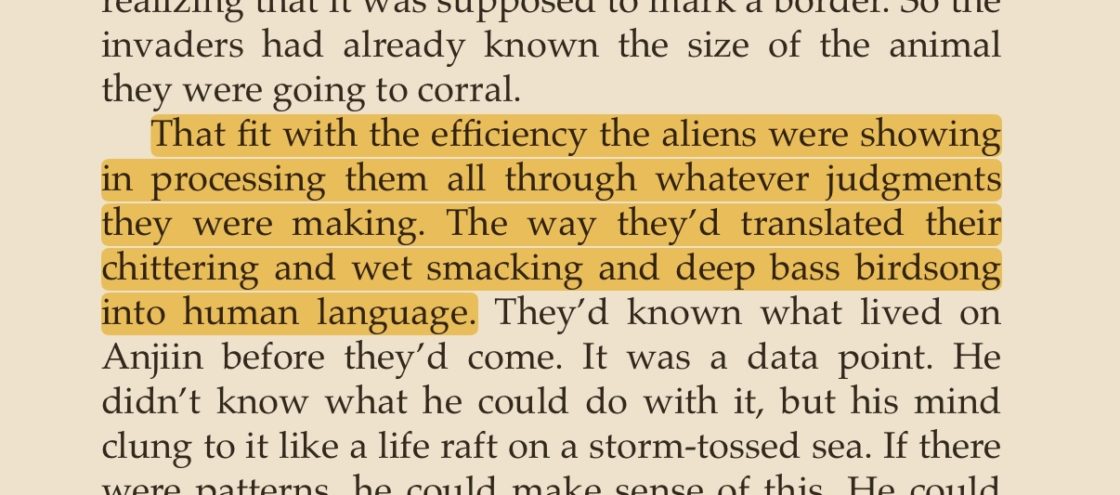
Yes, I’m enjoying The Mercy of Gods, the new science fiction novel from James S. A. Corey, aka the two authors (Daniel Abraham and Ty Franck) behind the great series The Expanse. More than ever, their authorial ear is attuned to the micro-interactions of the workplace (here, at least initially, scientific research labs and their governing bodies), more broadly of human communication, and now — since the looming alien threat seems to be slightly more evidently conscious than in The Expanse — between species. I’m only 25% of the way in, so there is much more to explore. And there are sequels to come, of course.

The Prone Gunman

Jazz + noir, together again

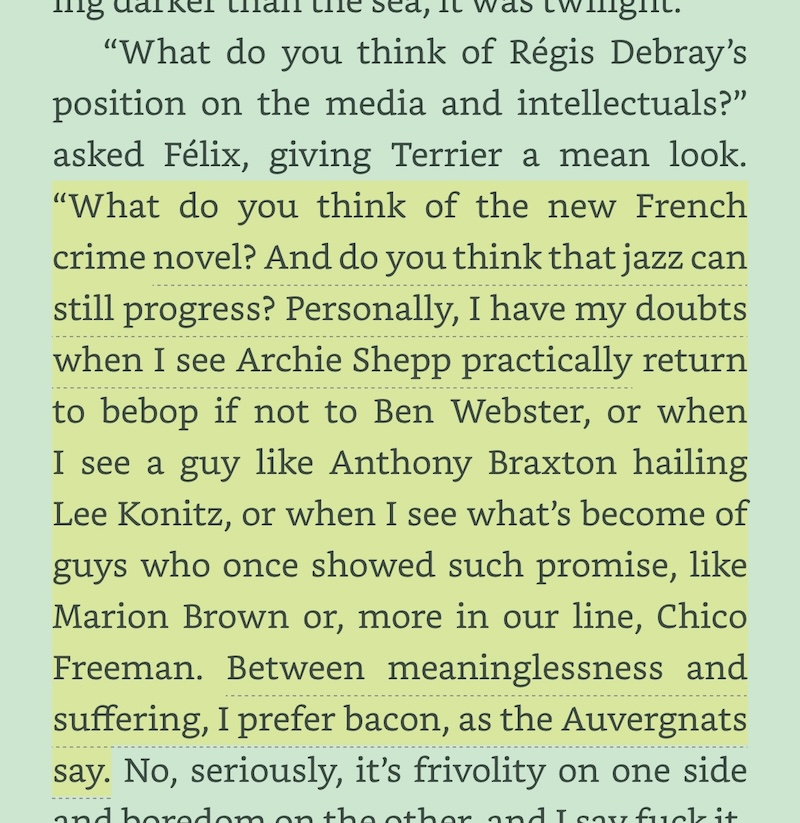
I wasn’t expecting an Anthony Braxton reference when I started reading The Prone Gunman (née: La Position du tireur couché, 1981) by French crime novelist Jean-Patrick Manchette (1942-1995). The person going on about jazz here isn’t the titular gunman. It’s an annoying character who’s married to the gunman’s ex. The novel is old enough that maybe in the early 1980s the “noir protagonist listens to jazz” trope wasn’t yet as tired as it has become — or perhaps this scene was already pushing back at the trope.

Scratch Pad: Kjartansson, Guitar, Ministry

From the past week

I do this manually at the end of each week: collating most of the recent little comments I’ve made on social media, which I think of as my public scratch pad. I also find knowing I will revisit my posts to be a positive and mellowing influence on my social media activity. I mostly hang out on Mastodon (at post.lurk.org/@disquiet), and I’m also trying out a few others. And I generally take weekends off social media.

As with last week, I had a fairly limited amount of social media posting apparently:

▰ I love how you can walk around SFMOMA and hear people humming bits of the song from Ragnar Kjartansson’s The Visitors installation. It’s a freeform extension of the exhibit. I’m gonna miss The Visitors when it ends its two-year-plus run in January

▰ It can feel like there are two types of guitar classes: (1) This song is new to me, and I can’t get the melody in my head; (2) I’ve been singing this song to myself for decades, but apparently I’ve been singing it wrong the whole time.

▰ I walk into the barbershop and the barber, just back from lunch, turns on some music. The song? Almost too perfect: the Zombies’ “Goin’ out of My Head.” More like “growin’” but still.

▰ I’m deep into reading too many books at the same time, but I did manage this week to finish one, Kaliane Bradley’s The Ministry of Time.

Solo Henriksen

His latest album: Kvääni

[bandcamp width=100% height=120 album=3814698817 size=large bgcol=ffffff linkcol=0687f5 tracklist=false artwork=small]

The Norwegian trumpeter Arve Henriksen’s new album, Kvääni, is the latest in his growing collection of digital-only releases, ones that complement the physical (LP, CD, etc.) albums he records for such labels as ECM and Rune Grammofon. While the arrangements on Kvääni are quite fleshed out at times — there’s Henriksen’s own electronically processed trumpet, plus backing pads, and percussion, and voices, and myriad other elements — the record is entirely of his own making. He has the sole credit as performer. It’s a solo record in the literal sense, but here he is very much a one-man band. There are echoes of Peter Gabriel in “The Mountain Plateau” and of course of Jon Hassell (it’s hard to send a trumpet through a guitar pedal and not being him to mind as a forefather) throughout, but it’s also very much Henriksen’s music: elegiac and wintery, blurring the lines between the analog embouchure and the digital processing, between studio recording and field recording. Some track titles provide a sense of their origin: “My Father from Isolahti” indeed includes the recorded speaking voice of an elderly man, and “On a Riverboat to Bilto” sounds like it was recorded outdoors, bits of wind noise and a lower fidelity than much of the rest of the album. With 20 tracks total, Kvääni feels like a collection of snapshots of Henriksen’s recording process, which provides its own sort of intimacy, a peek into his process.