
String shop repair notice
String shop repair notice
Each Thursday in the Disquiet Junto music community, a new compositional challenge is set before the group’s members, who then have five days to record and upload a track in response to the project instructions.
Membership in the Junto is open: just join and participate. (A SoundCloud account is helpful but not required.) There’s no pressure to do every project. The Junto is weekly so that you know it’s there, every Thursday through Monday, when your time and interest align.
Tracks are added to the SoundCloud playlist for the duration of the project. Additional (non-SoundCloud) tracks also generally appear in the lllllll.co discussion thread.
Disquiet Junto Project 0657: Straight Edged
The Assignment: Held tones, sharp edges.
There is just one step this week:
Record a piece of music that consists of nothing but held tones of varying lengths that start and end suddenly and that overlap as the piece unfolds.
Tasks Upon Completion:
Label: Include “disquiet0657” (no spaces/quotes) in the name of your track.
Upload: Post your track to a public account (SoundCloud preferred but by no means required). It’s best to focus on one track, but if you post more than one, clarify which is the “main” rendition.
Share: Post your track and a description/explanation at https://llllllll.co/t/disquiet-junto-project-0657-straight-edged/
Discuss: Listen to and comment on the other tracks.
Additional Details:
Length: The length is up to you.
Deadline: Monday, August 5, 2024, 11:59pm (that is: just before midnight) wherever you are.
About: https://disquiet.com/junto/
Newsletter: https://juntoletter.disquiet.com/
License: It’s preferred (but not required) to set your track as downloadable and allowing for attributed remixing (i.e., an attribution Creative Commons license).
Please Include When Posting Your Track:
More on the 657th weekly Disquiet Junto project, Straight Edged — The Assignment: Held tones, sharp edges — at https://disquiet.com/0657/
“If you’ve ever used the word ‘soundscape,’ you owe a small debt to the late Canadian composer R. Murray Schafer. You can repay that debt by simply taking the opportunity to listen—and doing so in an ‘openly attentive’ manner, as Schafer put it in his 1969 book, The New Soundscape.”
And that’s how my new essay at JSTOR Daily begins. It’s all about the origins of the modern usage of the word “soundscape,” and it follows up an earlier piece I wrote for JSTOR Daily, last year, about the sound design of the film American Graffiti.
I’ll have a bit more on the piece in the coming days.

I got to interview Robin Sloan for 48 Hills about his recent novel, Moonbound. I have an extra tidbit from the interview that I’ll share here later this week. Meanwhile, here’s one of my favorite parts of the interview:
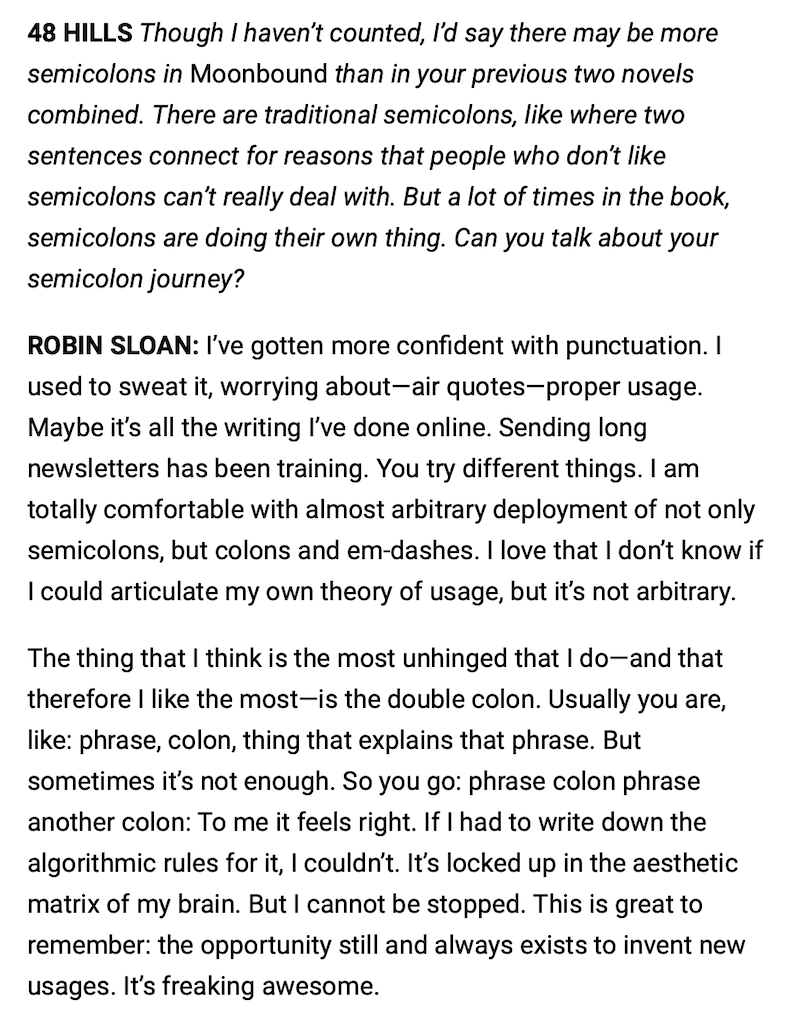
Read the full piece at 48hills.org.
It’s a Monday and you’re sitting in your office typing away, and there’s plenty to listen to, but why not whip up a quick little reworking of a loop from the FM3 Chan Fang Buddha Machine that someone recently sent to you as a gift? (Audio processed in VCV Rack. Buddha Machine audio inputted into a MacBook via an Edirol UA-25EX audio interface.) And a side note: SoundCloud shows this track as having been “mastered,” but that’s not the case. I did experiment with the built-in SoundCloud mastering option, applying the “Aurora” version, but it ended up too shrill for my ears. The ringing in particular sounded like a fire alarm was going off the whole time, so I replaced it with the original.