TWiS: “‘Territorial Privacy’ Instead of Silence”

A lightly annotated clipping service

These sound-studies highlights of the week originally appeared in the January 16, 2024, issue of the Disquiet.com weekly email newsletter, This Week in Sound. This Week in Sound is the best way I’ve found to process material I come across. Your support provides resources and encouragement. Most issues are free. A weekly annotated ambient-music mixtape is for paid subscribers. Thanks.

▰ SURROUND SOUND: This Tab AI necklace seems like it could be a potential privacy nightmare, but at the same time the combination of small microphones and AI is bound to have ramifications, so better to start keeping abreast of such developments sooner than later: “Tab is a small puck that hangs around your neck and listens to everything you (and the people around you) say. Essentially just a microphone and a battery that lasts up to 30 hours between charges, it uses Bluetooth to beam your audio to your phone and into the cloud, where ChatGPT currently transcribes your conversations, and various AI models will extract insights for you. (Its UX isn’t final, but assume you’ll use your phone screen for most anything you want to do.) Ultimately, Tab is meant to be an AI companion, or what Schiffmann calls a ‘clarity machine’ that rides along in every moment of your life.”

▰ SPACE, MAN: Workplace life is ever-changing (especially now that life/work balance is morphing into remote/office-work balance), as is use of those “privacy pods” that have been popping up in recent years: “The pods, some resembling old-school telephone booths, have emerged as one of the hottest segments in the $24 billion North American office-furniture industry. Manufacturers such as Room, Nook and Framery say business has been brisk. But some workers and managers say more booths means less eavesdropping, less gossiping, less camaraderie and less fun. … Other products seek a different balance between isolation and community. Furniture maker Steelcase offers a desk-encircling tent meant to ensure ‘territorial privacy’ instead of silence. Nook, headquartered in the U.K., makes hut-shaped hideaways intended to provide a sense of psychological safety without being completely enclosed.”

▰ PHONE HOME: The threat of AI fakes is getting real: “A San Rafael mother received a terrifying phone call in October, and a voice on the other line was a perfect replica of her son saying, ‘Mom, mom, I’ve been in a car accident!’ Then another man came on the line saying that he was a police officer, that her son had run a stop sign and injured a pregnant woman in the accident, and that he was going to be taken to jail. This was followed by another call from someone claiming to be a local public defender, saying that she and her husband needed to pay $15,000 bail ASAP to get their son out of jail.”

▰ QUICK NOTES: The Art of Listening: Two great items via Rob Walker’s always excellent The Art of Noticing newsletter: one on a payphone that plays birdsongsand the other an audio-enabled map of the world’s forests. ▰ Bird Brain: The Shriek of the Week is the Song Thrush, which, we are told, are “are loud, persistent performers.” ▰ Practice Makes Perfect: New scientific research shows that even birds “require daily vocal exercise to first gain and subsequently maintain peak vocal muscle performance.” ▰ Dog Days: The annual CES expo hosts unusual devices, and this year’s has been no exception. Case in point: a feeding device that will encourage the family pet to learn to play music. ▰ Frame by Frame: Also introduced at CES: Samsung has made a picture frame that doubles as a speaker. ▰ Location, Location, Location: Very interesting research on how geography has shaped language development.
On the Line

Some favorite recent sentences

"Silence is not visible, and yet its existence is clearly apparent. It extends to the farthest distances, yet is so close to us that we can feel it as concretely as we feel our own bodies. It is intangible, yet we can feel it as directly as we feel materials and fabrics."

That is the late Swiss philosopher Max Picard (1888-1965), as quoted by LM Sacasas in a recent issue of The Convivial Society. Writes Sacasas: “Those were the lines that first helped me perceive silence as an autonomous reality, and they did so simply by leading me to think again about what silence feels like. When in the presence of silence, I do not feel an emptiness, rather I feel something. Something looming, something active, something that is at work on me.” (The Picard quote is from his book The World of Silence, originally published in 1948.)

. . .

"Even the Pokémon noises are gently mellowed out in contrast to the coarser, more caterwauling sounds of the games; here the creatures purr, cry, coo and sigh like docile house pets."

That is Maya Philips writing in the New York Times about a new Netflix series titled Pokémon Concierge.

. . .

"He never allows you to rest, because he never settles into a groove or plays a familiar lick. His sound is a permanent antidote to complacency."

That is from a review in the New York Review of Books by Adam Shatz of Easily Slip into Another World: A Life in Music, the new autobiography from musician Henry Threadgill, who wrote it with Brent Hayes Edwards(Thanks, Evan Cooper!)

Sound Ledger

Audio culture by the numbers

925: The maximum speed in miles per hour of the new “quieter” supersonic jet

32: The percent by which harmful brain plaque, correlated with Alzheimer’s, was reduced in tests using focused ultrasound

45: The decibel level above which people generally find sound annoying

Sources: supersonic (nasa.gov), ultrasound (washingtonpost.com), decibels (wsj.com)

Visual Narrative of Sound

In the work of Janet Cardiff and George Bures Miller

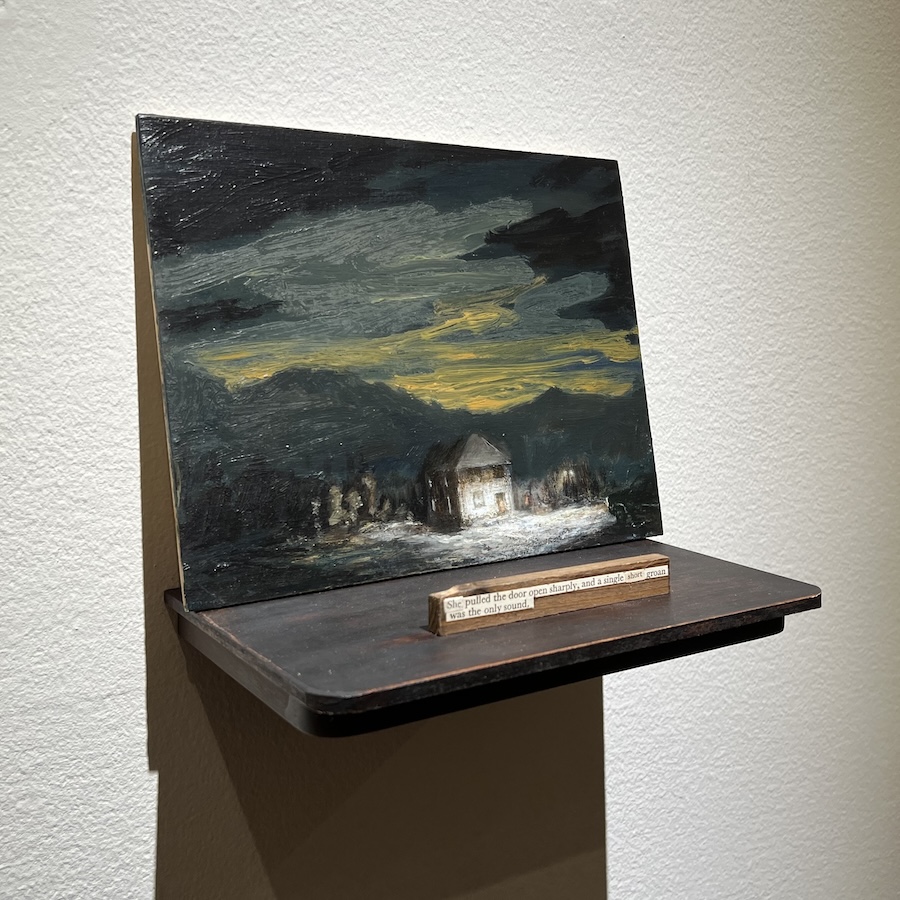
This is just one of the many works currently on display at the show from artists Janet Cardiff and George Bures Miller open through March 9 at the Fraenkel Gallery in San Francisco. Essentially all the works in the show engage with sound, two pieces filling entire rooms, others triggered by tiny red buttons the size of a bug bite. This one makes no sound, except perhaps in the viewer’s imagination.

Titled simply White House Night and dating from last year, it’s a fragile little painting of a little building against a murky backdrop, picturesque in a macabre sort of way, the piece’s delicacy emphasized by how it is not hung on the wall, but left to lean atop a small shelf. In front, on a piece of wood the odd shape of which suggests it’s been repurposed, are a couple lines of text, an assemblage, two words superimposed, or interjected, into what was either a pre-existing sentence, or two separate ones now joined together.

The combination of painting and rejiggered typography functions like a reverse of a piece by the late artist Tom Phillips: the words remote from the image and formed into a whole, even one with its seams showing, rather than the image serving to reorient a written sequence that preceded the art-making. It shares with Phillips the sense of making the most of limited resources, one of which is language.

There’s something almost accusatory about the edits, the “She” like a later clarification and the “short” carrying meaning the viewer can only guess at. We’re left with the image, so to speak, of a “short groan,” and the lingering presence otherwise of the deep silence that the structure, seemingly illuminated by a car’s headlights, contains.

Interview with Me About Music Technology

And what we talk about when we talk about software

Martin Yam Møller asks people more or less the same nine questions about music equipment for a running series of informative interviews on his website. These have included the musicians Sofie Birch, Emily Hopkins, Colleen, and Takeyuki Hakozaki, among many others. Møller asked me to participate back at the start of 2020, and I finally completed the Q&A this past week. To be very clear, I don’t remotely have the musical talent of the other people interviewed by Møller; as I mention in one of my answers, regarding my engagement with music-making: “using instruments has helped me understand more deeply the music I write about, and playing has informed the collaborations I do with musicians, as well as the occasions when I interview musicians and other people who work in sound.” That said, I really enjoyed chewing on his questions, things like which “knob/fader/switch” is my favorite, and what’s “the most annoying piece of gear you have, that you just can’t live without.” Below is the second half of the answer to one of the questions, just by way of example of how the interview plays out. His question in this case was: “What software do you wish was hardware and vice versa?” I easily came up with several answers for the first half of the question. The other half was much more difficult to answer, and now having looked over the responses from other participants in the series, I recognize I’m not alone. It seems like an obvious reverse, but the more I thought about it, the more I realized not only that I couldn’t really come up with a specific answer, but that the question itself reveals something about the limits of what we talk about when we talk about software. Here’s what I wrote:.

[A] lot of my favorite software, such as the Borderlands app, isn’t purely software; these are tools that work because of the physical interface on which they run. An app like Borderlands already is hardware, in a manner of speaking, because it runs on an iPad. However, a distinction can be made between a piece of software-driven hardware that will work until the thing breaks, like a guitar pedal with firmware, versus a piece of software that is dependent on a separate operating system, such as iPadOS in the case of Borderlands, that may break the software when the OS updates and the old hardware on which it ran is sunsetted. Any number of iOS apps fall into the latter category. 

In addition some software, like the Koala app, already have physical parallels in hardware: if I want Koala in standalone hardware form, I could just get an Roland SP-404 (I do want to try the MK II, which does a bunch of stuff the Teenage Engineering EP-133 K.O. II doesn’t). I love Samplr, which also falls into the Borderlands category of being iPad-specific. I love SuperCollider, but it requires a computer keyboard and a screen — I wonder what “hardware SuperCollider” might even mean, right? In many ways, SuperCollider is as tied to a keyboard as Koala, Samplr, and Borderlands are tied to iPadOS. So, no, there isn’t really a piece of software that I wish was hardware. 

Read all my responses at martinyammoller.com/9oddquestionsformusicgearjunkies.