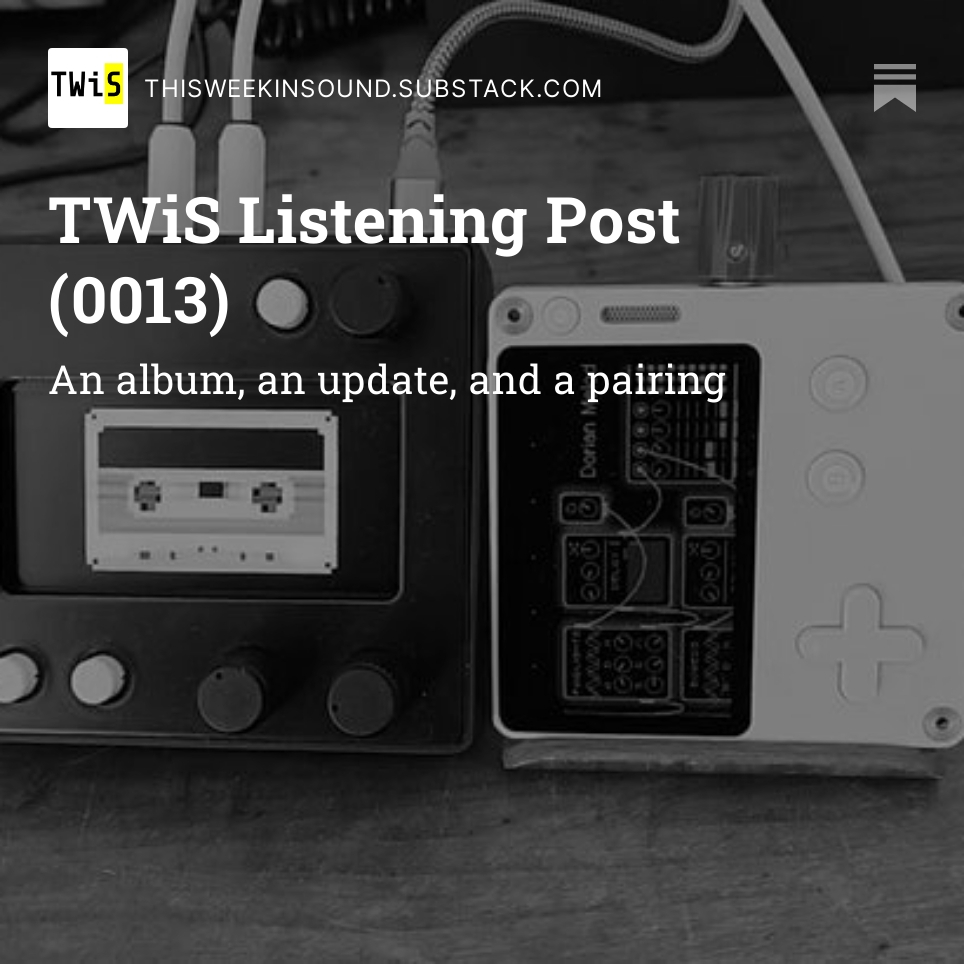
This went out yesterday as a weekly bonus — a thank-you to people who financially support This Week in Sound. It supplements the free Tuesday and Friday issues, which feature a broader array of material from the field of sound studies. It contained an annotated playlist of recommended music. I wrote about ambient and ambient-adjacent recordings from (1) Donny Mahlmeister (using a beat machine for quiet music), (2) Chieko Mori (koto minimalism), and (3) Öppenlab Yorkshire (employing a handheld game console).
The Assignment: Walk the listener through variations on the same percussive instrument.
/ By Marc Weidenbaum
Each Thursday in the Disquiet Junto music community, a new compositional challenge is set before the group’s members, who then have just over four days to upload a track in response to the assignment. Membership in the Junto is open: just join and participate. (A SoundCloud account is helpful but not required.) There’s no pressure to do every project. It’s weekly so that you know it’s there, every Thursday through Monday, when you have the time and interest.
Deadline: This project’s deadline is the end of the day Monday, September 25, 2023, at 11:59pm (that is, just before midnight) wherever you are. It was posted on Thursday, September 21, 2023.
Tracks are added to the SoundCloud playlist for the duration of the project. Additional (non-SoundCloud) tracks appear in the lllllll.co discussion thread.
Disquiet Junto Project 0612: Drum Vector The Assignment: Walk the listener through variations on the same percussive instrument.
Thanks to Mahlen Morris for having proposed this project.
Step 1: Pick a single percussion instrument.
Step 2: Record between 4 and 12 different short examples (roughly 20 to 60 seconds each) of playing that instrument. Imagine that each recording is by a different musician exercising a different aspect of the instrument. Make no deliberate attempt to match key or tempo or sonic quality between them.
Step 3: Imagine moving through space over the course of time, and encountering the sounds — overlapping somewhat — as you proceed. Arrange the recordings over the course of a track so that at least one and at most five of the examples are audible at any one time. To further the spatial movement, each could fade in at the beginning and fade out. They might, as well, move from position to position within the stereo field.
Step 4: If you wish, consider adding a noise bed underneath the entire piece to sew all of the pieces together, to provide a sense of the space one is moving through.
Eight Important Steps When Your Track Is Done:
Step 1: Include “disquiet0612” (no spaces or quotation marks) in the name of your tracks.
Step 2: If your audio-hosting platform allows for tags, be sure to also include the project tag “disquiet0612” (no spaces or quotation marks). If you’re posting on SoundCloud in particular, this is essential to subsequent location of tracks for the creation of a project playlist.
Step 3: Upload your tracks. It is helpful but not essential that you use SoundCloud to host your tracks.
Step 4: Post your track in the following discussion thread at llllllll.co:
Step 5: Annotate your track with a brief explanation of your approach and process.
Step 6: If posting on social media, please consider using the hashtag #DisquietJunto so fellow participants are more likely to locate your communication.
Step 7: Then listen to and comment on tracks uploaded by your fellow Disquiet Junto participants.
Step 8: Also join in the discussion on the Disquiet Junto Slack. Send your email address to [email protected] for Slack inclusion.
Note: Please post one track for this weekly Junto project. If you choose to post more than one, and do so on SoundCloud, please let me know which you’d like added to the playlist. Thanks.
Additional Details:
Length: The length is up to you. How long a walk do you want to take the listener on?
Deadline: This project’s deadline is the end of the day Monday, September 25, 2023, at 11:59pm (that is, just before midnight) wherever you are. It was posted on Thursday, September 21, 2023.
Upload: When participating in this project, be sure to include a description of your process in planning, composing, and recording it. This description is an essential element of the communicative process inherent in the Disquiet Junto. Photos, video, and lists of equipment are always appreciated.
Download: It is always best to set your track as downloadable and allowing for attributed remixing (i.e., a Creative Commons license permitting non-commercial sharing with attribution, allowing for derivatives).
For context, when posting the track online, please be sure to include this following information:
More on this 612th weekly Disquiet Junto project, Drum Vector (The Assignment: Walk the listener through variations on the same percussive instrument), at: https://disquiet.com/0612/
Thanks to Mahlen Morris for having proposed this project.
These sound-studies highlights of the week originally appeared in the September 19, 2023, issue of the Disquiet.com weekly email newsletter, This Week in Sound. This Week in Sound is the best way I’ve found to process material I come across. Your support provides resources and encouragement. Most issues are free. A weekly annotated ambient-music mixtape is for paid subscribers. Thanks.
▰ MUSIQUE D’AMEUBLEMENT: “As brands continue to search for ways to cut through the proverbial noise and connect with customers, we can only expect more appliance acoustics,” writes Johnny Brayson, reporting on what many people have noticed, which is that “Seemingly every appliance, from the vacuum to the dryer, is serenading us these days.” Also: “As novel as it may seem, it’s just new to the West. Appliances have been singing in other parts of the world before the dawn of the millennium, with Japanese appliance manufacturer Zojirushi incorporating chimes in their rice cookers as early as 1999. The sounds not only helped the brand stand out in the sea of standard beeps made by competitors’ products, but also it showcased the capabilities of then-new microcomputer tech, as programming the tones wasn’t possible before. Like Zojirushi, the consumer electronics brands filling American homes with song today are doing so for both emotional and practical reasons.” Erik Satie might be proud. (Thanks, Lowell Goss!)
▰ VOCAL DISCORD: Lisa Mulcahy at the Washington Post (gift link) explains both why one might find one’s voice annoying (“58 percent of the survey subjects said they didn’t like listening to themselves,” per Harvard teaching hospital research), and what can be done about it: “Several interventions are possible, including vocal cord injections using collagen, gel fillers or Botox. … Voice therapy using airflow exercises can be a helpful, safe alternative.” Me, I depend on speech-to-text tools, like MacWhisper and rev.com, to transcribe things for me, in part to save time, but also so I don’t have to hear myself. (Thanks, Mike Rhode!)
▰ TOTALLY TUBULAR: A new update to the more recent of the AirPod Pros — or, as scriveners in the field of gadget journalism term them, AirPods Pro — means the devices “will automatically adjust to your environment or activity so you don’t have to touch the earbuds or reach for your phone.” Yes, this is a product update, and no it isn’t the end all or be all of just about anything, but per other recent writing here, I do think it’s highly valuable to track both technological milestones and exploratory interface tweaks, because today’s peculiar, fledgling firmware adjustment is the near future’s new normal. Not just observing these changes but documenting them in real time is highly valuable. “When there’s a change in your surroundings,” writes Billy Steele at Engadget, “Adaptive Audio gradually starts tweaking the blend of ANC and transparency. So if you enter a loud coffee shop or sit near a noisy A/C unit, AirPods Pro gently increases the level of noise cancellation to combat the clamor. The point is to smooth the transition, so the change in cancellation level doesn’t become a distraction itself.” (Related but less of a tectonic shift: there are 20 new iOS ringtones, including ones crafted by musician Adam Young, of the electronica act Owl City.)
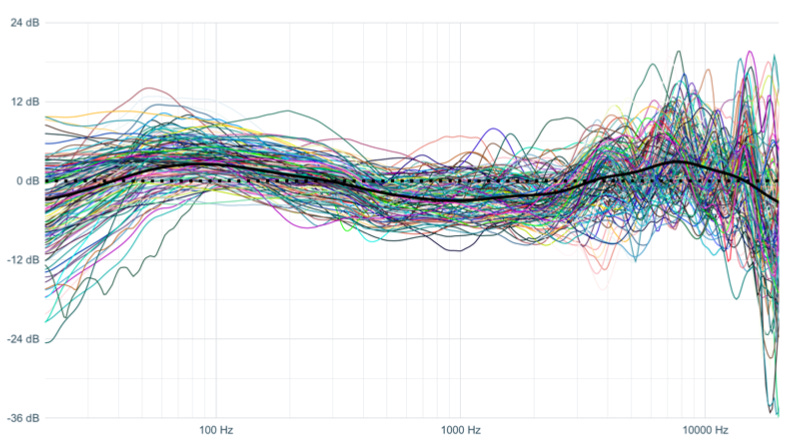
▰ ALL EARS:SonarWorks has posted a survey of data about the headphone industry, noting: “The headphone market is highly consolidated with the top 10 headphone models together representing 36% market share and the top 3 models 19% market share.” Details include market share among the top 162 models, with Apple at roughly 20%, between three models. (Caveat: “Unfortunately, China and India were left out of our research due to a lack of available data.”) There are also several charts. This one below: “The frequency responses of the top 162 headphone models are represented by colored lines with the weighted average shown as a solid black line.” The variance at the high end (on the right) is quite striking. (Thanks, Kirke Godfrey!)
▰ QUICK NOTES:Pivot Tabled: I’m comfortable saying that I don’t understand the new product offering from Clubhouse, the “voice social media” service. ▰ Class App: Duolingo’s music lessons are, indeed, coming. I’ve been doing German for — checks phone — a 135-day streak. I’m looking forward to trying it out. ▰ Quiet Mode: Nathan Moody notes, on Twitter/X, the ASMR promotion of the upcoming Expendables film (apparently Extraction 2 and A Quiet Place did similar things). ▰ The Other Tweet App: Check out birdsong.fm, which is what it seems like (thanks, Jason Wehmhoener!) ▰ Mm-Hmm: 3M is on the hook for six billion dollars (for veterans and service members) due to hearing loss “from faulty earplugs.” That’s two billion per M. (Thanks, Rich Pettus!) ▰ Doggone Crazy:Researchers in Hungary are learning how best to talk to a dog. (Also, thanks, Rich!)
“His way of being in the world was encapsulated in his ‘lower case’ methodology, making for a gently provocative musical legacy that I am sure will undulate tidally into and out of focus over the coming decades.”
The “His” is Steve Roden, the late artist (and a friend of mine), who died earlier this month. The “I” is Lawrence English, writing an appreciation in the Quietus. I fully subscribe to English’s “tidal” prediction — the projected ebb and, especially, the flow.
. . .
“I didn’t find birding so much as it found me.”
That is Ed Yong, author of An Immense World: How Animal Senses Reveal the Hidden Realms Around Us, in his newsletter.
. . .
“The Zebra owned a little radio; it played static, and also a station that stayed on the air all night long, playing scratchy recordings of Schumann and Chopin from somewhere in the darkness of Central Europe, where insomnia had become something of a religion.”
That sentence is “recent” only as in the “recent to me” sense. It’s from 1991. It’s from the second novel, Dark Star, of apparently 15 in the Night Soldiers historical spy series by Alan Furst. And for context, the “Zebra” is the nickname of someone the book’s protagonist spends an evening with. The time is just prior to World War II.