
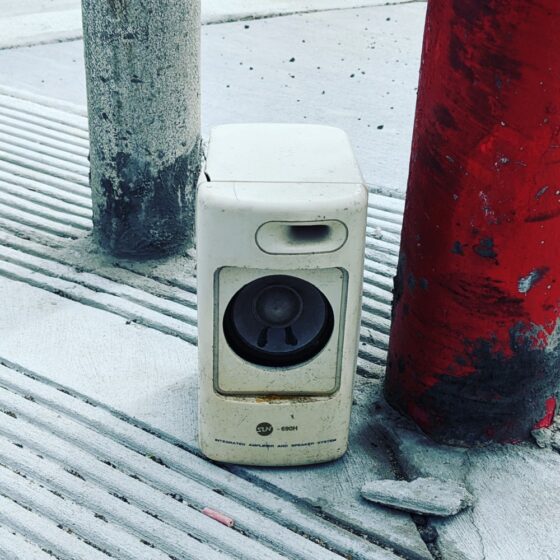
Retro Surveillance Theater
An ongoing series cross-posted from instagram.com/dsqt
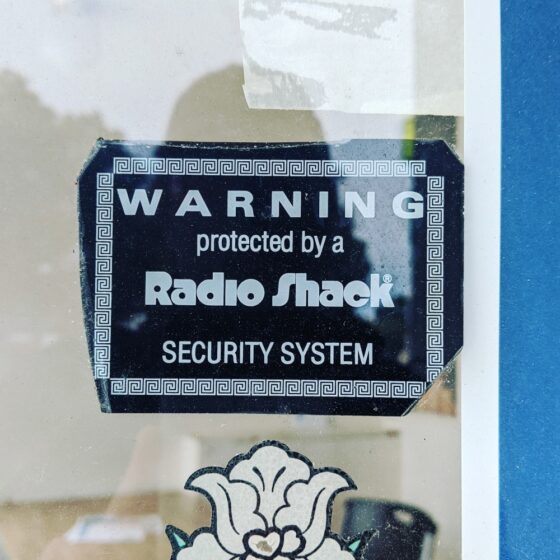
Security, or “Come right in and make yourself at home”?
At a Planetary Scale
Music from Nathan McLaughlin
The acoustic guitar is so prominent, so closely mic’d, so emotionally present, that the sounds circumnavigating Nathan McLaughlin’s playing may only become fully apparent to the listener when the guitar pulls back. They’ve been there all along, small atmospheric bits, like echoes, like shadows, like lens flares. But perhaps they’re something more, like glitches in the fabric of reality, because when the guitar does go away, the backdrop becomes the foreground, and the sheer beauty of what’s been running below the radar becomes fully evident, a rich, subtle, plaintive airing of tonal spaciousness. It’s a revelation.
Such is the first track on *Saturn*, McLaughlin’s remarkable new two-part EP of music played based on “planetary scales” (he cites Joscelyn Godwin’s *Harmonies of Heaven and Earth: Mysticism in Music from Antiquity to the Avant-Garde* in the liner note; the planetary scales are from work by Rudolf Steiner). Like the live performance of his I mentioned at the start of the U.S. response to the pandemic ([“Minimalism and Its Echoes”](https://disquiet.com/2020/03/24/nathan-mclaughlin-decentralized-sonic-quarantine/)), the music here sounds improvisatory, largely due to how it drifts from song form into something rangier and more free-flowing. But there’s no doubt, upon repeat listens, that this is deeply considered work, music in which the arrangement (notably the muted appearance, on the EP’s second track, of violin performed by Oliver McLaughlin) is paramount. Everything is in a keen balance with everything else. To listen to *Saturn* is to witness balance in action.
Album posted at [planetarymusic.bandcamp.com](https://planetarymusic.bandcamp.com/album/saturn). More from McLaughlin at [nathanmclaughlin.zone](https://www.nathanmclaughlin.zone/).
Current Listens: Ugandan Synths, Eno/Anderson Chat
Heavy rotation, lightly annotated
This is my weekly(ish) answer to the question “What have you been listening to lately?” It’s lightly annotated because I don’t like re-posting material without providing some context. In the interest of conversation, let me know what you’re listening to in the comments below. Just please don’t promote your own work (or that of your label/client). This isn’t the right venue. (Just use email.)
▰ ▰ ▰ ▰ ▰ ▰ ▰ ▰ ▰ ▰ ▰ ▰ ▰ ▰ ▰
NEW: Recent(ish) arrivals and pre-releases
▰ A standout track on Nika Son’s new album, *To Eeyore*, is “Fake News,” built from slowly diverging and coalescing wave forms, to which she then adds disturbingly emotionless vocals, processed to create a sonic uncanny valley. In an interview at [kaput-mag.com](https://kaput-mag.com/stories_en/nika-son-i-often-feel-more-connected-to-animals-than-to-humans/), Son, also known as Nika Breithaupt, explained a bit about the piece: “I don’t normally work much with my own voice, but for this piece I used it deliberately. As with the computer voices I am interested in experimenting with real languages, with words that by manipulation become a fantasy language, an uncontrolled instrument.” There’s also [a video](https://www.youtube.com/watch?v=1ocZ2KhAGaA) for the track, directed by Helena Wittmann. The album is on one of my favorite labels, Entr’acte.
▰ Afrorack, aka Brian Bamanya, is a Uganda-based electronic musician who works primarily with DIY instruments. This live, 20-minute set ably traverses the common ground between noise and techno. It’s of a concert from the tail end of January 2020.
(Peter Kirn re-upped this recently at [cdm.link](https://cdm.link/2020/07/afrorack-uganda-live-at-ctm/).)
▰ This is a Zoom call we all wish we’d been on. In an online conversation, Simon McBurney hosts Laurie Anderson, Brian Eno, and Nitin Sawhney on the broad topic of “ways of listening,” talking about sound and art during the pandemic. Anderson describes bird-watching as a social distancing sport, and Brian Eno extols a favorite smartphone app (Radio Garden, to which Sawhney immediately agrees with a big thumbs up). There’s even screen sharing, when Sawhney (experiencing some now universally familiar complications, including the stream eventually freezing) displays a work in progress. McBurney describes, following his experience staging *The Magic Flute*, his belief that Mozart felt that music can change people’s state of consciousness. And those are just a few of the subjects. It’s a wide-ranging and highly enjoyable conversation. (Hat tip to [synthtopia.com](http://www.synthtopia.com/content/2020/07/30/laurie-anderson-brian-eno-nitin-sawhney-on-ways-of-listening/).)
This Week in Sound: Wonky Skulls
A lightly annotated clipping service
These sound-studies highlights of the week are lightly adapted from the July 27, 2020, issue of the free Disquiet.com weekly email newsletter This Week in Sound ([tinyletter.com/disquiet](https://tinyletter.com/disquiet)).
As always, if you find sonic news of interest, please share it with me, and (except with the most widespread of news items) I’ll credit you should I mention it here.
▰ ▰ ▰ ▰ ▰ ▰ ▰ ▰ ▰ ▰ ▰ ▰ ▰ ▰ ▰
THIS WEEK IN SOUND
▰ The big sound-studies story this week has been the fake (or “fake”) crowd noise at professional sports events being broadcast during Covid. How long these events will go on is unclear, what with Major League Baseball having postponed two games scheduled for this evening. Igor Bonifacic reports that the NBA will be using Teams, the Microsoft answer to Slack: “The displays will allow players to see and hear the people who are watching them via Teams.” How long that’ll last before people start making noise and doing things at home they wouldn’t do in person is also unclear. Joe Reedy notes: “Stadium sound engineers will have access to around 75 different effects and reactions.” These sounds originated in the video game series MLB The Show. (And since most of what I know about baseball originates either as scandal in the news pages or as fiction, this scenario has sent me back to reread Jonathan Lethem’s short story “Vanilla Dunk.”) “You’re still focused on the game but that noise is very helpful. I could tell the first few scrimmages with pure silence was tough for some guys,” Reedy quotes Eric Sogard of the Milwaukee Brewers.
https://www.engadget.com/nba-microsoft-teams-192426876.html
https://abcnews.go.com/Sports/wireStory/ballparks-crowd-noise-video-game-season-71833283
▰ Before getting to all those stories about how quiet the world is getting, first note that noise complaints in New York City are up nearly 300 percent. Shaye Weaver attributes the uptick to “more people crammed together at the same time,” as well as to protests and the fireworks running up to the Fourth of July. The research cited was an analysis by apartmentguide.com of data from NYC Open Data.
https://www.timeout.com/newyork/news/noise-complaints-in-nyc-have-increased-almost-300-percent-since-february-072720
[https://www.apartmentguide.com/blog/new-york-noise-complaints/](https://www.apartmentguide.com/blog/new-york-noise-complaints/)
[https://data.cityofnewyork.us/Social-Services/311-Noise-Complaints/p5f6-bkga](https://data.cityofnewyork.us/Social-Services/311-Noise-Complaints/p5f6-bkga)
▰ “We can safely say that in modern seismology, we’ve never seen such a long period of human quiet,” according to seismologist Raphael De Plaen. Tanya Basu writes on how Covid has quieted the planet: “Everyday urban activities like commutes, or stadiums full of fans simultaneously going wild in ‘football quakes,’ are strong enough to register on seismometers.” (Thanks, Rob Walker!)
https://www.technologyreview.com/2020/07/23/1005574/lockdown-was-the-longest-period-of-quiet-in-human-history/
▰ Michael Le Page reports on “optical cochlear implants that use light to stimulate the nerve cells.” Note that the nerve cells must be genetically modified for this to take effect.
https://www.newscientist.com/article/2249633-hearing-restored-in-rats-by-modifying-ear-cells-to-respond-to-light/
▰ “The two major tools to promote deaf accessibility in video games are (1) subtitles/captions and (2) visual cues.” Morgan Baker provides a detailed primer.
https://www.gamasutra.com/blogs/MorganBaker/
▰ “In most toothed whales, the internal organs in the skull are squashed into the left side to make way for soft tissues which help them to echolocate”: Katie Pavid explores the science of why whales look that way. Apparently such skulls are called “wonky.” The article uses variations on the word “wonky” eight times. (Via Cheryl Tipp)
https://www.nhm.ac.uk/discover/news/2020/july/echolocation-gives-whales-lopsided-heads.html
▰ “A team from the Systems Engineering Department at the University of Lagos in Akoka, Lagos, Nigeria, have discovered that people can identify other people by the matchless nature of their laughter because, unlike voice and manner of speech, laughter almost cannot be mimicked,” writes Anton Shilov. In other words, your next password may be your laugh, no kidding.
https://www.techradar.com/news/your-next-banking-password-could-be-based-on-laughter
▰ “Half a century later and visual and voice deepfake technology can give a glimpse at an alternate reality where the landing failed”: The landing is the U.S. arrival on the moon. The deepfake is of Richard Nixon announcing the death of the astronauts. There are 98 days until the next U.S. presidential election, and the concept of audio deepfakes isn’t quite keeping me up at night, but it sure is heavy on my mind. Read Eric Hal Schwartz on the topic. And if your middle name is Hal, it’s sort of inevitable you end up on the artificial intelligence beat, right? (This isn’t the first time I’ve quoted Schwartz in the newsletter, but I think it’s the first time I’ve made that joke.)
https://voicebot.ai/2020/07/20/rewriting-the-moon-landing-with-a-deepfake-built-on-synthetic-speech/
▰ “Hackers use machine learning to clone someone’s voice and then combine that voice clone with social engineering techniques to convince people to move money where it shouldn’t be,” writes James Vincent of the “audio deepfake scam.”
https://www.theverge.com/2020/7/27/21339898/deepfake-audio-voice-clone-scam-attempt-nisos
▰ ▰ ▰ ▰ ▰ ▰ ▰ ▰ ▰ ▰ ▰ ▰ ▰ ▰ ▰
GRACE NOTES
▰ The trailer for the upcoming TV series Biohackers features an amazing urban doorbell and a homebrew “biopiano” using plants. I’m in. (And a silent rave, too, which Beth Elderkin of io9 pointed out.) The Netflix algorithms have my number.
▰ The narration of this audiobook I’ve been listening to while going for walks is so stilted, I bet if I found a printed copy I could confirm pauses align with pages being turned. Also, though it’s from the library’s online service, it includes spoken instruction to change CDs.
▰ I don’t miss concerts half as much as I miss running into people at concerts.
▰ The unique internet pleasure of observing a musician you admire purchase a used piece of music equipment in which you are interested, and then awaiting a release that features the result.
▰ My next sequencer is MIDI data of people nodding in agreement on Zoom conferences posted to YouTube where folks are in sync, so to speak, with what the speaker is saying.
▰ Ableton Quantum Entanglement Link