Scratch Pad: Neighbor Band, Hate-Shazaming

At the end of each week, I usually collate a lightly edited collection of recent comments I’ve made on social media, which I think of as my public scratch pad. I find knowing I’ll revisit my posts to be a positive and mellowing influence on my social media activity. I mostly hang out on Mastodon (at post.lurk.org/@disquiet), and I’m also trying out a few others. And I generally take weekends off social media.

▰ Kudos to whoever on the Poker Face team ran the episode 7, season 2, credits in the typeface from the movie Heat

▰ It appears a drummer now lives near the tiny office I rent. I think I can work with this, as traffic noise and distance muffle much of it. Headphones can manage the remainder. I mean, someone can’t practice drums all day. Right? Right??

▰ So much of my favorite music is glitch. Thelonious Monk is piano glitch. Kid Koala is turntable glitch. Gregorian chant and early polyphony are architectural glitch. Janis Joplin is vocal glitch. I love when the fragility of engineering is put to purposeful use.

▰ The recent documentary (really more like a commissioned group memoir) Becoming Led Zeppelin was very enjoyable, and it was fun to be reminded of Jimmy Page having, in his early work as a session musician, done work on Muzak. I’d love if some superfan had managed to track down the specific material he contributed to.

▰ Keeping an eye on my Mac Mini via Screen Sharing on an iPad connected to my MacBook via Sidecar is my mundane version of Inception

▰ My Shazam is 90% music I disliked so much I had to find out what it was (maybe call this habit “hate-Shazaming”), and 10% stuff I loved but couldn’t identify, half of that originating from the inside of taco trucks

▰ I am far more up for this Superman movie than I expected to be. The trailer roll-out is doing its job. I mean, the teeth making a sound when they hit the camera after being knocked out by a punch (at 1:15)? Bonus points for major Frank Quitely vibes. Sign me up.

▰ Update: the drummer who moved near (but not too near!) the little office I rent appears to have made a bassist friend. They dig Cream, Led Zeppelin, and Black Sabbath.

▰ This hold music is like a weaponized lullaby

▰ Update: The drummer near my little rental office skipped a day of practice, but filling the void was someone a few buildings away screaming on a phone for so long and so intensely that someone in a neighboring office started laughing.

▰ Finished reading one book this week: The Mushroom at the End of the World by anthropologist Anna Lowenhaupt Tsing. Well into several others, including the second Bosch and Stephen King’s The Long Walk, and probably too many others to count.

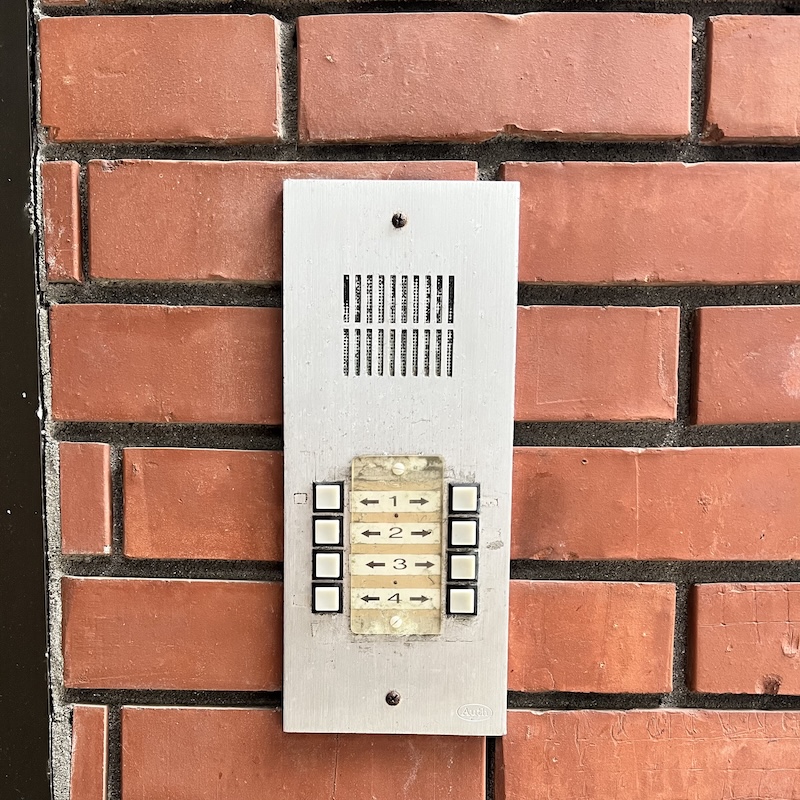
▰ And this week in #dronescrolling — i.e., stuff other people posted: Tom Gauld posted, on Instagram, a four-panel comic involving the sound of a fountain pen, and I won’t give away the ending. (Thanks, Mike Rhode!) ▰  Robin Fox, on Instagram, posted the internal organs of a 1939 instrument, the Hammond Novachord, that contains no fewer than 163 (!) vacuum tubes. ▰ The account that goes by c1t1zen had a funny response, on Threads, to my latest doorbell post.
Clicking with Neal Stephenson (1994)

Re-re-reading "Spew"

Every few years I re-read “Spew,” the Neal Stephenson story published in the magazine Wired in 1994. It’s still online, as are we all.

“Spew” is a prescient if purposefully exaggerated consideration of what was already called the “social graph” but wouldn’t achieve poisonous fruition until Facebook and its ilk took off a decade-plus later. Here, in a story of hyper-focused advertising, Stephenson gets close, with the term “social web.” Gmail, which scanned people’s emails to produce targeted ads (as may Yahoo and other email providers to this day, apparently), wouldn’t launch for another 10 years. Stephenson in “Spew” took early note of what we today term surveillance capitalism.

He also paid attention to the ability to turn the tools of internet-connected observance on oneself. YouTube, foreseen here in some technology-intensive live-streaming, debuted the year after Gmail, in 2005. Back in 1994, this idea was, one might recall, still a stretch: “You have turned your room — my room — into a broadcast station,” the narrator exclaims believably. Twitch didn’t surface until 2011.

The subjects of Stephenson’s premonitions include his own future work. He calls the troubling sludge that is the foreseen horrible Internet (capitalized back then) the Spew, not unlike the Miasma, as it would be labeled decades later in his novel Fall; or, Dodge in Hell (2019).

I recently re-read Stephenson’s novel Cryptonomicon, so my eyes were primed to notice, this time around, Stephenson’s use in “Spew” of the word “gomer” to mean someone old, embarrassing, and ultimately disposable. In Cryptonomicon, that word is half the name of a furniture company, Gomer Bolstrood, which later appears (earlier chronologically) in his Baroque Cycle. So, while the tone of “gomer” is different, the usage in “Spew” is very much this story’s narrator’s perspective of something out of date.

There are some great lines throughout, such as this one, echoing the Rolling Stones’ classic anti-advertising/consumerist rant, “(I Can’t Get No) Satisfaction”: “I can tell you’re cool because your water costs more than your beer.”

I mention “Spew” now because this following section of the story stood out to me in a way it hadn’t on previous reads. Note how the fetishized fine-tuning of sound design provides a tactile quality and utility in an increasingly frictionless media landscape:

Click. Course, it never really clicks anymore, no one has used mechanical switches since like the ’50s, but some Spew terminals emit a synthesized click — they wired up a 1955 Sylvania in a digital sound lab somewhere and had some old gomer in a tank-top stagger up to it and change back and forth between Channel 4 and Channel 5 a few times, paid him off and fired him, then compressed the sound and inseminated it into the terminals’ fundamental ROMs so that we’d get that reassuring click when we jumped from one Feed to another. Which is what happens now; except I haven’t touched a remote, don’t even have a remote, that being the whole point of the Polysurf. Now it’s some fucker picking a banjo, ouch it is an actual Hee Haw rerun, digitally remastered, frozen in pure binary until the collapse of the Universe.

You can read the full story at wired.com/1994/10/spew, though that may be behind a paywall.

Disquiet Junto Project 0702: Chain of Applications

The Assignment: Make music by misusing a piece of music software.

Each Thursday in the Disquiet Junto music community, a new compositional challenge is set before the group’s members, who then have five days to record and upload a track in response to the project instructions.

Membership in the Junto is open: just join and participate. (A SoundCloud account is helpful but not required.) There’s no pressure to do every project. The Junto is weekly so that you know it’s there, every Thursday through Monday, when your time and interest align.

Tracks are added to the SoundCloud playlist for the duration of the project. Additional (non-SoundCloud) tracks also generally appear in the lllllll.co discussion thread.

Disquiet Junto Project 0702: Chain of Applications
The Assignment: Make music by misusing a piece of music software.

This project is the second of three that are being done by the Disquiet Junto in collaboration with the 2025 Musikfestival Bern, which will be held in Switzerland from September 3 through 7. The festival topic this year is « Kette » — which translates, as the organization explains, to “Chain”: “Chains connect but they also bind. They create relationships but also restrictions. As a gift they look nice, feared when used in vice, and yet they can span bridges across fire and ice.” All three Junto projects will engage with the work of Svetlana Maraš, who is the Composer-in-Residence for the 2025 festival.

We are working again at the invitation of Tobias Reber, an early Junto participant, who is in charge of the educational activities of the festival. This is the seventh year in a row that the Junto has collaborated with Musikfestival Bern.

There is only one step in this project:

Select a piece of software, preferably one you use regularly, and misuse it in the service of recording a piece of music.

Note: If you don’t generally use software, then misuse something else you regularly use when making music.

Tasks Upon Completion:

Label: Include “disquiet0702” (no spaces/quotes) in the name of your track.

Upload: Post your track to a public account (SoundCloud preferred but by no means required). It’s best to focus on one track, but if you post more than one, clarify which is the “main” rendition.

Share: Post your track and a description/explanation at https://llllllll.co/t/disquiet-junto-project-0702-chain-of-applications

Discuss: Listen to and comment on the other tracks.

Additional Details:

Length: The length is up to you.

Deadline: Monday, June 16, 2025, 11:59pm (that is: just before midnight) wherever you are.

About: https://disquiet.com/junto/

Newsletter: https://juntoletter.disquiet.com/

License: It’s preferred (but not required) to set your track as downloadable and allowing for attributed remixing (i.e., an attribution Creative Commons license).

Please Include When Posting Your Track:

More on the 702nd weekly Disquiet Junto project, Chain of Applications — The Assignment: Make music by misusing a piece of music software — at https://disquiet.com/0702/

David Lynch’s Objects & Aura

A legend's estate sale

There’s an auction for personal items from the life and work of the late filmmaker David Lynch. I’m relieved to not harbor much of an attachment to objects that are accompanied by what Walter Benjamin might have described as the aura of previous ownership — all the more so given the apparent uptick in price such an aura can incur.

However, given Lynch’s extended interest both in sound and in music-making, I was intrigued by what may be for sale, so I scrolled through the auction listings. In addition to lots of guitars (including a four-in-one combo) and guitar pedals, and even a Stylophone and a hybrid Indian instrument called a Swar Sangam, a few things did stand out:

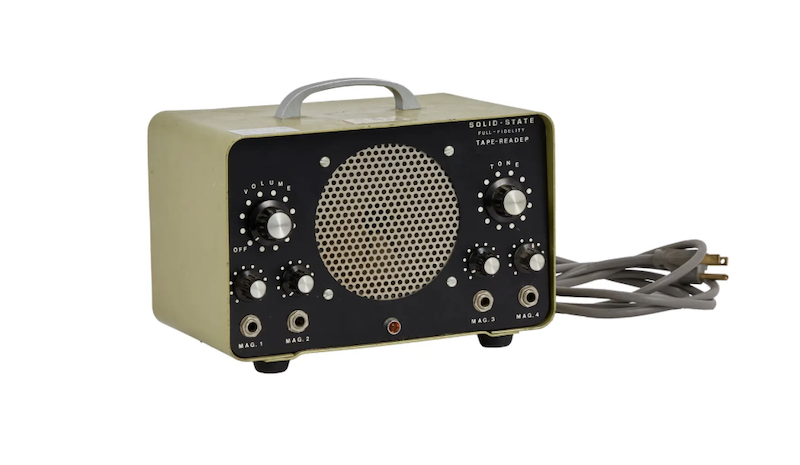
A solid-state Moviola 1027C Tape Reader:

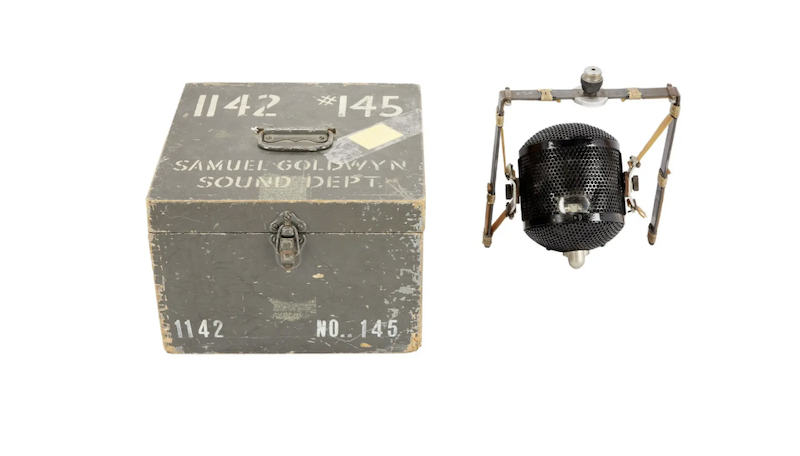
A 1930s Western Electric RA-1142 transmitter ribbon microphone, in a quite awesome sound department case:

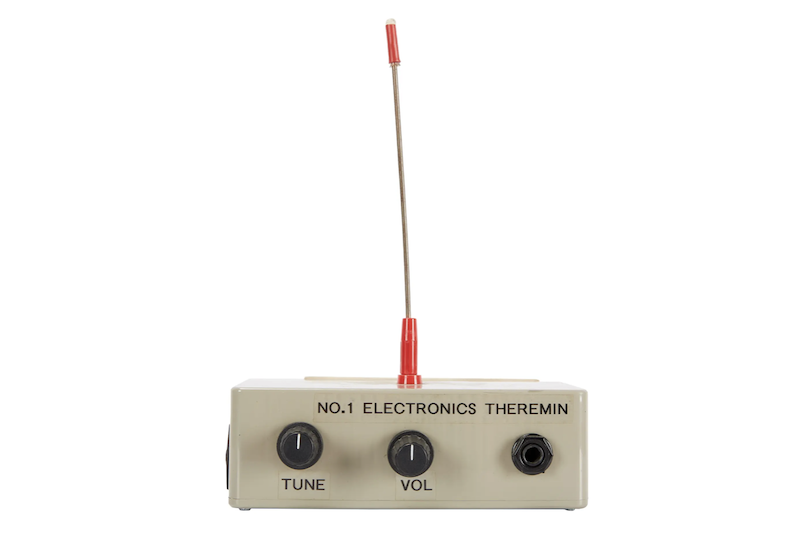
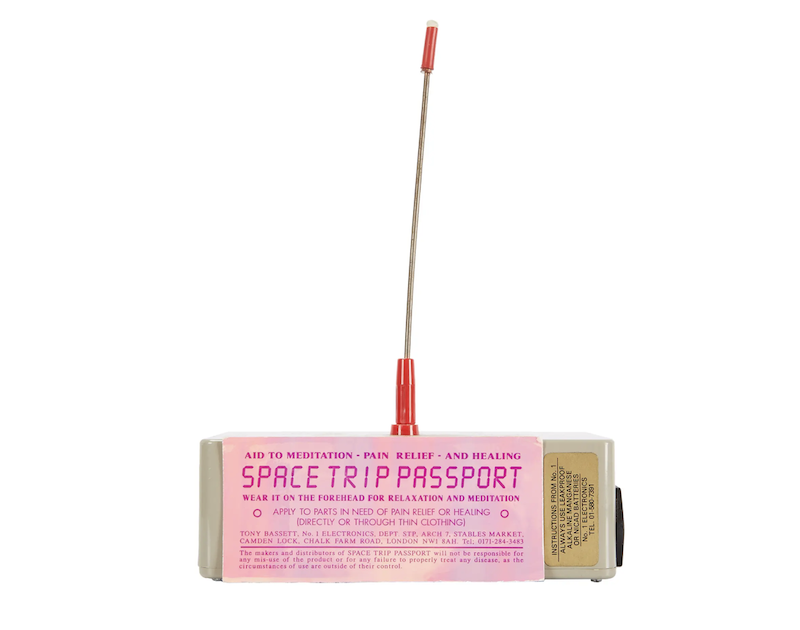
A Theremin by Tony Bassett of No.1 Electronics. Note the “Space Trip Passport” on the rear further below:

The auction begins June 18, 2025, at 10am Pacific Time in Los Angeles at juliensauctions.com.