On Repeat: Beats, Live, Score

Home/office playlist

On Sundays I try to at least quickly note some of my favorite listening from the week prior — things I would later regret having not written about in more depth, so better to share here briefly than not at all.

▰ Very much enjoying the recent Barker album, Stochastic Drift (released by Smalltown Supersound on April 4), especially the heavy Selected Ambient Works Volume II vibe of the track “Positive Disintegration.” (Barker is British, and lives in Berlin.)

[bandcamp width=640 height=406 album=758871653 size=large bgcol=ffffff linkcol=0687f5 artwork=small]

▰ Fantastic live set from jazz bassist Linda May Han Oh (Malaysia-born, Australia-raised), with Ambrose Akinmusire (trumpet — Oakland, California) and Pulitzer Prize winner Tyshawn Sorey (drums, New Jersey), recorded at the Keith Haring Theater, Performance Space, NY, back in January. Akinmusire is a somewhat recent favorite of mine, and I love hearing my instrumentalist favorites in supporting, or at least non-leading, roles.

▰ Dutch musician Rutger Hoedemaekersscore for the science fiction TV series Moresnet is moody and dramatic — cinematic, for sure, but also pleasingly touched by the weird. Hoedemaekers previously worked on, among other projects, Trapped (with Jóhann Jóhannsson and Hildur Guðnadóttir) and The Last Berliner.

[bandcamp width=640 height=472 album=3161033881 size=large bgcol=ffffff linkcol=0687f5 artwork=small]
Scratch Pad: Covers, Gunshots, Jelinek

At the end of each week, I usually collate a lightly edited collection of recent comments I’ve made on social media, which I think of as my public scratch pad. I find knowing I’ll revisit my posts to be a positive and mellowing influence on my social media activity. I mostly hang out on Mastodon (at post.lurk.org/@disquiet), and I’m also trying out a few others. And I generally take weekends off social media.

▰ The house stereo in this cafe is playing one cover song after another, and it’s a bit like being transported to an alternate reality where different people wrote and performed all these songs. That said, I like our reality better. Or liked — perhaps I’m stuck here forever.

▰ Pro tip: something is likely wrong with either your headphones or software if the speech-to-text tool you’re using keeps transcribing everything you’re saying as “[gunshots] [gunshots] [gunshots]”

▰ “Your experience order number is …”

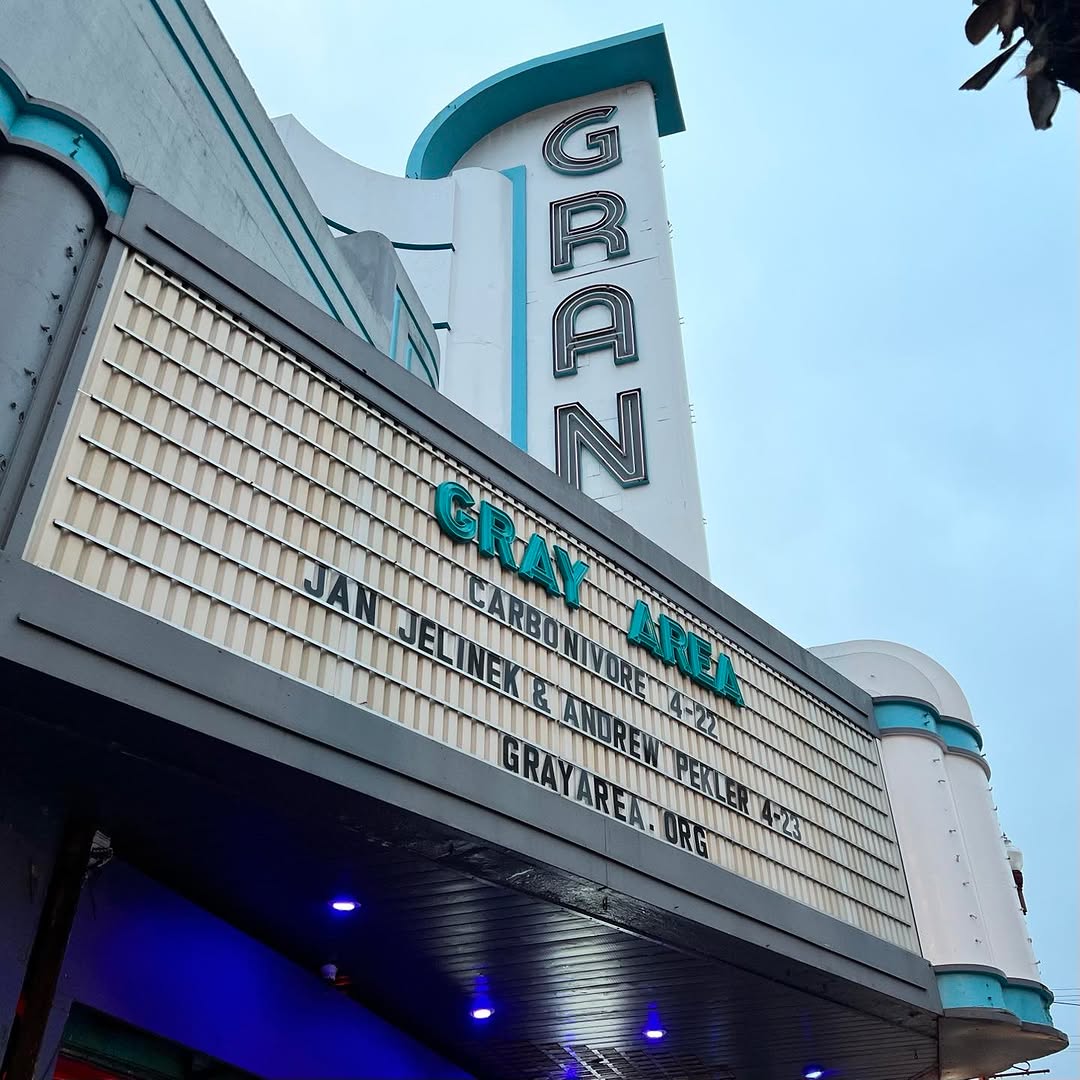
▰ A very good evening, April 23 (Andrew Pekler, Jan Jelinek), also featuring Chris Otchy as the opener:

▰ Dunno if this Apple case I got on eBay for my aging iPhone 13 is legit but it’s more legit than the previous iPhone case I got on eBay

▰ Hyper-local* post: the macapuno ice cream at Polly Ann in the Sunset District is extraordinary, entirely distracting me from the chocolate with which it shared a small cup

*San Francisco

▰ I’d like to play more video games, but I end up reading novels. I’d like to listen to more podcasts, but I end up listening to audiobooks.

Listening to Bosch

Michael Connelly's period detail

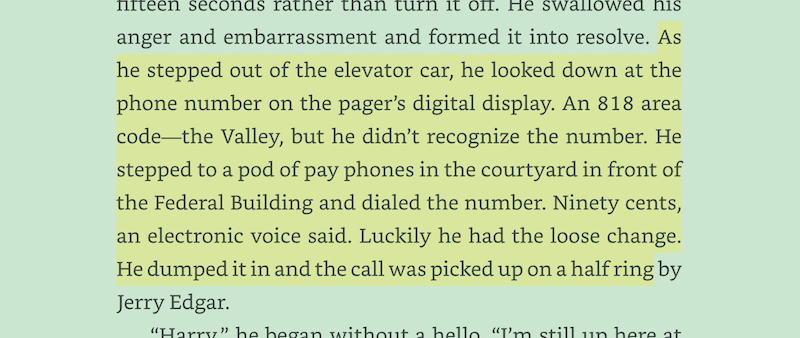
This segment is from early on in The Black Echo, the first in the Bosch series of detective novels by Michael Connelly. I’ve watched all of the TV adaptation, and figured I would give one of the books a read, prompted in large part by an article in the Los Angeles Times by Sue Horton about the centrality of that city (which I have a strong affection for, though I’ve never lived there) to Connelly’s books. There are 25 Bosch volumes to date. That’s a whole lot of Los Angeles, though then again, Los Angeles, nearly four million people spread out over nearly 500 square miles, is a whole lot of city.

The earliest Bosch novel is old enough that the technology here is noticeably pre-modern. In a subsequent scene in the same book, Bosch’s partner, Jerry Edgar, waits for a “machine” so he can take care of writing up the day’s reports. The “machine” is not a computer but a typewriter, of which there aren’t enough in the department to go around. When a computer does enter the picture, along with it comes a dedicated human operator, a signal to the reader of how unusual such an object was back in the late 1980s and early 1990s. The first Bosch book was published in 1992, by which time I’d had a computer — two or three, that is — for well over a decade. But the workplace, especially the city government workplace, was and remains a different setting from a home office.

What struck me about this particular section of The Black Echo is how carefully Connelly describes all the details of phone communication: the checking of the pager, the approach to the pay phones, the required coins, and perhaps most importantly, the way meaning can be construed from interactions, like here how quickly Bosch’s partner picks up the phone. This is the sort of writing that someone engaged in historical fiction might work hard at, getting all the micro-interactions, all the object names and uses, exactly right. What’s great is that Connelly did it at the time, writing about the sort of technological interfaces that can get lost as time proceeds — a lesson that those writing today, fiction and non-fiction, should keep in mind, as the technology of communication continues to change rapidly.

Disquiet Junto Project 0695: Clean After Each Use

The Assignment: Put a piece of music through the dryer.

Each Thursday in the Disquiet Junto music community, a new compositional challenge is set before the group’s members, who then have five days to record and upload a track in response to the project instructions.

Membership in the Junto is open: just join and participate. (A SoundCloud account is helpful but not required.) There’s no pressure to do every project. The Junto is weekly so that you know it’s there, every Thursday through Monday, when your time and interest align.

Tracks are added to the SoundCloud playlist for the duration of the project. Additional (non-SoundCloud) tracks also generally appear in the lllllll.co discussion thread.

Disquiet Junto Project 0695: Clean After Each Use
The Assignment: Put a piece of music through the dryer.

Step 1: Think about lint for a moment — all the stuff that’s cast off from your clothes when you send them through the dryer.

Step 2: Now consider what might be cast off from your music if you could send your music through the dryer for a cycle or two.

Step 3: Select a piece of your own music, and send it through the metaphorical dryer. What results?

Tasks Upon Completion:

Label: Include “disquiet0695” (no spaces/quotes) in the name of your track.

Upload: Post your track to a public account (SoundCloud preferred but by no means required). It’s best to focus on one track, but if you post more than one, clarify which is the “main” rendition.

Share: Post your track and a description/explanation at https://llllllll.co/t/disquiet-junto-project-0695-clean-after-each-use/

Discuss: Listen to and comment on the other tracks.

Additional Details:

Length: The length is up to you. Keep it light?

Deadline: Monday, April 28, 2024, 11:59pm (that is: just before midnight) wherever you are.

About: https://disquiet.com/junto/

Newsletter: https://juntoletter.disquiet.com/

License: It’s preferred (but not required) to set your track as downloadable and allowing for attributed remixing (i.e., an attribution Creative Commons license).

Please Include When Posting Your Track:

More on the 695th weekly Disquiet Junto project, Disquiet Junto Project 0695: Clean After Each Use — The Assignment: Put a piece of music through the dryer — at https://disquiet.com/0695/

Musikfestival Bern x Disquiet Junto

Chain chain chain ...

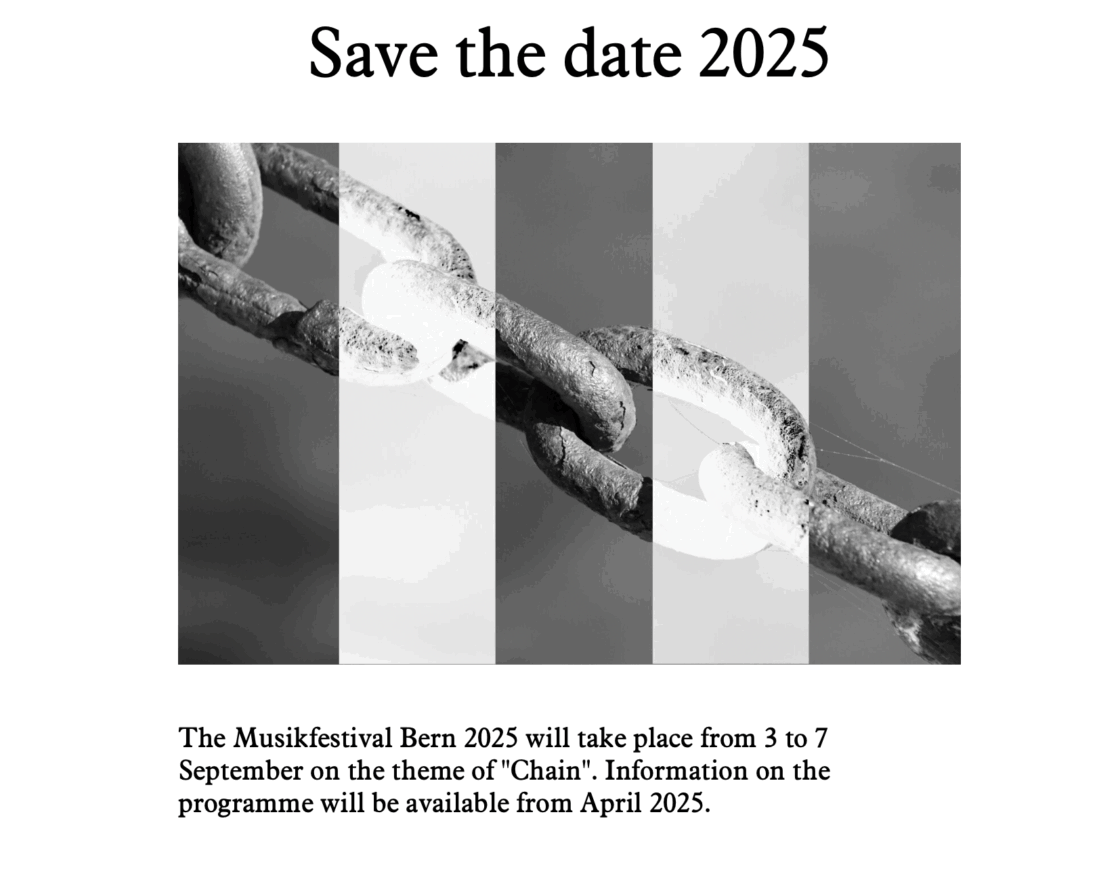
I’ll have more details in the coming weeks, but for now I’m excited to report that the Disquiet Junto is again teaming up with Musikfestival Bern for a trio of music composition prompts this year. The first will occur on May 1, the second in mid-June, and the third in mid-July. More on the festival at musikfestivalbern.ch (from which the above screenshot was taken). Thanks again to Tobias Reber for the invitation to collaborate.