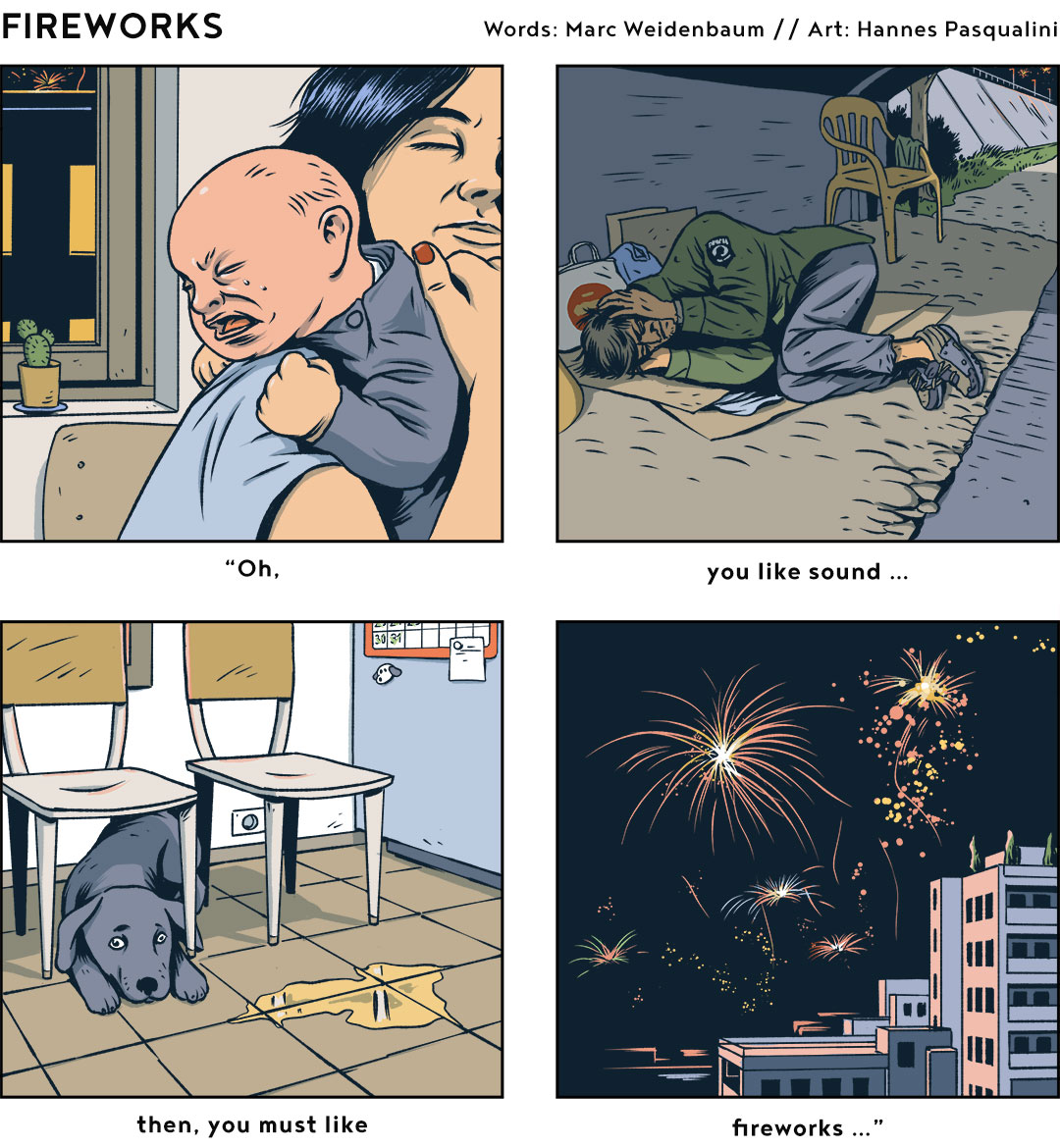
I’m excited to be back at it with Hannes Pasqualini. He and I collaborated on a half dozen four-panel comics in 2020 at the start of the pandemic, and now we’ve got a new batch in the works. This one, “Fireworks,” is the first of them, with more to follow. We’re calling the series Frame by Frame. The next one will be published on January 13, and after that the plan is to do one on the first Monday and third Monday every month. See a full index of Frame by Frame comics at disquiet.com/fxf.
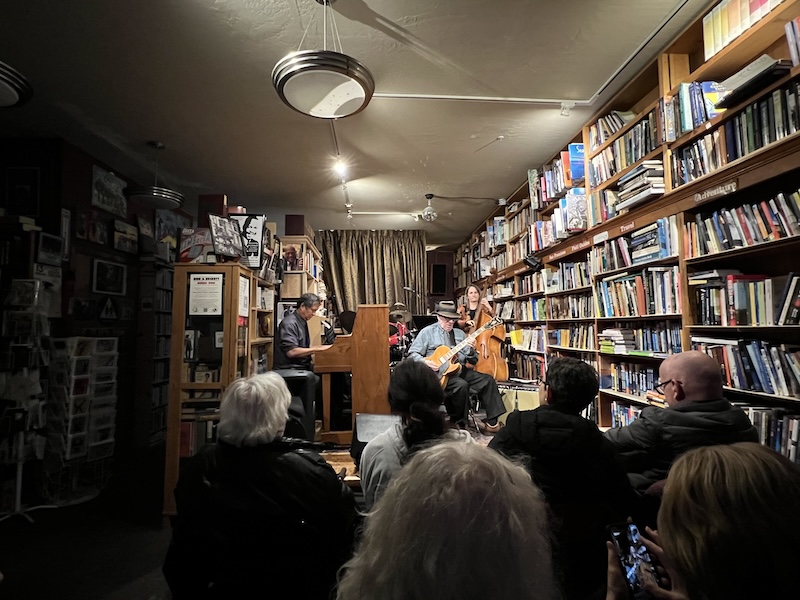
Caught the final concert of the year at the venerable Bird & Beckett, a book and record store in San Francisco’s Glen Park neighborhood that doubles several nights a week as a music club, mostly jazz. The evening’s event, on Saturday, December 28, was a quartet led by guitarist Duncan James and featuring Bob Blankenship, drums; Larry Chinn, piano; and Carla Kaufman, bass. Bird & Beckett streams every concert live on its YouTube channel, and then leaves them there as part of its massive archive. If you look closely at the video, you’ll see the back of my head for the full run of last night’s show. I almost moved across town to Glen Park a long time ago. In such an alternate timeline, I’d have been at this place at least one night a week.
At the end of each week, I usually collate a lightly edited collection of recent comments I’ve made on social media, which I think of as my public scratch pad. I find knowing I’ll revisit my posts to be a positive and mellowing influence on my social media activity. I mostly hang out on Mastodon (at post.lurk.org/@disquiet), and I’m also trying out a few others. And I generally take weekends off social media. In fact, currently I’m off social media entirely (and I’m off a lot of other digital social venues, as well, including several Slacks, several email discussion lists, several Discourses, etc.), and that will remain the case until the first week or so of January. So, what follows are some notes I made for myself — a digital social network of one, though occasionally people do reply to posts I write — from the past week:
▰ I would like to meet the people who order Blank Forms publications through target.com. One-stop shopping for toothpaste, plasticware, Maryanne Amacher, and Éliane Radigue.
▰ Since I can’t solder, it’s usually not DIY but SDI4M (someone did it for me)
▰ Anyone who thinks contemporary children’s culture is too violent has not seen (or fails to remember) the Halloween sequence in the supposedly heartwarming classic Meet Me in St. Louis.
▰ Been watching the third and final season of the What If… ? series, all about Marvel alternate universe stories. I knew one episode was titled “1872” and had Kate Bishop in it, and so I allowed myself to hope it was Hawkeye as Emily Dickinson, or vice-versa, but it was a western. (There was one line about poetry, but unrelated.)
▰ Got a new household device, same manufacturer as one we already had (totally different types of device, one kitchen and the other living room), turned it on, and of course it makes the same startup sound
▰ Went to see Ragnar Kjartansson’s The Visitors for the umpteenth time at SFMOMA. I swear it is better with each viewing. Each time I go I sit focused on a specific screen, this time on Kjartansson himself. The sound at his screen’s end of the nine-screen installation is a lot more sparse, as it’s further from the drums and the two pianos.
▰ I finished reading one novel this week, We Are Legion (We Are Bob) by Dennis E. Taylor. I picked it up based on the recommendation of the owner of a local comic shop, and I really enjoyed it. It has a reputation as funny, but the funny is really just part of what’s going on. I had a blast and will definitely read the next in the series. This was the 30th novel I finished reading in 2024. I thought I might finish one more by the end of December, but with my mom in town for a week it’s unlikely, and that is, of course, fine.
It’s been a solid five weeks since I logged off social media, and it’s been a good five weeks. It took two weeks before I really felt not just off but off off, and since then I’ve been enjoying the more insular than usual mode. I found I had approached, if not achieved, a kind of observational homeostasis, where I was still noting — and notating — things, even when not sharing them publicly. I always say my social media accounts are, collectively, my public scratch pad, which is distinct from my personal scratch pad. I do look forward to getting back online solidly by the first full week of January, in part because I miss some of the interaction, but also because it’ll be interesting to see how my off time has informed my next phase of on time. I do subscribe to the idea that being primarily offline, and seeing online activity as a break, is a potentially healthier and more productive approach than the obverse.
The Assignment: Create a sonic diary of the past year with a dozen (or more) super-brief segments.
/ By Marc Weidenbaum
Each Thursday in the Disquiet Junto music community, a new compositional challenge is set before the group’s members, who then have five days to record and upload a track in response to the project instructions.
Membership in the Junto is open: just join and participate. (A SoundCloud account is helpful but not required.) There’s no pressure to do every project. The Junto is weekly so that you know it’s there, every Thursday through Monday, when your time and interest align.
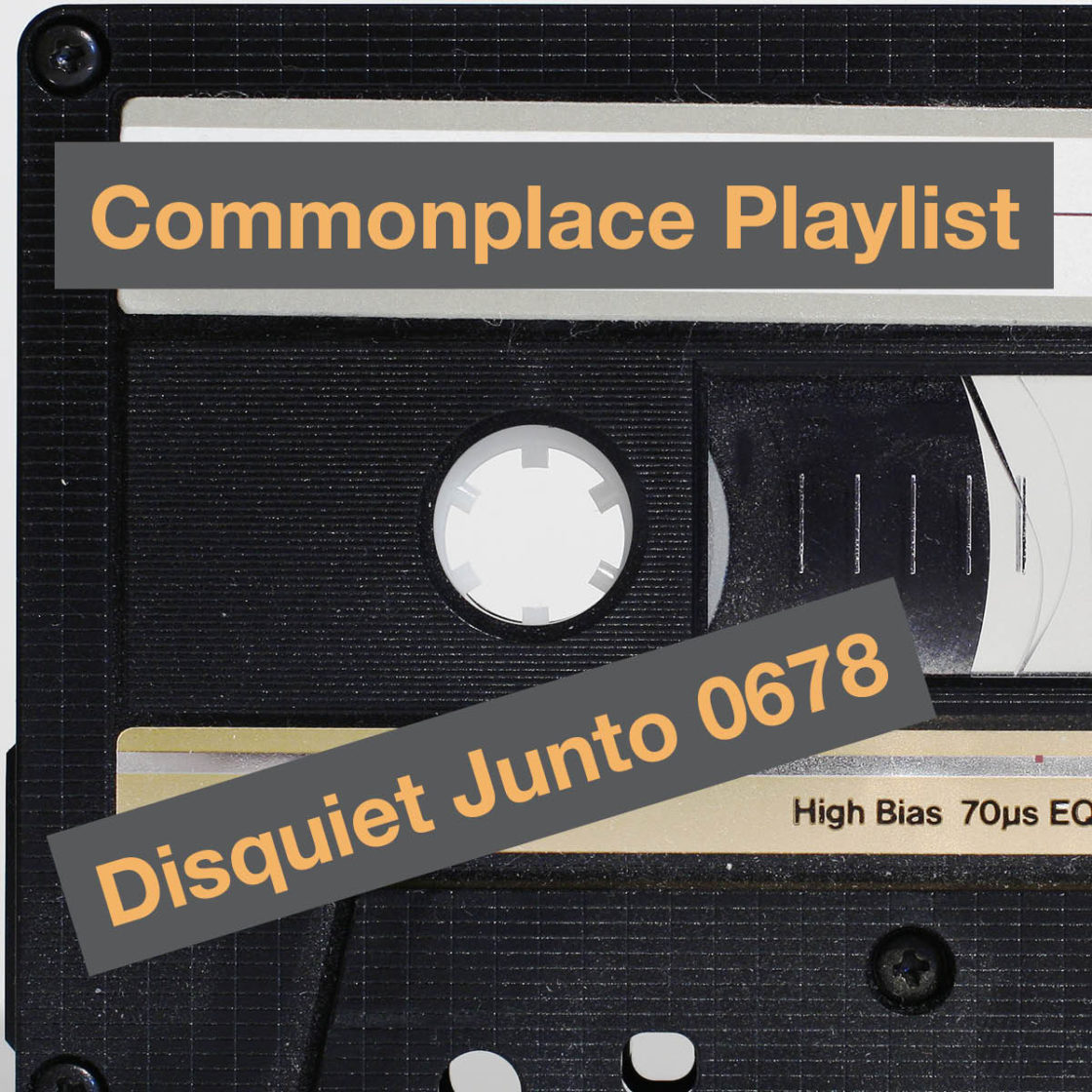
Disquiet Junto Project 0678: Commonplace Playlist The Assignment: Create a sonic diary of the past year with a dozen (or more) super-brief segments.
As has become the tradition at the end of each calendar year, this week’s Junto project is a sound journal: a selective audio history of your past 12 months.
Step 1: You will select a different audio element to represent each of the past 12 months of 2024 — or you might opt for even more elements, choosing a segment for each week, or each day, for example. These audio elements will most likely be of music that you have yourself composed and recorded, but they might also consist of phone messages, field recordings, or other source material. These items should be somehow personal in nature, suitable to the autobiographical intention of the project; they should be of your own making, your own devising, and not drawn from third-party sources.
Step 2: You will then select one segment from each of these (most likely) dozen audio elements. If you’re doing a dozen items, one for each month, then five-second segments are recommended, for a total of one minute. Ultimately, though, the length of the segments and of the overall finished track are up to you.
Step 3: Then you will stitch these segments together, equally weighted, in chronological order to form one single track. There should be no overlap or gap between segments; they should simply proceed from one to the next.
Step 4: In the notes field accompanying the track, identify each of the audio segments.
Tasks Upon Completion:
Label: Include “disquiet0678” (no spaces/quotes) in the name of your track.
Upload: Post your track to a public account (SoundCloud preferred but by no means required). It’s best to focus on one track, but if you post more than one, clarify which is the “main” rendition.
License: It’s preferred (but not required) to set your track as downloadable and allowing for attributed remixing (i.e., an attribution Creative Commons license).
Please Include When Posting Your Track:
More on the 678th weekly Disquiet Junto project, Commonplace Playlist — The Assignment: Create a sonic diary of the past year with a dozen (or more) super-brief segments — at https://disquiet.com/0678/