When you send me an album without proper metadata for the tracks, this is what I do:
I unzip the archive.
I load it into VLC for a quick listen. (Recommendations for alternate, elegant, quick-listen apps on a Mac appreciated.)
I notice the tracks have little if any information — and may even be in the wrong order.
I pull up AudioRanger, which is the software I use to edit the metadata of audio files. (If other tools are recommended, please lemme know.)
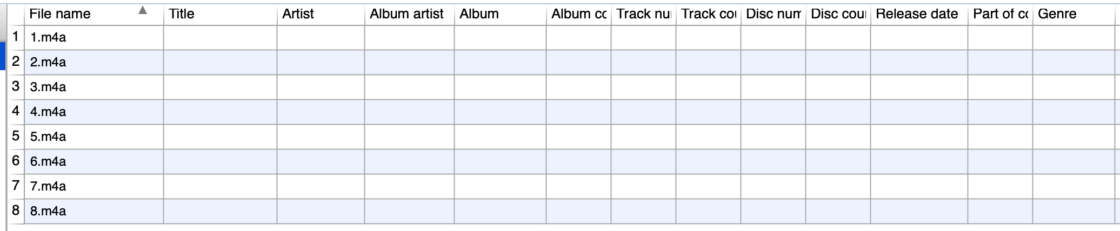
I see in the grid what is missing. The main things I look for are:
Title (track) Artist Album (title) Track number Release date
I proceed to fill those in manually. The biggest hassle is the track title information.
I then locate the album’s cover, either in your .zip file (thank you!) or on your Bandcamp page. Sometimes I can’t find it.
I then attach the image to the files, again using AudioRanger.
Then I save this material.
Then I load it into my digital jukebox (I use Plex).
Often these promotional .zip archives don’t actually include the press materials. Easily some 75% of the time, I create a .txt file and copy and paste in the background information, and then I save that in the folder with your audio files.
Think of how much easier it would be for the people to whom you’re sending your music if you just took the extra step to edit your metadata. On a positive note, something about Bandcamp’s audio hosting process generally seems to ensure that all such information is in the right place (sometimes excepting the press information).
I do this manually at the end of each week: collating (and sometimes lightly editing) most of the recent little comments I’ve made on social media, which I think of as my public scratch pad. Some end up on Disquiet.com earlier, sometimes in expanded form. These days I mostly hang out on Mastodon (at post.lurk.org/@disquiet), and I’m also trying out a few others. I take weekends and evenings off social media.
▰ There’s this kid who can’t whistle but sure practices a lot who walks by the house every morning on the way to school and it is the best thing ever
▰ Due to the fairly intense wind outside (30 MPH gusts), in the building where I rent a tiny office the skylight is making a buzzing that sounds like there’s a fly here the size of an avocado
▰ Working through 7th chords (major, dominant, minor, diminished, half-diminished, minor flat 5) during guitar class felt somehow like sorting through pages of D&D rules
▰ Thought some random tab on my laptop was playing a drone album, but it’s the bathroom fan
▰ Afternoon trio for laundry machine spin cycle, passing jet plane, and low level electric hum
▰ My email inbox would seem to suggest that more records have been released in the first two weeks of March than in all of 2023. It’s sort of out of control, but hey, worse things than an embarrassment of riches.
▰ The March 14 Strands game on the New York Times’ website was particularly fun
▰ Alert! Wim Wenders Criterion Closet! He says he’s the first person allowed to enter it twice. Last time was 11 years ago, before he had Blu-ray. He spies Until the End of the World on a shelf and says he thinks it may be the best thing he ever did.
▰ I finished reading several books last week, including my eighth novel of the year, Colson Whitehead’s Harlem Shuffle, which is up there with other favorites I’ve read in 2024 (Jennifer Egan’s TheCandy House, Mick Herron’s The Secret Hours, and Alastair Reynolds’ Permafrost). Lively and personal, and so smart, especially how it threads in the characters’ personal histories. I also finished the first proper non-fiction book I’ve read this year, Matthew Desmond’s Poverty, by America, and I’ve read a ton more of the manga series The Fable (about a hitman who is required to take a year off), by Katsuhisa Minami, which I’m now up through volume 16. It’s always interesting how, when you read a few books proximate to each other, connections surface. The Whitehead and Desmond both deal with the invisible and visible boundaries of class and race, the Whitehead and Minami deal with hitmen, and all three deal with characters/individuals whose lives are significantly constrained by societal forces. That statement isn’t to excuse the murderous occupation of the main character in The Fable, more to point out how difficult it is to properly hide oneself when one has been a killer for so long.