These sound-studies highlights of the week originally appeared in the August 5, 2023, issue of the Disquiet.com weekly email newsletter, This Week in Sound. This Week in Sound is the best way I’ve found to process material I come across. Your support provides resources and encouragement. Most issues are free. A weekly annotated ambient-music mixtape is for paid subscribers. Thanks.
▰ LISTEN IN: “US researchers have been able to reconstruct a ‘recognizable version’ of a Pink Floyd song based on the pulses of activity moving through a specific part of the brain’s temporal lobe in volunteers as they listened to the hit Another Brick in the Wall Part 1.” The implications are substantial: “For example, the musical perception findings could contribute to development of a general auditory decoder that includes the prosodic elements of speech based on relatively few, well-located electrodes.” (Thanks, Glenn Sogge!)
▰ TWO EARS GOOD: “We’ve already got machine-learning systems and natural language processors that can translate human speech into any number of existing languages, and adapting that process to convert animal calls into human-interpretable signals doesn’t seem that big of a stretch. However, it turns out we’ve got more work to do before we can converse with nature.” Andrew Tarantola digs into why modern AI and ML (artificial intelligence and machine learning) miracles don’t mean we’ll be chatting with our pets anytime soon. Though even if we can’t talk to the animals, learn their languages, we can learn from them: “Better understanding their calls will help us better understand their levels of stress, which can serve both modern conservation efforts and agricultural ends.”
▰ CRY BABY: On the one hand, it’s fascinating that crocodiles can recognize and respond to and perhaps even relate to the sound of human babies crying. On the other, this could just be another way to find food. “It’s possible the answer was both. Some crocodiles tried to bite the speakers. However, Dr. Grimault said, ‘We saw one crocodile that came and tried to defend the loudspeaker from other crocodiles.’ It put its body in front of the speaker and turned to face its fellow predators.” (Thanks, Mike Rhode!)
▰ MISSED ALARM: “Hawaii boasts what it describes as the largest system of outdoor public safety warning sirens in the world, alarms that blare in cases of danger. Residents who survived the fire have wondered aloud why no one activated the sirens, which emit noises at a higher decibel level than a loud rock concert and can be heard from more than half a mile away.” Every major news story seems to have a sonic component: “The emergency sirens are tested once a month, but they weren’t sounded for some unknown reason to announce these fires.”
▰ SIREN SONG: Fascinating — those emergency vehicle sirens don’t have to necessarily be as violently loud as they are. This from New York City: “One bill, sponsored by Councilmember Gale Brewer, proposes to add a device to emergency vehicles that would emit a low-frequency pulse, already used in the U.K. and across the U.S., that drivers can feel instead of hear. The second bill, sponsored by Councilmember Carlina Rivera, aims to replace the blaring New York siren with the lower-frequency two-tone siren popular in Europe. … A 2015 University of Michigan study found that reducing noise by even five decibels could decrease a community’s prevalence of hypertension by 1.4 percent and coronary heart disease by 1.8 percent — that’s approximately 279,000 fewer cases.” (Thanks, Adrienne Wong!)
▰ BIRD LISTENER: “’Birds are my eyesight,’ said Ms. Glass, a poet and a professor of English at West Valley Community College who has been blind since birth. ‘When I check into a hotel in Pittsburgh, I might remember the rock dove and the house finch in the parking lot, rather than the architecture.’” The New York Times’ Alexandra Marvar writes about blind birders: “According to Freya McGregor, a 35-year-old birder and occupational therapist specializing in blindness and low vision, the term ‘birder’ was once reserved for those who were more serious than the hobbyist ‘bird watcher.’ But increasingly, ‘birder’ is becoming a catchall, thanks to a growing awareness that some hobbyists identify birds not by watching, but exclusively by listening.”
▰ HER STORY: “‘Sometimes you’re breathing into a microphone for 20 seconds,’ [a voice actor] said. ‘Sometimes you have to do something like kiss your hand to get a more authentic sound.’” The New York Times covers the growing and increasingly mainstream industry of female-oriented audio erotica.
▰ DOWN UNDER DONE: Elle Gibbons and Jodie Boehme go into detail of how they recorded the soundtrack for ABC Science programming about Australia: “We wanted to start the show in silence — well, as close to silence as we could find in the natural world. … The remoteness of the location and lack of vegetation (no leaves to rustle in the breeze) meant we could demonstrate how even one of the quietest landscapes was still awash with sound. We recorded wisps of wind, the buzz of a fly and the roof of our tent flapping. Microphones were attached to each of Ann’s boots, allowing us to record in stereo a hyperreal sound of the crunch of her footsteps over the salt.”
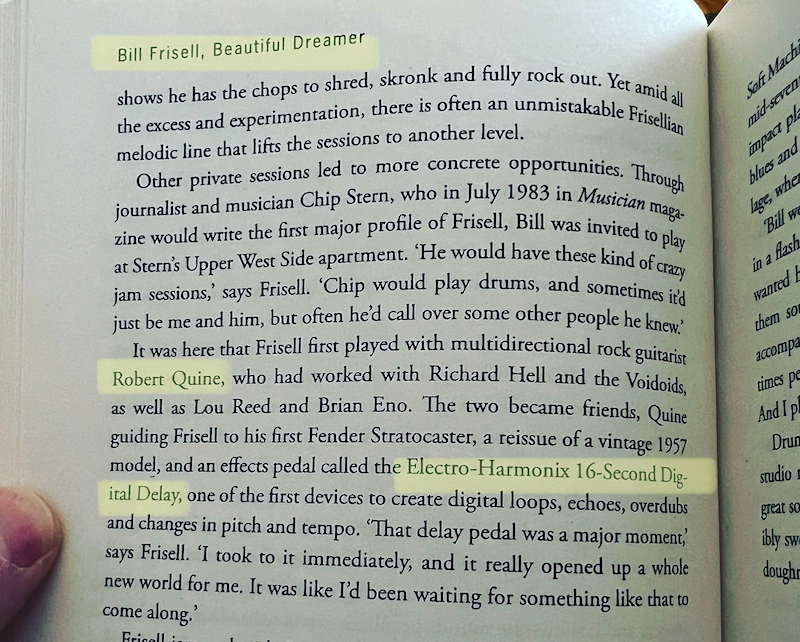
▰ QUICK NOTES: ▰ Zoom Out: Zoom has done a 180, and it won’t train AI on customer data. ▰ Delay Line: You’ve likely seen the widely circulated photo of the doorbell with the guitar pedal attached, but have you heard it in action? (Via Loraine James — thanks, Tobias Reber!) ▰ Game On: There’s a two-day convention in Burbank, California, on sound (design and music) for video games. I kinda wanna go. It’s called GameSoundCon and it happens on October 17 and 18. ▰ Bug Out: Damon Krukowski can hear the decimation of insects and birds from his backyard garden. ▰ Screening Time: The “Live Voicemail” feature in the upcoming iOS 17 will let you read a transcription of a voicemail as it is being recorded, and “pick up the call while the person is leaving their message.” ▰ Show Time: Composer Austin Wintory talks about how his interest and experience in musical theater informs his work on video game music, most recently on Stray Gods. ▰ String Theory: Another Instagram short from The Repair Shop (one of my favorite TV series), this one collecting the “other” soundsthat a guitar makes.