I do this manually at the end of each week: collating most of the recent little comments I’ve made on social media, which I think of as my public scratch pad. I used to do this on Saturday mornings over coffee, but it recently became clear to me that that timing is counterproductive, since I aim to take weekends off social media — thus, doing this chore on Saturday morning meant pulling up social media on Saturday morning, which is not what I want to be doing. So, now I’m collating late Friday afternoon, and then posting on Saturday morning. As for social media, these days I mostly hang out on Mastodon (at post.lurk.org/@disquiet), and I’m also trying out a few others.
▰ I like how the phone voice menu estimates the wait. There’s a brief pause after the number as the system constructs a sentence. It says “7 …” and the ellipsis provides you with more than enough time to wonder: “hours? days?” Eventually it clarifies “… minutes.”
▰ I know, I know, see Oppenheimer in a theater on a big screen. But also: do the same for Teenage Mutant Ninja Turtles. It’s far richer graphically than I had imagined it might be, up there with Spider-Verse. I mostly went to hear the Reznor-Ross score on a big system, and I was astounded visually.
▰ You could do worse than blasting Chloe Lula’s tracks on her recent split EP, Synergy, while crossing a bridge as midnight approaches
▰ It’s Wednesday just before noon as I type this and every hour or so all I can think is, “There’s a new Autechre album due out tomorrow.”
▰ New release from Autechre — seven live 2022 sets — on its way
▰ I don’t attend the annual Outside Lands fest because, clearly, I mostly listen to fridges hum, gears break, and birds sing; much music with a proper chorus and verse makes me break out in hives. But the day before is full of distant brief muffled mic checks and it’s pretty grand.
An ongoing close first-impressions listen to the new Autechre live collection (so far the first two nights, of seven total)
/ By Marc Weidenbaum
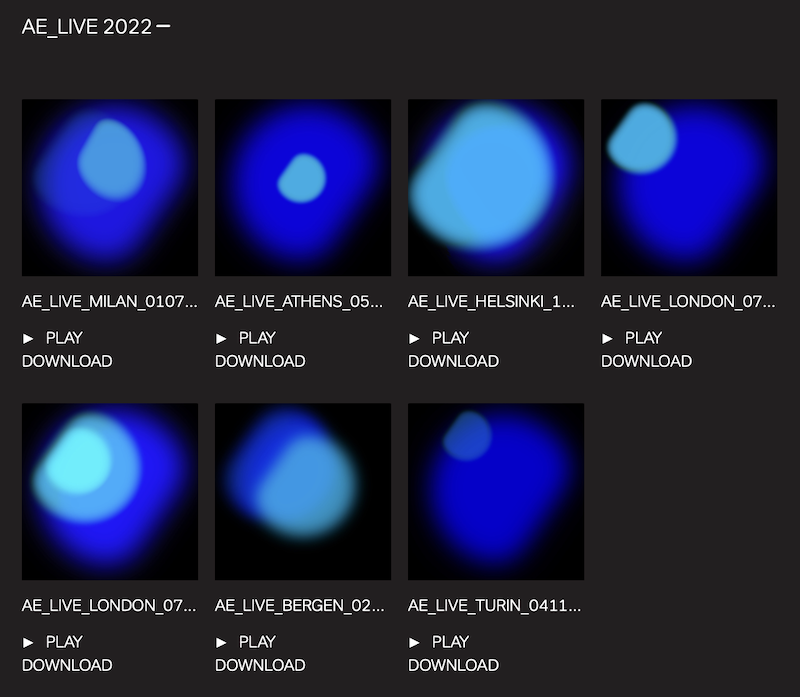
AE_LIVE 2022– is the latest from Autechre, the duo of Rob Brown and Sean Booth, just out today, August 10, 2023, on their longtime label home, Warp Records (warp.net — at the moment, it’s not on Warp’s Bandcamp page). As I’ve attempted in the past, I’m going to embrace the release’s voluminous depths — seven nights recorded in six cities (Milan, Athens, Helsinki, Bergen, Turin, and two in London), rendering as over seven hours of music — and try to keep track of thoughts as I wander through its murky territories.
I’ll be updating this as I go, which might involve re-listening to one or more of the seven evenings and adding more notes.
General thoughts as they surface:
01 Why does each evening have an underscore before the year, but the album title doesn’t?
02 Why do all the downloads just have the album cover instead of the individual track covers? At least that’s what happened when I downloaded them as a single large set.
03 Are the concerts really just an hour apiece, or is this a select section of each evening?
04 Athens (Greece, not Georgia) lucked out — it’s over 20 minutes longer than the shortest of the evenings (the second of the two London shows).
05 Note to users: each evening is one uninterrupted track, with no song (or in Autechre’s case: “song”) titles.
06 There are three purchase options: MP3, WAV / FLAC, and WAV (24-bit). I splurged for the latter, though I wonder if my aging ears can hear the difference (or if my younger ears could have).
07 A friend pointed out that the randomly generated names of the Zip archives (e.g., “8c54-b5c73ad8e50b.zip”) that contain the downloadable audio files look like the titles of Autechre releases.
08 I’m wondering how these were recorded. I’m guessing straight from the mixing board. I wonder if the audio factors in, at all, the spaces in which the performances happened.
09 When I use the term “machines” I mean virtual ones, as well, of course.
AE_LIVE_MILAN_010722
00:00:10 — The Milan evening, the opening of the collection, sneaks in so quietly that I hit pause a few seconds after it starts, perhaps more a sign of my impatience than anything else. I wonder if my headphones are connected, if my laptop is functioning. Then I hit play and there’s finally a comforting frazzled-circuits sound before the muffled beat kicks in. It’s almost like walking into the hall after the concert has begun, after proceeding down a series of corridors, the music seeping in until you finally arrive at the main room.
00:07:25 — Sometimes I think we’ll find out that the algorithmic and generative approach Autechre is known for actually takes a back seat to simply using voice control as a means to control sound: to shape it, to transform it, to manipulate various settings. This phrasing, familiar from other work in recent years, often sounds like human speech straining to be comprehended. Or metaphorically, a machine doing so.
00:19:21 — I often find myself actively resisting the urge to rewind when first listening to a new Autechre release. A minute ago, I’d swear, this percussive noise — ploppy, arid — was much pitched much higher, and I’m wondering how it got here from there.
00:20:23 — Those percussive noises are getting deeper and wetter, confirming the downward trajectory mentioned just above.
00:22:02 — This is entering “pachinko in Limbo” territory.
00:28:25 — More Pacman than patchinko by now. Autechre doesn’t get enough credit for her playful it often is. Though admittedly, I like it most when it’s less playful.
00:34:50 — I could deal with more of this evocative Scheherazade fantasia slo-motion material.
00:36:33 — After over half an hour of near seamless transitions, this moment arrives like the firmest division of before and after thus far: a solid downbeat, even if it’s quickly subsumed by the luxuriant electronica morass. Tellingly, the impact disperses quickly.
00:38:11 — It’s like cybernetic wind shear.
00:39:56 — As is often the case, Autechre brings to mind The Sorcerer’s Apprentice, not just the metaphor of replicate systems run amok, but the overall elaborate approach.
00:56:25 — A funky, soulful, slinky reminder of how much of Autechre exists in part as a willful complication of popular forms. A minute later, though, the music has really dissolved (welcomingly).
00:58:01 — And now the (almost) poptimist veil is fully lifted, and the creaky undergirding is what we’re left with (and it’s all the better for it).
01:00:49 — It’s getting dryer and dryer, back to the pointillist percussion from very early on. It feels, though, like we’ve gotten back to where we started without going in reverse. The tiny, percolating, ping-ponging beats emerge from something other than what they submerged into at the start of the session.
01:02:44 — Cybermumblecore at its best. I fully admit that I generally prefer Autechre at the extremes: when it is at its most or (as here) least aggressive.
01:06:18 — Music like Autechre’s, redolent of technical virtuosity (and all the more fascinating because it sounds more interested in using machines at cross-purposes rather than merely getting the engines functioning at peak performance — which is, come to think of it, the difference between the emergent Miles Davis electric era, and the mainstream fusion that followed upon it), can feel at times like it’s letting you know how it functions. As the set comes to an end, the beat slows, like something made of gears that is coming to a stop. I can’t help but think that this is, nonetheless, an illusion: a theatrical depiction of a machine coming to rest, not the actual sound of Autechre’s technology being slowed.
01:06:40 — And the beat is gone. And the fade-out sounds like a granular freeze of the moment: slowed, then muffled, then over.
AE_LIVE_ATHENS_050722
00:00:01 — This one starts off strong. I’m also aware it’s the longest of the collection’s seven sets, so I’m pacing myself. That glitchy static sound is the same as on Milan, but it’s buried in there, and the beat is more straightforward, the overall effect much more present, much less enveloped by sonic vellum.
00:01:45 — Hope you weren’t sitting to close to the speakers when this beat hit. It sets everything thus far into the background. Fascinating effect. If Milan accomplishes the backgrounding of sound with muffly low-pass filters, this one does so by putting something even louder and more precise in the foreground. Your sonic field of vision, so to speak, changes immediately and immeasurably.
00:02:55 — The heavier of the beats is flying around space, like a marble in a box.
00:05:06 — Another one of those moments when you wonder how exactly it got this frenetic without ever feeling like it’s suddenly switched gears.
00:06:08 — Autechre uses bursts with some frequency. Bursts are like the opposite of glitch, or more to the point they’re like full-bodied glitch, quick arrays of sustantive sequential beats in fast succession. What makes them work here is the sheer randomness of the patterning. A lot of people describe listening to Autechre like being under assault. This is what real assault is like: volume and complexity is one thing, but it’s the mercurial brutality that makes it really overpowering.
00:07:41 — The bottom suddenly dropped out, all but a series of what sounds like computer-modeled aluminum pans flapping in the breeze.
00:10:54 — If you’d been waiting for alien dance music, then you’ve been happy for a while by this point.
00:22:04 — Autechre in its xenobiology phase, all alien noises
00:22:32 — Another sudden shift, things again slowing, like we’ve entered a lounge bar. What will follow: luxuriant mellowness, or a sudden assault? The thing about PTSD techno is there doesn’t need to be a beat for you to await the next beat. Meanwhile, as the seconds pass, there is clicking like nothing so much as intercepted — and indecipherable — communication.
00:24:00 — And another transition, this time with a four on the floor groove, like the dance is happening overhead, a few stories up.
00:25:35 — And another transition, into a pachinko parlor with failing electricity, the emergency alerts melting.
00:31:57 — Proper ethereal vocals have been part of the mix, and I have no idea for how long. They arrived like ghosts and, as with so many transitions in Autechre’s music, you don’t know they’re there until they’ve been there.
00:37:13 — There are fierce little pings at work that are unlike anything until now, sharp hard sounds that have a deeper pitch than anything this brief should be capable of.
00:39:30 — And a whole new sonic ecosystem has emerged. There are so many transitions in this Athens show. You’re continously shifted from one to another. There are so many, I’ve lost count, and as they proceed, I note them less frequently. You just have to give yourself over to the constant change.
00:48:20 If you’ve listened to enough Autechre, you know the difference between “pachinko” mode and the rarer “bug zapper” mode. This is, for a spell, the latter.
00:51:75 — If you wanted to know what an Autechre album on the Chain Reaction label would sound like, here you are. And where it goes is fantastic, all wiry acrobatics and more alien vocalizing. This is a reminder not to expect the section — or any section — to last long.
00:54:46 — If I were teaching a class about classic Autechre moves, I’d mark this transition as a teachable moment. Back it up, listen, get into the groove, and then pay attention at and after this juncture, as it frays and becomes something else entirely.
01:00:00 — Cybernetic melodica amid pulsating techno. A great moment.
01:04:23 — If the whole set didn’t have such a consistent sense of digital perfection, the echoing at work here would make me think it was recorded outside, or in a deep hall so large it constitutes its own macro-environment. Bonus for more muffled vocalizing.
01:11:55 — The end of this sets feels like it’s setting a high bar. It’s a sprawling procession of fleeting ideas and sensory frames, and yet it never breaks or pauses. It morphs continuously and seamlessly.
01:13:00 — I’m trying to imagine what this was like in a large crowd, because as the piece nears the end, the scale shrinks, and it gets downright intimate. As in Milan, it slows like a machine running out of gas.
01:16:17 — As the Athens show doesn’t so much come to a close as continue to come to a close, I wonder if part of its extended length (relative to the other sets) represents Autechre having recognized at the time that they had something good going, and they just went with (and for) it. This last 10 minutes or so is Autechre’s version of a slow jam, and I’d happily take an album of it.
The Assignment: Compose a piece of music with three times as much silence as sound.
/ By Marc Weidenbaum
Each Thursday in the Disquiet Junto music community, a new compositional challenge is set before the group’s members, who then have just over four days to upload a track in response to the assignment. Membership in the Junto is open: just join and participate. (A SoundCloud account is helpful but not required.) There’s no pressure to do every project. It’s weekly so that you know it’s there, every Thursday through Monday, when you have the time and interest.
Deadline: This project’s deadline is the end of the day Monday, August 14, 2023, at 11:59pm (that is, just before midnight) wherever you are. It was posted on Thursday, August 10, 2023.
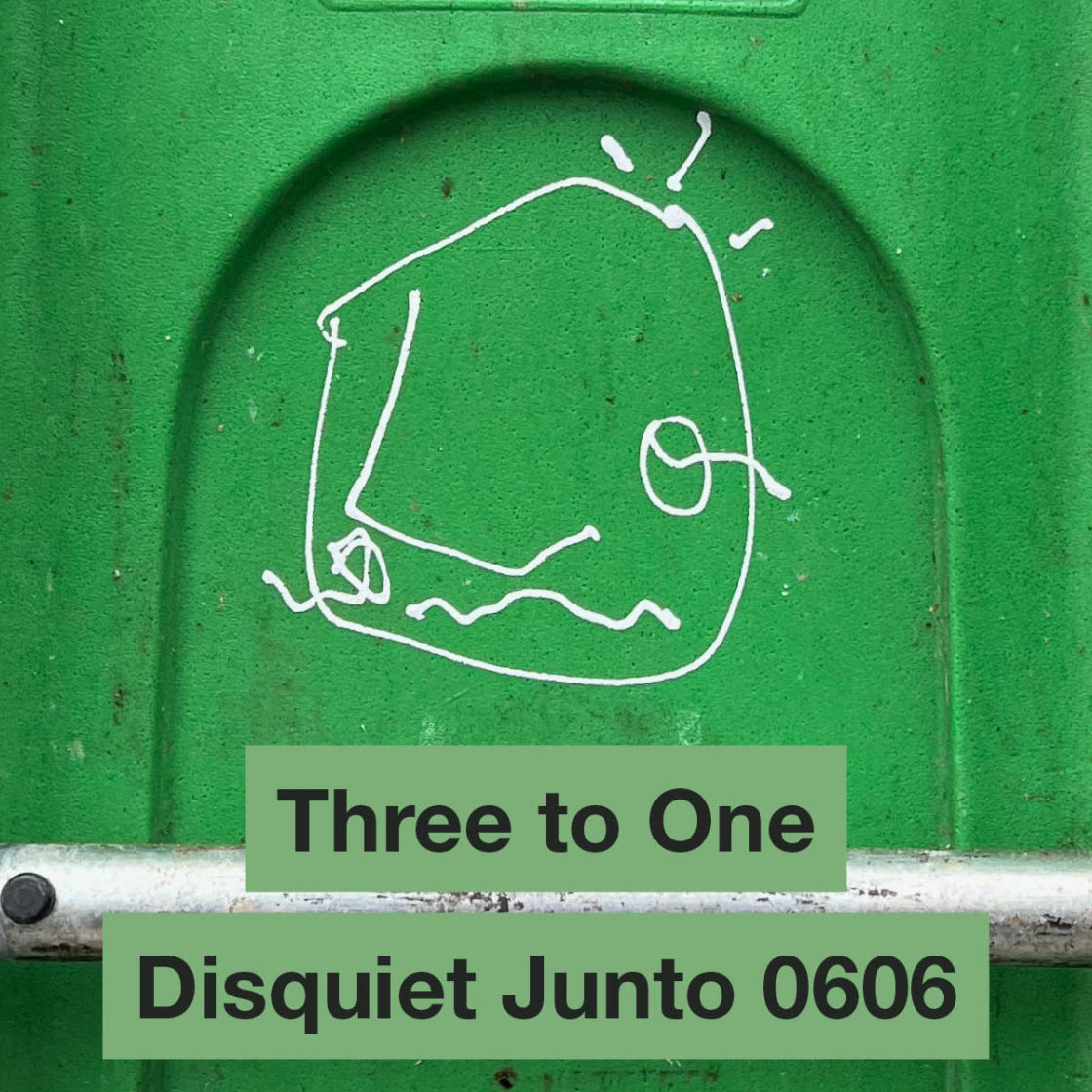
Disquiet Junto Project 0606: Three to One Compose a piece of music with three times as much silence as sound.
There’s just one step to this project:
Compose a piece of music that is 75% silence and 25% sound.
Background: Jason Richardson proposed a previous project, which was 50/50 in terms of the radio of silence to notes. As that project unfolded, Klaus-Dieter Hilf (aka RabMusicLab) commented that maybe the instruction should have read “sound” in place of “notes.” Since the project went well, this time around the amount of silence has been increased, and Hill’s proposal has been implemented.
Eight Important Steps When Your Track Is Done:
Step 1: Include “disquiet0606” (no spaces or quotation marks) in the name of your tracks.
Step 2: If your audio-hosting platform allows for tags, be sure to also include the project tag “disquiet0606” (no spaces or quotation marks). If you’re posting on SoundCloud in particular, this is essential to subsequent location of tracks for the creation of a project playlist.
Step 3: Upload your tracks. It is helpful but not essential that you use SoundCloud to host your tracks.
Step 4: Post your track in the following discussion thread at llllllll.co:
Step 5: Annotate your track with a brief explanation of your approach and process.
Step 6: If posting on social media, please consider using the hashtag #DisquietJunto so fellow participants are more likely to locate your communication.
Step 7: Then listen to and comment on tracks uploaded by your fellow Disquiet Junto participants.
Step 8: Also join in the discussion on the Disquiet Junto Slack. Send your email address to [email protected] for Slack inclusion.
Note: Please post one track for this weekly Junto project. If you choose to post more than one, and do so on SoundCloud, please let me know which you’d like added to the playlist. Thanks.
Additional Details:
Length: The length is up to you.
Deadline: This project’s deadline is the end of the day Monday, August 14, 2023, at 11:59pm (that is, just before midnight) wherever you are. It was posted on Thursday, August 10, 2023.
Upload: When participating in this project, be sure to include a description of your process in planning, composing, and recording it. This description is an essential element of the communicative process inherent in the Disquiet Junto. Photos, video, and lists of equipment are always appreciated.
Download: It is always best to set your track as downloadable and allowing for attributed remixing (i.e., a Creative Commons license permitting non-commercial sharing with attribution, allowing for derivatives).
For context, when posting the track online, please be sure to include this following information:
More on this 606th weekly Disquiet Junto project, Three to One (Compose a piece of music with three times as much silence as sound), at: https://disquiet.com/0606/
Thanks this week to Jason Richardson and Klaus-Dieter Hilf.
I’m very much looking forward to this documentary, Music for Black Pigeons, in which filmmakers Jørgen Leth and Andreas Koefoed interview a slew of great contemporary jazz musicians. Apparently the footage is from nearly a decade and a half of sessions. Featured musicians include Jakob Bro (who also provides the film’s score), Bill Frisell, Lee Konitz, Joe Lovano, Paul Motian, Mark Turner, Joey Baron, Andrew Cyrille, Craig Taborn, Thomas Morgan, and Palle Mikkelborg.
Some key moments in the trailer:
0:28 — A car horn aligns harmonically with the already playing saxophone.
1:15 — There’s a measurable pause before Manfred Eicher, the ECM Records founder and producer, not yet identified, says “A pause tells very much where you want to go, and, very much, where you come from.”
1:45 — Midori Takada, composer and percussionist, states: “For me, music is not entertainment. It’s life.”